Where are the downtown residents, though? Increasingly, that’s Glenwood South and the Warehouse District, and RMC / Dawson / McDowell is a lot closer to them than is Moore Square / Salisbury / Wilmington / Blount.
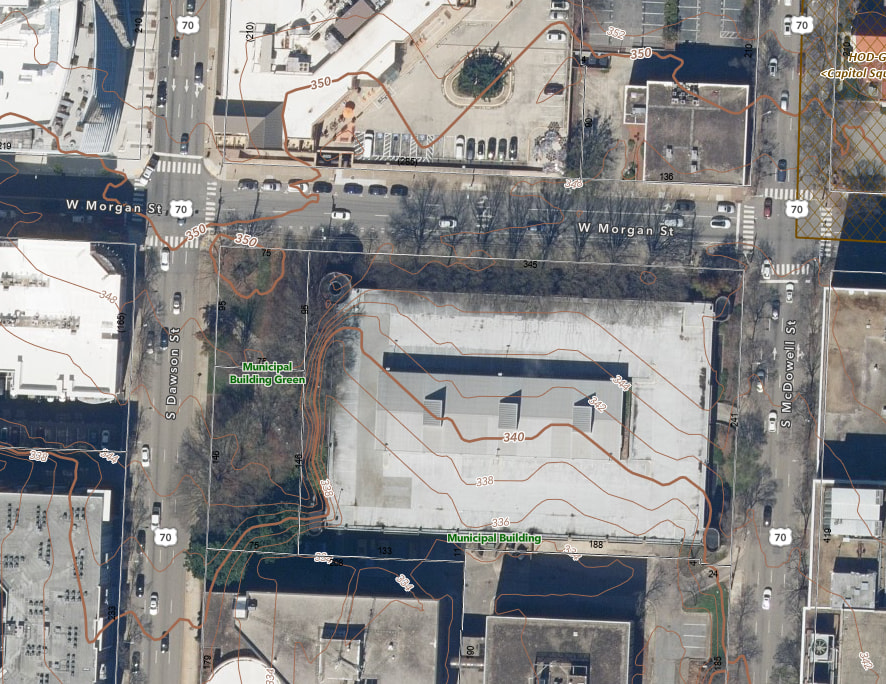
There is much more room to work with here than you’re thinking, I suspect. I mean you seem to have the numbers right, but I measure about 420x250, so a bit over 100,000 square feet.
And Charlotte’s blocks are not larger than Raleigh’s, they are somewhat smaller. CTC especially sits on a block that is narrower than average. It is about 350x275, or right around 100,000 square feet. The main bus shed is about 350x175. They fit six five bus bays end-to-end in that 350’, with two aisles, and four platform faces. So we should be able to fit seven six bays back-to-back in our 420’. That would be up to 24 total bus bays with a similar 175’ wide, two-aisle, four platform face layout. Fewer total bus bays if you make some room for 60’ bendy buses, but still more than enough. This also leaves 75’ of width for whatever - ramps, ancillary facilities, etc.
1 Like
Precise Property Dimensions:
Raleigh:
420x241 → 101220 sq ft
Charlotte:
((337 + 359) / 2) x ((304 + 332) / 2) →
348x318 → 110664
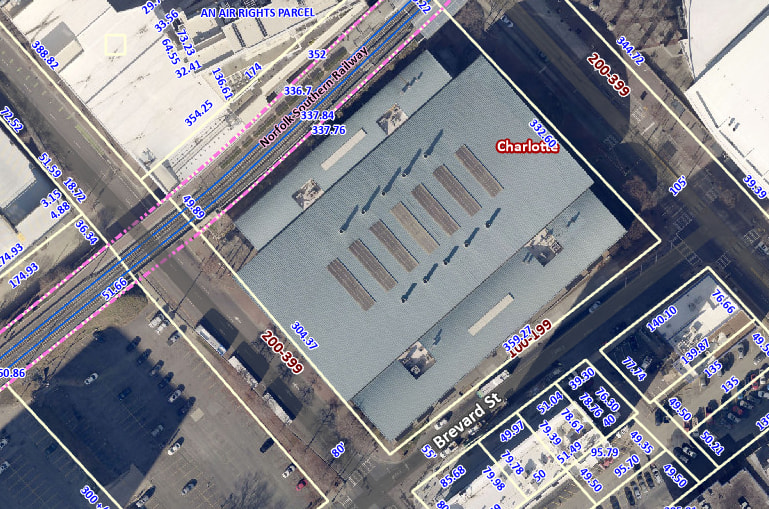
I would argue that although Charlotte’s is about 9% larger in terms of overall area, the fact that ours is closer to a perfect rectangle, and is 420’ long, instead of 348’, makes ours more advantageous for use as a bus facility. Remember their bus shed is 175’ wide, and qualitatively feels quite generous with very good sight lines and bus circulation. A facility of exactly this width would fit easily into the 241’ we have to work with.
At the municipal complex, I’d say fitting at least 24 standard-length bus bays is basically a lock. Not to mention the additional 6 bays at RUSBus, which would now be just 2.5 blocks away, about a 3 minute walk.
Whereas, current GoRaleigh station has 15 bays, and is a 10 minute walk from RUSBus.
5 Likes
The alternate route actually goes into Smoky Hollow/Glenwood South. Both go into the Warehouse District.
1 Like
I guess what I am proposing is to put the GoRaleigh station at the municipal complex, and completely eliminate the jiggety-jig of circulating the buses through downtown between Moore Square and RUSBus. Have them stop at one spot that is as quickly accessible and centrally located as possible. That will probably cut more than 5, perhaps up to 10 minutes off the total run time of every bus. In addition, having them only operate directly in and out on Dawson and McDowell, which are the two fastest streets downtown, would certainly save several more minutes. All of this adds up in spades in terms of efficiency, meaning buses are better able to stay on schedule and run more frequently.
2 Likes
If folks have to walk there to take the bus from Glenwood South, you’ve already lost them.
3 Likes
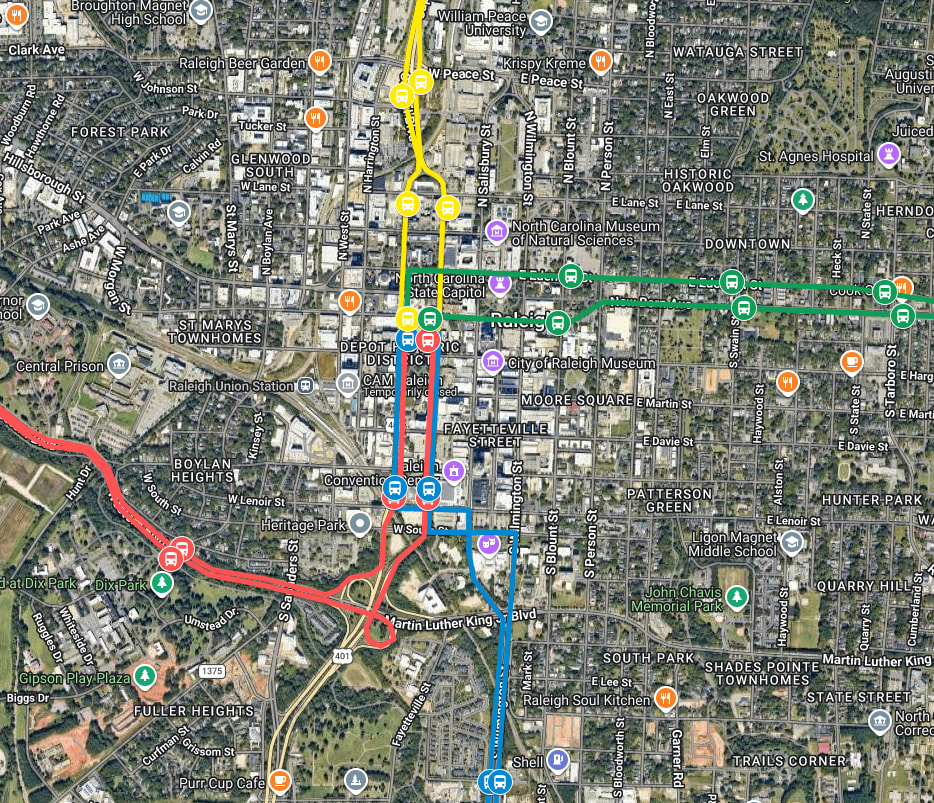
This is the general idea as far as the BRT is concerned.. Glenwood South gets stops on the Capital BRT at Peace and Lane. No more jiggety-jig.
Through-route the BRT lines with each other if it makes sense. Or don’t.
5 Likes
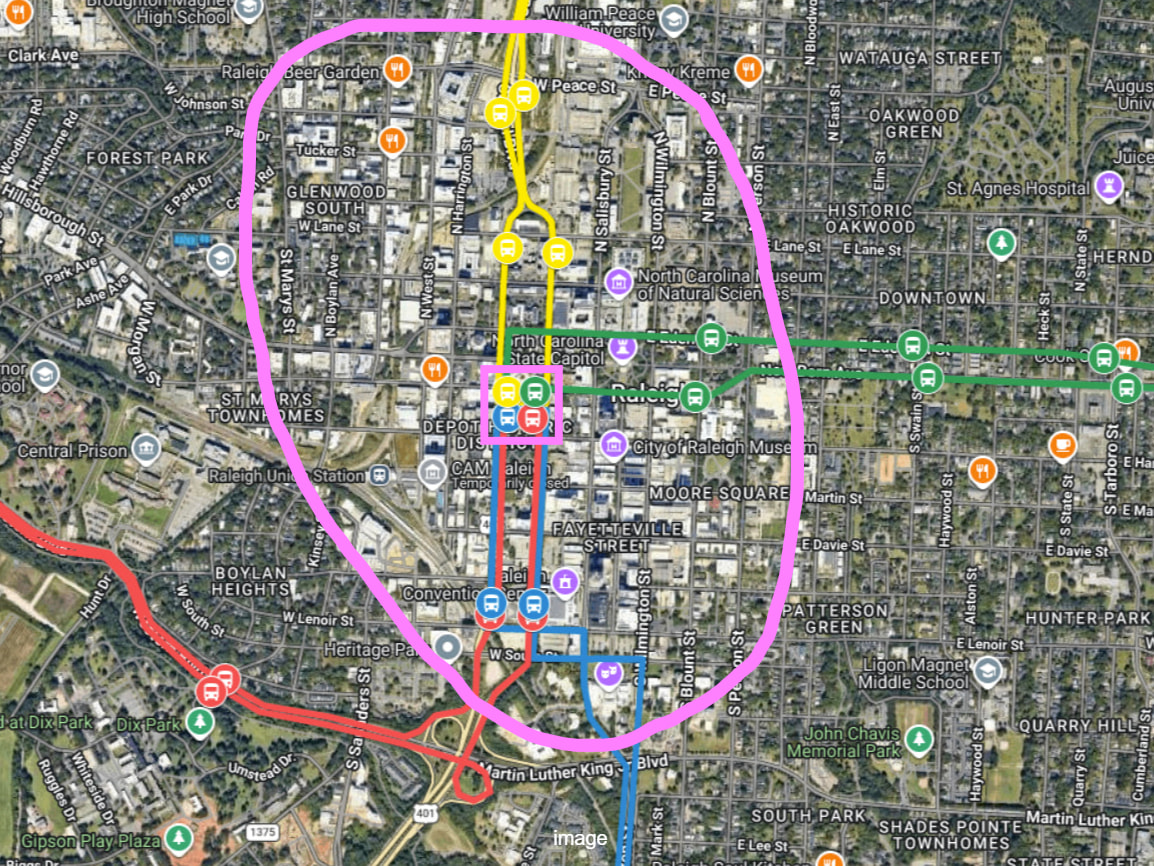
Send this to Het Patel or a GORaleigh staff member and see what they say. It wouldn’t hurt to ask them if this would be feasible.
1 Like
With the current GoRaleigh Station, and RUSBUS, staff probably wouldn’t be willing to talk about any change of station at all until council and RTA say that a movement of GoRaleigh Station is on the table. Council is probably not willing to discuss that until they have a formal proposal and some sort of political cover. Council was just asking for an update from staff regarding the current status of GoRaleigh Station and transit.
It might be hard to get buy in from GoTriangle for not serving RUS BUS directly, but New Bern and Southern already don’t based on current plans, so I don’t know what GoTriangle’s priorities are.
I also don’t know how the phasing of this would work, would New Bern BRT serve Moore Square until a new station is built? Anything is possible if we just make a decision to prioritize this. Moore Square is overflowing with buses right now, so many buses end up laying over on city streets and one disabled bus pulls the whole station to a halt.
I still want to double check the geometries, but I’m at work  Evidently, I did have some numbers wrong, but I also think that I worried about accesses. Dawson and McDowell are both state roads, so I question if bus lanes are available. Adding more curb cuts to such a high-speed road also bothers me a bit, especially to such a low-speed facility but I also would like it if we could calm it to be more of a street.
6 Likes
Could the city not ask for bids, or propose, a new bus exchange on the east side of Moore, where they are trying to get some other things built? Phoenix just opened a new bus transfer station downtown that was part of a whole rebuilding and redevelopment of the block. I will try to find it on Dezeen for y’all. The municipal block seems workable as well, but then we pull the transfer station from the east side, and how close to we want it to the Union Station transfer station - that would appear built and a ghost town - and why can’t we just use it?
Here is the Phoenix project - scroll all the way down for a couple drawings of how the bus and light rail transfers will work.
2 Likes
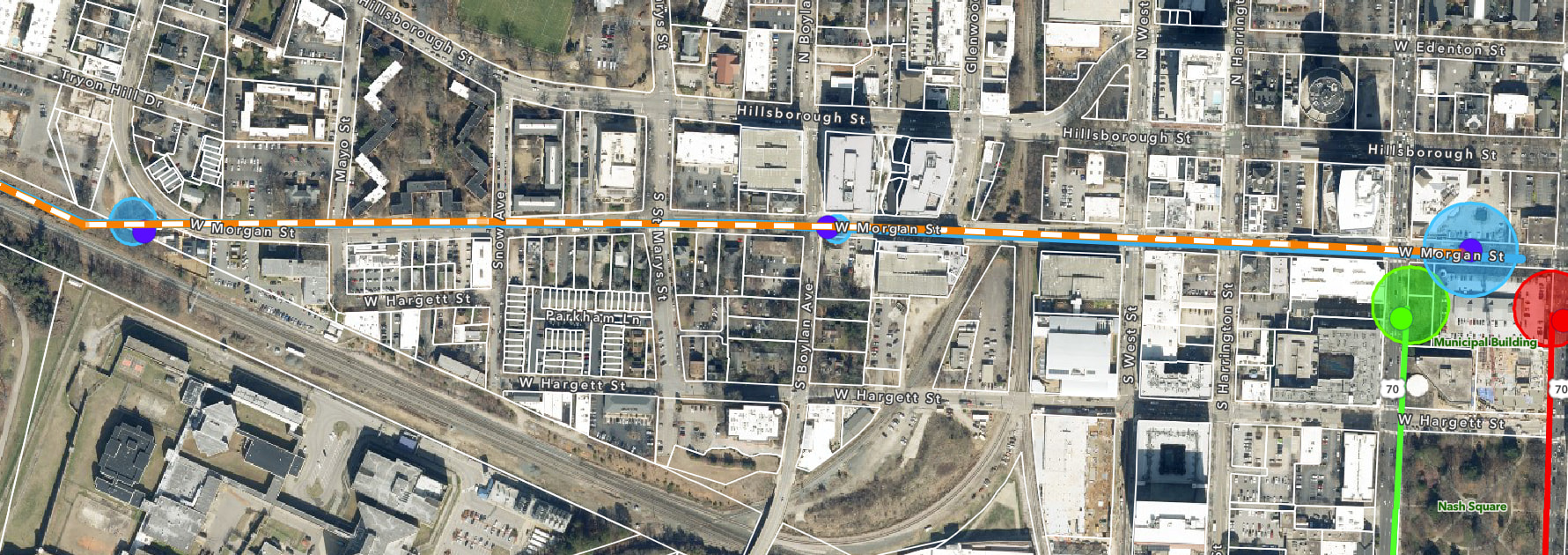
Adding to the dream, but a transportation hub on Morgan St could be nice for a light rail line to the arena district… only 3/4 mile straight shot along surface streets to get to the rail corridor. 

8 Likes
While I do like to promote @Francisco 's good idea of moving GoRaleigh Station to the place where the Municipal Complex parking deck is today, I don’t really have the time nor motivation to follow through by raising it with the Powers That Be.
We do have council members and RTA board members who watch and occasionally comment on this thread though! Maybe they’ll pass it on. And you’re of course you’re also welcome to pass on the idea as well. Of course you don’t have to credit me because it wasn’t even my idea in the first place. Not sure about @Francisco. It was posted on a forum, at this point I’d consider the idea public domain.
Since moving GoRaleigh station is in the public consciousness these days, it’s possible that the notion will gain some traction. If that’s the case, there will be an official alternatives analysis, and think it’s inescapable that this will come up as a candidate site. There may be some fatal flaw to this idea, like the state being unwilling to play ball, as @core2idiot suggests, or some specific future use already being earmarked for that spot. In that case, here are some possibilities, in order of my evaluation and preference:
1. Raleigh Municipal Complex parking deck.
Ownership: 100% City of Raleigh. Low slung parking deck likely nearing end of life.
Location: Extremely central. Close to Union Station and Fayetteville Street.
Transit ops: Right on Dawson/Mcdowell pair.
Feasibility: Large enough and almost perfectly rectangular. Only challenge: surrounded on 3 sides by NCDOT roads, including numbered highways.
Overall: 10
2. Historic Union Station (the block west of Nash Square)
Ownership: Some City of Raleigh, otherwise private. Old Union Station is currently for sale. Highwoods owns NW quadrant of the block and they would likely be interested in a PPP. Condo buildings at NW and SE corner of the block.
Location: Extremely central. A block further from Fayetteville St, but just a short block (300’) from RUSBus
Transit Ops: Not quite as good for quick in-and-out from downtown but not bad. Direct access to/from Dawson is available once RFD moves out. Few/no circulators required.
Feasibility:  All surrounding roads are owned by City of Raleigh. Partnership with Highwoods needed. Can condo buildings be worked around (or acquired)?
Overall: 6
3. Moore Square East
Ownership: 100% City of Raleigh.
Location: On the eastern edge of downtown. Walkable to Fayetteville Street but very far from Glenwood South or Warehouse District.
Transit Ops: Access somewhat challenging especially from the west. City of Raleigh roads, but close to neighborhoods. Would require circulating routes to connect with RUSBus.
Feasibility: City is trying to redevelop it and would have to restart / cancel RFP. Closer to neighborhoods than downtown.
Overall: 4
4. Rebuild in place (Fix GoRaleigh station)
Ownership: Mostly City of Raleigh except for one historic property (112 E Hargett). Parking deck also 1980s vintage but much taller (8 levels) and seemingly better built than the Municipal Complex deck.
Location: Close to Fayetteville Street and the historic core, but further from growing areas like Warehouse District and Glenwood South.
Transit Ops: No significant ops changes required, but routes in and out of downtown can be slow. Would require circulating routes to connect with RUSBus.
Feasibility:  Requires demolishing a large parking deck and a 2 story historic building. A temporary location for GoRaleigh would have to be found during construction.
Overall: 3
5. Dawson/Morgan/South
Ownership: 100% City of Raleigh. No known plans to date.
Location: On the southern edge of downtown. Might start to appease the people who want “those people” out of downtown. Possible commuter rail connection.
Transit Ops: Right on the Dawson/McDowell pair, but east/west routes have futher to travel to get there.
Feasibility: Surrounded by state-owned, numbered highways. Possibly large enough when you include former South Street right-of-way, but awkwardly shaped.
Overall: 2
6. County General Services property (Harrington & Johnson)
Ownership: Wake County has expressed a desire to eventually redevelop here and they might be amenable to working with Raleigh
Location: On the northern edge of downtown. Might start to appease the people who want “those people” out of downtown. Possible commuter rail connection.
Transit Ops: Easy access from southbound Capital but from northbound would probably only be workable with a flyover
Feasibility: Very large property. Contingent on County cooperation. Challenges associated with flyover.
Overall: 1
7. Raleigh Pathways Center (SW Corner Wilmington & MLK)
Ownership: 100% City of Raleigh. Small, ~30 year old building currently in use. All its functions would have to find a new nearby home.
Location: South of downtown. Walkable to Memorial Auditorium, Shaw University, and Convention center, but not much else. Possible commuter rail connection.
Transit Ops: Good access to Wilmington, Western, MLK, for access from the west, east, and south, but poor access from the northern quadrant of the city.
Feasibility: Contingent on demolishing building and relocating the programs it houses. Triangular parcel, but almost certaionly large enough. State owned roads but likely less of a concern than on Dawson/McDowell.
Overall: 2
All sites considered are at least partly owned by Raleigh or Wake County. I would not be even willing to put something further from downtown than these (like the NCDMV site) on the table.
8 Likes
Everybody wants new stops on the Charlotte-Raleigh line. Typically trains are running 60 mph at the Fairgrounds station site. By the time the train decelerates, stops long enough to embark and disembark passengers, and accelerates back to running speed, you’ve added a few minutes to the Charlotte-Raleigh running time. Do that once, and it doesn’t matter. Do that repeatedly (i.e. Fairgrounds, Hillsborough, Lexington, Harrisburg, and however many more communities are asking for a stop) and you diminish the train’s attractiveness for people who just want to ride between Charlotte and Raleigh without sacrificing too much time relative to I-40/85.
Intercity rail and local transit are two fundamentally different things. They should be coordinated, sure, but asking intercity rail to serve a local transit function is a path to doom.
4 Likes
Having an events schedule makes a lot of sense. I think that @JLambertMelton hits it squarely on the head of the nail: Fair/Fairgrounds, State Games, Canes Games, Concerts.
5 Likes
This is a BRT thread (not a rail thread) but I think that ridership should be the guide. If adding a stop increases overall ridership, meaning the increase in ridership from the new stop is larger than the loss in ridership from the slower schedule, then the stop should be added.
Some combination of total trips and passenger-miles should be used.
Take for example a new stop in Lexington. If one person who was previously riding Raleigh-Charlotte decides to cancel their trip, and one new person rides from Raleigh-Lexington, that’s a net loss because total trips is the same but passenger miles is less.
However, if the person riding Raleigh-Charlotte still cancels because of the slower schedule, while one person rides Raleigh-Lexington, and another rides Lexington-Charlotte, I’d count that as a win, because total passenger-miles stayed the same but total trips increased by one.
I’m not exactly sure how to weight between trips and passenger miles. I’m OK going with ridership forecasts as far as adding stops, understanding and accepting that forecasts are imperfect, and can sometimes be gamed to yield a desired result. Really the same thing should be done for removing stops. If a stop is resulting in lower ridership than without it, the stop should be removed.
In the long run I think we need two tiers of intercity service. One would be an express that covers the bigger population centers, mostly the existing Piedmont stations, and eventually continue up the S-line to Richmond and DC. The other would be an intercity local and add things like small towns, universities, and other destinations. NCSU, RTP, Duke, Hillsborough, Elon, Thomasville, Spencer, Concord, etc. Maybe the local could go via Winston-Salem. Perhaps it could also continue on to places like Goldsboro or Wilmington.
The express train should shoot for a ~3 hour schedule from Raleigh to Charlotte. The local would shoot for ±4 hours.
7 Likes
13 Likes
ok …this is AI schlep…At present, Raleigh’s transit mode share is very low, currently sitting at roughly 0.6% to 1%?? if this is even near true…expenditure for going underground is desired or necessary? would not spalttergunning more buses be a better route? If the city pays for parks , why not more transit ‘flow’? i kinda get that. But there are limits i suppose? a wave of transit riders to get us to 2 or 3 percent? soon?