I agree – we needed more attendance in order to be able to take nominations and have any vote feel legitimate. I’m hopeful that with the follow-up efforts this week’s attendees will be making to recruit participants we’ll get more neighbors out next month and will have a vote and get things rolling.
RCAC distributed by-laws for reactivating CACs to use as a starting point because RCAC doesn’t have copies of all the legacy CACs’ by-laws. I found it frustrating that the attendees who voiced opposition to starting with the RCAC by-laws had not read the RCAC by-laws, could not produce the legacy Central CAC by-laws, and could not name even one difference between the RCAC by-laws and the legacy Central by-laws that was objectionable. Before the next meeting our facilitator is going to try to track down the legacy by-laws and one of the other attendees will do a comparison and we’ll review the differences at the meeting. I don’t know exactly what the procedure would be to reactivate with the legacy by-laws. The cleanest way would be to adopt the RCAC by-laws and then immediately vote on the spot to switch to the legacy by-laws. I don’t know if that would be amenable to everyone, however.
In any case, adoption of by-laws should not be controversial, because the RCAC by-laws clearly provide for alterations. When South CAC restarted a couple months ago they adopted the RCAC by-laws without fuss. The difference with Central was that there were one or two people present this weekend who simply don’t trust the city and want to protest against the city telling Central what to do – nevermind that RCAC and the city are separate entities. Again, I think that if a few more people show up next month the RCAC by-laws can be adopted as a starting point, even if there are a couple vocal dissenters. Then Central can change the by-laws however it pleases after reviewing the legacy by-laws and discussing their merits.
With the hub-bub about by-laws and lots of discussion about board nominations and what the make-up of the board should be, we weren’t left with much time to talk about CAC borders. A couple people who used to attend legacy CAC meetings insisted that the map was racially gerrymandered in the 1970s, but they couldn’t provide any evidence or explanation of this. I explained that RCAC and individual CAC leaders (which are actually the same people) are open to redrawing the borders, but that project will require work, which means we need more people to get involved.
Good question about the actual value of RCAC. I get the impression that RCAC doesn’t meet very often, and that it’s mainly a mutual support network for CAC officers and a channel for them to take common issues to the city’s Community Engagement office – mundane stuff like funding for signage, AV equipment, and so on. Do we really need it? I haven’t seen enough to form an opinion on that. I will say I’m not sure how CACs would be activated, merged, or split with any legitimacy without a governing body to sign off on those actions. And I’m very glad Central has access to a facilitator from RCAC who can run the reactivation meetings and advise on the responsibility of officers and on other procedural matters.
Saturday, July 18 at 2:00pm at Top Greene is the next meeting.
Good take, and I agree that CACs can’t be the only form of engagement with the city. But I feel CACs are a valuable tool in the engagement toolbox because they can bring city officials and staff out to talk directly with residents about specific topics. It would be very hard to get that kind of engagement by writing individual emails to council and staff, or even by serving on particular boards. I mean are you going to be able to just call up the president of Shaw and have coffee with her so you can talk about how residents can better connect with the university? Can you get one-on-one time with the police chief to ask how the police will crack down on noise? And so on.
The other thing is that at CAC meetings you get to meet other members of your community. I know you guys have a great thing here with this forum and you’re able to share a lot of valuable info with each other, but there are plenty of people living right around us who aren’t Very Online and are still great to meet and engage in a chat.
If most of us agree that the format of CACs will never effectively engage even double-digit percentages of a region, then I don’t think they should ever be leveraged to garner any type of “vote” that impacts our city. They are perfectly fine for disseminating information to those who can attend, and fine for city officials and employees to spread information, but they shouldn’t be used to judge the stance of an entire community when participation is rarely higher than 2% (pulling this from memory when I calculated attendance years ago).
Yes, 27612+27613 were practically in their own CAC (Northwest). Attendance of 25 was a strong turnout. Even if you exclude people in 27613 who live outside the City limits, you’re talking upwards of 50,000.
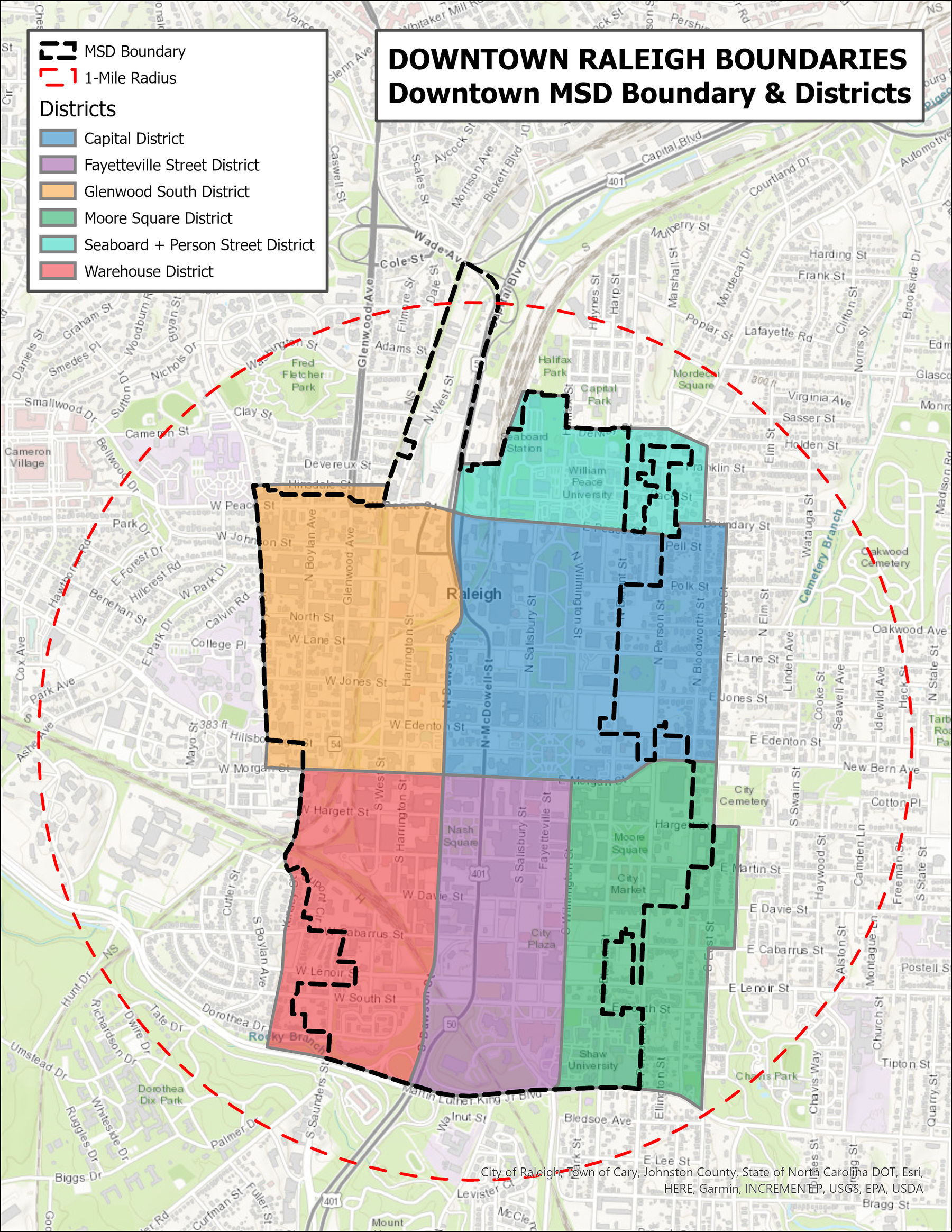
This morning I’ve been attempting to compare downtown district maps, CAC maps, the MSD boundary, and city council maps. I have to say that it’s been enlightening to me that downtown is Balkanized even more than I expected.
I’ve been communicating with the Glenwood South Collaborative about the CACs, and was told that this CAC map isn’t up to date. I don’t know if that’s correct or not.
I then looked at the downtown district map that I found online that’s overlaid with the MSD boundary. Again, I’m not certain if this is up-to-date as well.
Some take-aways
Within Glenwood South, and Smoky Hollow in particular, it appears that 4 CACs come together at the corner of Peace and West. That’s just insane.
CACs that cover parts of downtown are mostly paired with SFH neighborhoods who lean NIMBY (I don’t want to paint with a broad brush). These include Forest Park, Glenwood-Brooklyn, Oakwood, Mordecai, and Boylan Heights. I’m not sure if South Park has exhibited particular NIMBY behaviors or not. Maybe others can weigh-in here?
The MSD seems to carve out particular parcels. As no surprise to me, SFHs seem to be mostly carved out, but it also appears that some multifamily is carved out particularly in the North Person District. The vast majority of multifamily homeowners and renters are contributing to these overlay taxes while single family residents don’t. Is this fair, especially when multifamily representation is highly muted through Balkanization?
Like @OakCityDylan stated, I think my issue was with the CACs ability to vote on things. That should go away and instead just a place for feedback to be taken down, in plain english, and sent to decision makers. No votes, just stories about what people think.
Then, the maps are my next problem. They need to be used for “back of the office” admin purposes only. Since these are so front and center, people get territorial, and not everyone thinks like that. People are part of neighborhoods, yes, but they are part of communities and some communities are not bound by geographic boundaries. I don’t know how, but feel with a proper brainstorming group, there could be a way to run CACs as to inform people and get feedback on things, wherever in Raleigh that you live. Hell, even if you don’t live in Raleigh, come on in and tell us what you think cause that could be helpful too.
Fix those two things and I’m hugely interested again.
Right. Why do we still need “boundries”? Just have meetings in strategic places that apply to a given area/community. It seems all we really need is a Raleigh Citizens Advisory Council. We can probably even rename it completely.
Voting or no voting power, and I do agree with “no voting”, even feedback gets diluted downtown with all of the Balkanization among a variety of maps.
In the end, I don’t see council being neutral on the comments or stories regardless of whether they are actual votes or not. These are politicians who rely on votes, and they will always pay attention to those who are organized, donate, and vote.
Well, I’m also a voter. And anyone running for City Council who touts that they even consider CAC complaints (because it’s always complaints) when making decisions over, you know, logic and reason - will immediately be disqualified from my consideration in voting for them
The head of the Midtown CAC (which covers the area where I live) is a vocal NIMBY who opposes every new development proposed. maybe why CACs have some value?
i have attended some PEDALSafe bicycle advocacy meeting in RoanokeVA. some group rides add visibility. personal discussion may have merit beyond cyber-flaming.