It just seems like an unnecessary layer of process that makes life more difficult for both the city and the rider.
Well Umo is owned by Cubic, who basically supplies all of the transit cards in the country, including NYC and Portland. Apparently they recently lost the contract for London. I’ve maybe seen one other supplier and Umo is cheaper to implement for our size of agency since it’s cloud hosted, GoTriangle operating their own fare back office is a significant ask.
It used to be a separate company and I’m kind of surprised that it hasn’t improved that much under Cubic. Maybe GoTriangle could work with them for better clarity and clarify on their own website.
1 Like
Does this mean that in places like MiamiDade County, where the buses are simply tap2pay as an option, they have a fare back office?
Miami-Dade’s fares are administered by Cubic but they’re using a semi-custom solution, rather than the turn-key Umo solution. Miami Dade Transit probably operates a dedicated Fare back office, built by Cubic but they also spent $50 million on initial deployment and another $33 million more recently.
Umo is awesome, since basically a Transit agency sends Cubic a design for cards and buys readers and they’re done but I haven’t seen any Umo agencies support Open Payment.
With Miami’s system supporting so many international riders (especially the route between MIA & Miami Beach), I suspect that they had to figure out a way to make tap2pay work.
Am I missing something? How hard can it be? Tap2pay is ubiquitous in 2026 in just about every retails location. Putting it in a bus system cannot be that difficult.
1 Like
Remember: this is Raleigh. We’re still working on getting up to snuff for 2021!!! Give it another 5 years and we can worry about the problems of today.
2 Likes
If I had to guess, interest on the umo account balance, is one of their major revenue streams. With tap to pay enabled, few people would have a balance, they’d pay more in transaction fees, and the price to transit agencies would be much higher.
On top of that, Apple charges a FAT fee to use apple pay and that’s in addition to the cc fees. However, I agree that tap, regardless of the cost, should be implemented. At the very least on the BRT routes ON LAUNCH!
1 Like
Good points. Perhaps have both UMO for regular riders at the current fares, and implement tap to pay for convenience for infrequent riders, at a slightly higher fare to cover the fees. Similar to how QuickPass works with our Toll Roads.
4 Likes
Umo claims to support “open payments,” aka tap-to-pay:
NFC is far superior to QR codes for transit boarding. Futzing with brightness and trying to hold a phone completely still is difficult when boarding a bus.
7 Likes
It is also a priority item in the regional technology plan.
1 Like
The website only claims it’s compatible with their VAL100 Reader, and a pretty new development at that. We use the old custom built Delerrok Touchpass readers, which while Delerrok said they might support Open Payment later, I don’t think they ever got certified. These are basically Raspberry PIs with a special sensor suite.
I would expect that we get updated readers as part of the regional technology plan and they might be VAL100s with support for Open Payment.
1 Like
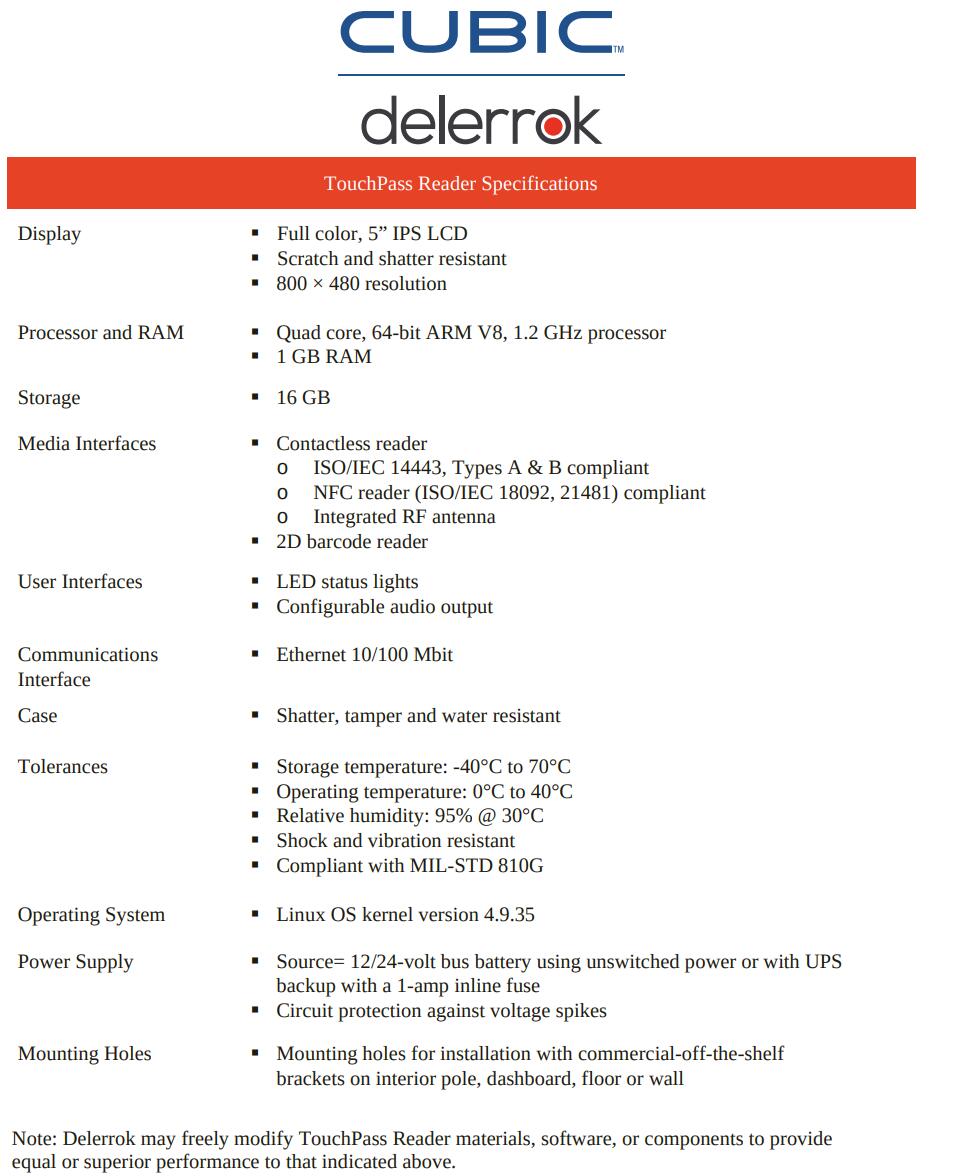
For those interested for some reason, I found a document of Cubic/delerrok replying to an RFP in Ventura County for deploying Touchpass/Umo. It appears to be for the deployment of the same readers that we use: https://www.goventura.org/wp-content/uploads/2020/11/ATTACHMENT-ITEM9_AGREEMENT-EXHIBITS-C-G.pdf
It has the tech specs for the readers. I think that it surprised be that they’re running such a new kernel but I already knew they ran Linux:
Starting on page 199 of the pdf, it talks about how the implementation of Open Payments affects a transit agency, with it being clear that they don’t support it. Mentioning that for example an agency that has $1.50 fares, would pay a minimum of $0.32 in fees to the credit card company. It being easier in Europe since bank card fees are capped to 0.3%.
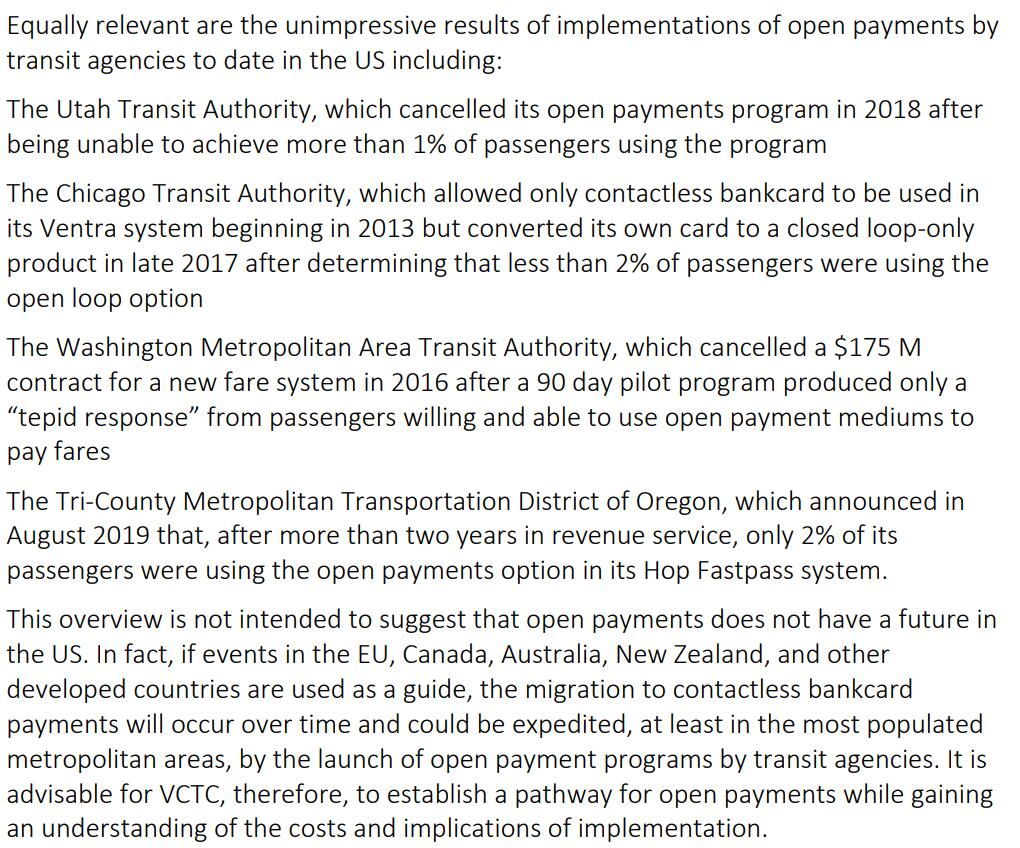
I would imagine that a large part of the move to the VAL100 on the part of Cubic, was likely that HID was willing to get or was already EMV Level 3 certified, when the existing readers weren’t. EMV certification required each credit card company they want to support to independently audit the reader and software. I imagine that delerrok thought it would be easier to get EMV certified than it turned out to be and none of their customers were willing to pay for it.
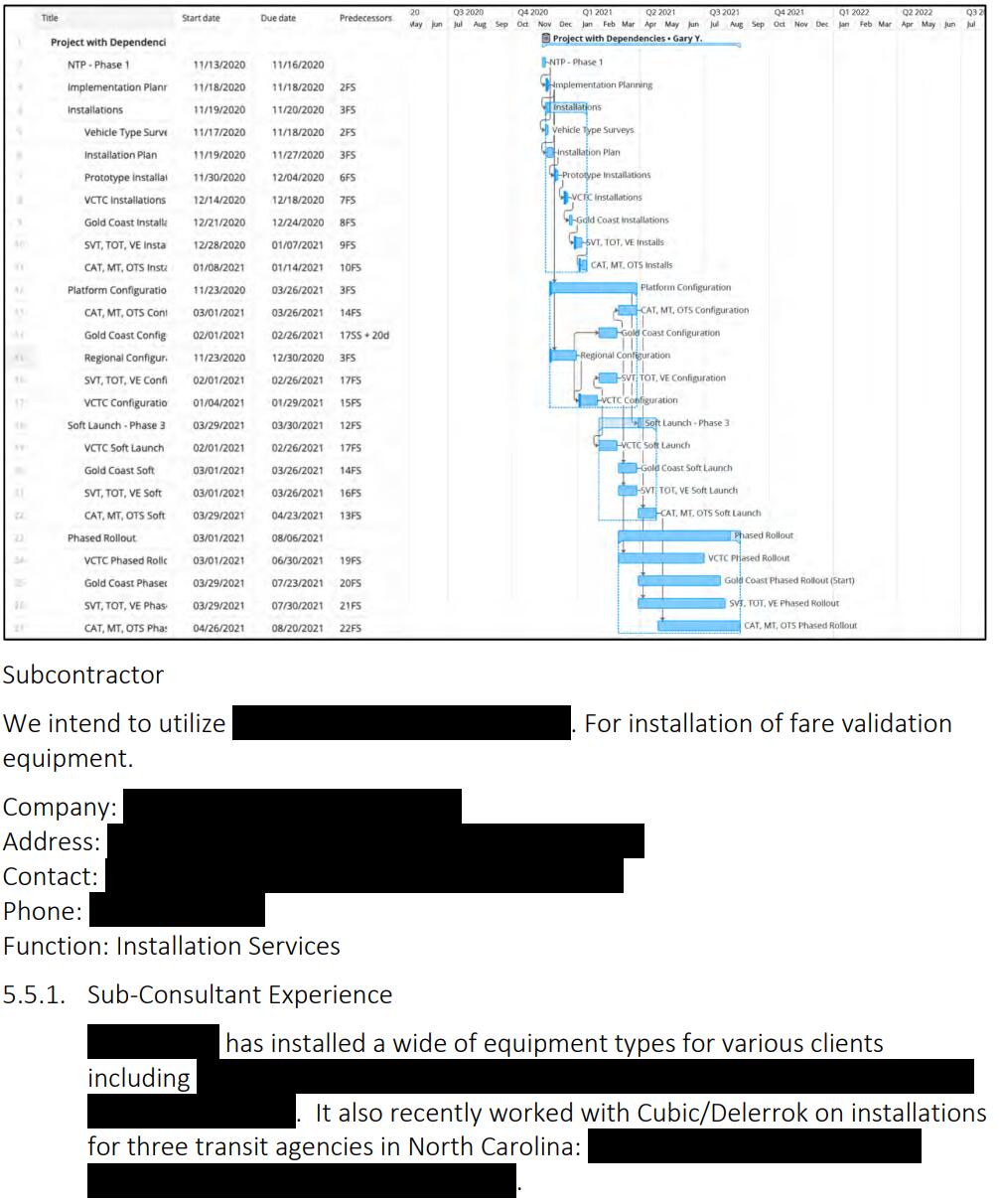
They also have a proposed roll out of Umo/Touchpass, stating that they want to use the same sub contractor they used for three agencies in North Carolina, I wonder if that’s the triangle agencies or the triad agencies, they do later on say to contact Greensboro as a reference:
9 Likes
Thanks for the research and report!
1 Like
Wow, it literally does seem to be a Rapsberry Pi 3 with some extra stuff on top. Thanks for the info!
2 Likes
A more recent data point: “nearly 9% of all Clipper trips… paid using credit and debit cards in February” 2026
https://www.planetizen.com/news/2026/04/137359-bay-area-transit-loses-1m-month-credit-card-fees
The fees are still a problem, though; see links from Shared-Use Mobility Center and Brookings. “Bank card fees that U.S. agencies pay to accept credit and debit cards for fares are many times higher in the U.S. than in Europe.” (Mobility Payments)
2 Likes
I don’t know if this has been mentioned somewhere else and I missed it, but a presentation from yesterday’s Planning & Development Committee meeting seems to suggest that GoTriangle dropped this upcoming financial year’s funding request for 15-minute frequencies on route 700 (sort of similar to original route 100X plan?); the presentation seems to suggest they’re prioritizing 30 minute frequencies on route DRX instead so route 100 can once again deviate to the airport. Don’t know how I feel about this as I don’t travel to Durham often but maybe someone else has thoughts…
1 Like
This is in the updated Wake Transit Plan.
I’m deeply opposed to this maneuver. Honestly I think we should get rid of the DRX/CRX and focus that money on frequency and span on the 100/700/800/RDU, as well as get rid of the sometimes deviation to RDU on the 100. Local and Express service on the same corridor seldom makes sense.
They basically need to run the DRX every 15 minutes and the 100/700 every 15 minutes, so that it makes sense to wait for the one that makes more sense for your journey rather than take whatever leaves first. I don’t think there’s enough ridership to support that.
I also eventually want the RDU Shuttle to be a RTC-Brier Creek Connector with a station at RDU but I think the RDU Authority would be opposed to that.
1 Like
While a connection between Brier Creek and the RTC would be good, I’m not sure I necessarily agree with converting the RDU Shuttle into a RTC-RDU-Brier Creek connector.
I’m not convinced that there’s enough demand between Brier Creek and RDU to justify deviating travelers between the two to the airport, not to mention I think they tried this already about 18 years ago?
I forget the context as for why I was doing this, but I was doing some digging on past GoTriangle/Triangle Transit routes on the Wayback Machine, which is how I figured this out. I was only able to find a schedule that was so old it still has the old names of Terminals 1 & 2, but it doesn’t include a map. There is an archived system map however that shows the deviation that travelers between Brier Creek & the then-RTC would have to take, which I guess is possibly why they seemed to have gotten rid of the Brier Creek section in 2009 (alongside the opening of the current RTC apparently?):
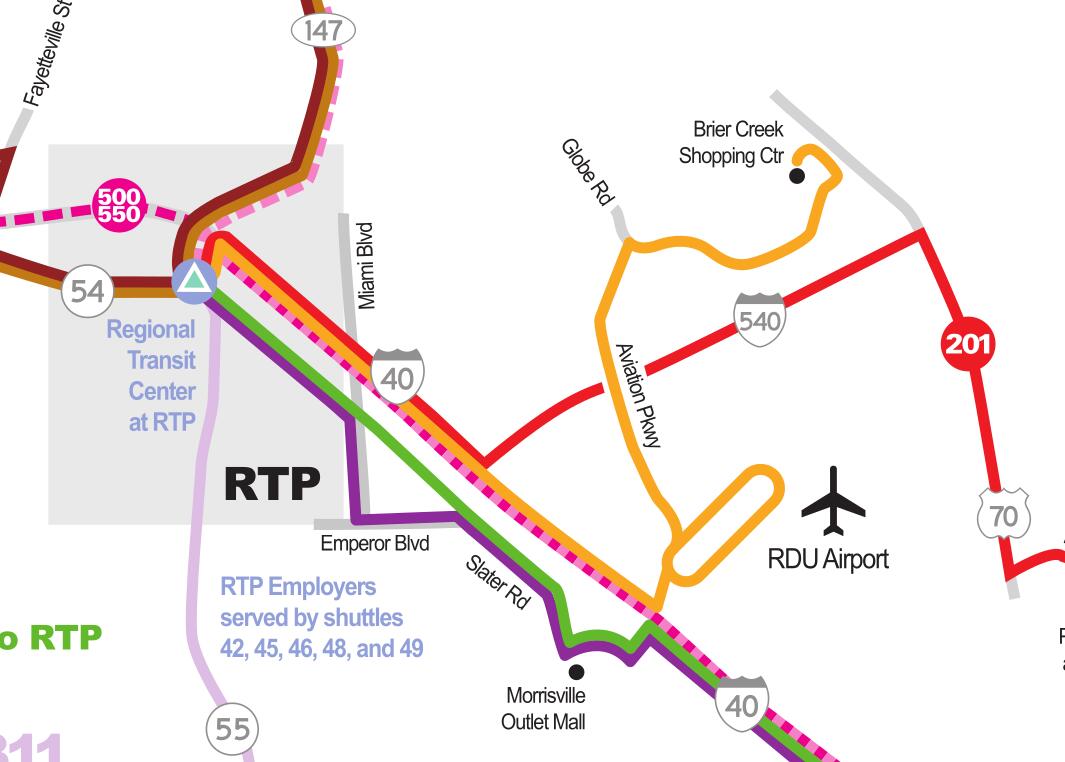
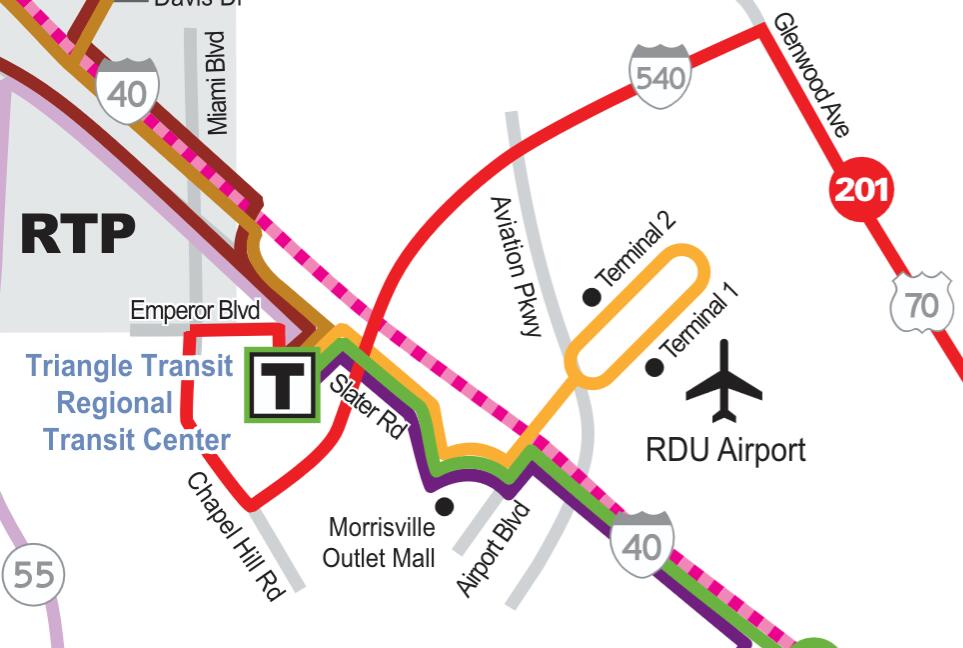
Obviously ridership numbers would be completely different in 2026 compared to 2008, but if they were to do this I’m not sure how they would route it. They could have a more straight routing to Brier Creek by routing north on International Dr to Lumley Rd, but then:
- With the current road/stop layout, you would either have to loop around the airport once before continuing through or risk forcing passengers destined to Terminal 2 to ride through Brier Creek first (or passengers destined to Terminal 1 through to the RTC first). I guess you could just get off and walk between the terminals, but then:
- Turning right out of International Drive to get to the arrivals floor of T2 (where the stop is now) is already awful with the current layout, but theoretically much easier once the John Brantley Boulevard Extension is completed
Or, you could have a deviation similar to that of 2008’s Route 747, but would deviatiating to the airport add too much time to justify it? Especially from the site of the new Triangle Mobility Hub?
I don’t necessarily oppose routing Route 100 back through the airport, especially if it means more frequent service to the airport, so it might be worth considering a separate route that goes through Brier Creek and continues on to another destination (like maybe North Hills?)