…just wait until it’s expanded and ALL of 540 becomes a toll road…
1 Like
That is actually what Raleigh wants from what I understand.
1 Like
It does seem to be the major desire of most…although, the older I get the less I seem to be in the majority…Lol 

1 Like
Yes. I am not against 540 really, but I don’t ride on it hardly ever except to go to Durham as I live in Cary and I can get there pretty quick. But I do think all of 540 could eventually be a toll road…
I-540 was originally pitched to provide relief for North Raleigh to get to RTP and Durham. And it did work getting lots of traffic of 70, Six Forks, Falls of Neuse that went to 440 and then 40.
I just groan when I see these rail plans that ignore much of the populated areas of the region. At best, they have rail plans that go along Capital Blvd up to Wake Forest. No attempt to include any other part of 440 or 540 into a rail - spoke system to feed commuters into DTR. But traffic patterns here are so dispersed that it’s hard to build a system that covers a majority of residents.
It seems if we can only have rail along existing train tracks, then we’ll be stuck with unsatisfactory solutions.
3 Likes
“It seems if we can only have rail along existing train tracks, then we’ll be stuck with unsatisfactory solutions.”
You realize this is how 95% of commuter rail in the US is laid out, right?
1 Like
And that’s probably why it’s not working out so good. Like in Charlotte or Nashville where the systems are under performing. Great for freight - not so great for connecting population centers to destinations.
2 Likes
So the problem is that we have terrible passenger rail because we’re restricted to freight rail pathways.
What solutions do you have, though, if you say you have to have heavy rail? I can only think of…
- lowering land costs (not happening because capitalism + American land rights are basically sacred)
- massively expanding eminent domain (lawsuits galore)
- building on the median of highways (massive traffic jams during construction + expensive + really difficult commuter/pedestrian access)
- anything else?
3 Likes
Run new rail lines. Just like what was proposed in the Orange/Durham line. Note along I-40 from Hwy54 to 15-501 was all new line. And through out the Duke campus was new line. It’s a matter of paying for it of course.
I like the idea of running rail along the Interstate corridors… while people are sitting in backed up traffic, the trains are chugging along. I-540 could scoop people up all the way from Knightdale and around to RTP. Or along Wade Avenue from 440 to RDU and on to RTP. Etc. Go where the people are already travelling, and use existing ROW paths.
1 Like
Wait, I’m not sure if you got my message in that last post? The whole point was that, if you were to build a new rail line, there’s a whole pile of inherent hurdles you’d have to jump over that makes it too impractical without fundamental shifts in how things work in the Triangle*.
If you want to build a structure for heavy trains, you need to build heavier bases that are dug deeper into the ground -assuming the ground that our interstates run on can support them in the first place, including all the bridges that you’d have to (re)build.
Light rail is called light rail for this reason: the Durham-UNC route could get away with their 18 miles of tracks filled with aerial segments and tight turns because their trains would’ve been smaller and less heavy. Each station idea was also immediately surrounded by transit-oriented development which are dense, walkable, and multimodal, and they didn’t require miles of access bridges to connect pedestrians to every station. Even though you had density (read: demand from a captive market), lots of land donations, and smaller infrastructure from the Durham light rail attempt, it still would’ve cost about $110 million per mile ($2.2 billion divided by 18 miles).
If you want to build along an existing highway’s right-of-way, assuming you have permission, you’d need to either build on the median (and take away shoulder space that could be used to evacuate vehicles in an emergency for months on end) or on the edge (and restrict chances for highways to widen in the future). Keep in mind that there are plans to eventually add express and/or toll lanes to most Interstates in the Triangle by the 2040s, too, which will probably shrink or eliminate some of the grassier medians we have in the area. I’d think the DOT wouldn’t be very happy if a wrench got thrown into those plans for a rail system that hasn’t even gone through a Major Investment Study yet.
Add in the fact that you asked about heavy commuter rail, with its higher construction costs, geometric limits due to how it can’t make tight turns, legal restrictions on what you can pull off because of its shape and size, and this…
…then the costs seem to far outweigh the benefits of building rail in outer Raleigh right now, when we haven’t even built a core network yet. Priorities, maybe?
I’m a fan of a comprehensive rail system in every corner of the Triangle. But the devil is in the details, and on closer inspection, it looks like an even bigger field of landmines than Vincent Price’s backyard. And this is before we bring the environment and ridership onto the table.
Besides, it looks like BRT (purple) may be a better solution that’s already being considered by CAMPO’s 2045 plans, anyways:
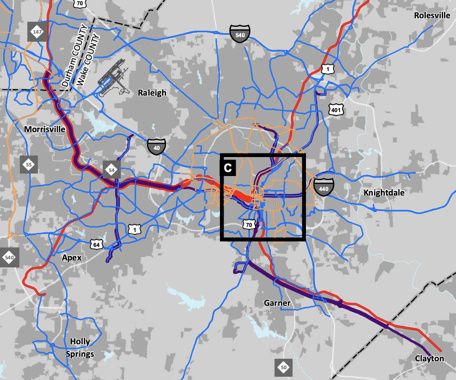
*: don’t get me wrong; I want everything reasonably possible to happen to make public transit a reality around here. It’s just that… uh… see previous post; pretty sure the land/business-owners and commuters who would get caught in the crossfire would burn supportive politicians at the stake when they get their chance in the ballot.
5 Likes
From the previously posted article:
In a recent Carolinal Journal op-ed, John Hood, chairman of the John Locke Foundation and one of the project’s opponents, wrote, “North Carolina is a populous, fast-growing, and urbanizing state. But that doesn’t mean our settlement patterns are friendly to large-scale rail transit, or likely ever become so. Our ‘urban’ counties are really suburban places for the most part. Most people still opt for homes in low-density developments. Most don’t work, live, or shop in downtowns.”
Which tells me we need to provide more options. I think our projected apartment adds downtown are good, but back to building more condos so professionals can invest in downtown. The younger generations don’t want a huge house. They’ll trade space for convenience and there aren’t many options downtown. Oh, and then there’s the matter of our NIMBY council not supporting density.  Karla and I talk about Denver being a strong candidate for a next city (far down the road) and having good public transportation plays in to that.
6 Likes
Which is exactly why ya’ll need to stay “here” in Raleigh, because good change happens when we work from the inside…so, please stay! 
4 Likes
We bleed DTR right now. Not leaving anytime soon.
7 Likes
The John Locke Foundation will continue to fight transit in our state by using a self-fulfilling prophecy with data about how few currently use transit in our state. There will always be these kind of anti-train Op Eds, but they capture the reality of the world we live in today and not the reality of a future built with TOD. Their formal position on transit in NC
What they rarely refer to, when talking about transit, is the growth we are experiencing and what mobility will look like if we don’t change our community design thinking and planning. They advocate for non-lane-dedicated busses as the primary solution, which would have minimal advantages over driving oneself. This is the kind of thinking that encourages sprawl.
However, these kinds of objections are persuasive at a glance, and are going to be rampant as Wake moves forward with our transit plan. The greater community needs to be educated about the benefits better transit infrastructure and TOD will provide our region as we grow. Our electeds need to be on board.
4 Likes
Transit is not about current issues. It’s about future issues and shaping future growth in a manageable way. Raleigh, and the greater triangle area in general have 2 options with all the people moving into the area.
-
Continue like we ave over the past 40 years, keep building more sprawl in an ever increasing radius out into the rural areas. Zebulon, FV, WF, Holly Springs, Roleseville, etc. With worse and worse traffic all the way around. Keep building more roads and face ever increasing congestion and commute times.
-
Start building more density, in clusters (DTR, North Hills, Penamark site, Glenwood mall area, Wake Med area, etc.), interconnected by mass transit and have the new folks moving into the region move there vs. 15+ miles out in a new subdivision.
What is the area going to look like in 15-20 years?
9 Likes
Interesting story on the Light Rail debacle.
Sad for people that get kicked off their land by eminent-domain - and then the project ends up not happening. These kinds of stories builds resistance to future efforts to build these large projects.
The biggest beef people are having is now GoTriangle can sell these lots for several times what they paid, keeping the profits.
8 Likes
would only seem right that the original owners should be able to buy the land back at price they where paid or get a share of the difference in price that resales for.
There needs to be change made in eminent-domain laws.
A question comes up, why sell it? While the current project is canceled, 20 years from now I would not be surprised to see a new push for some sort of transit (lol if I’m still around to see it). So keep what has been bought for future use. Then guess that requires long range planning, which for political crowd and their minions, long range is next election.
4 Likes
yeah we need to keep right of way for future projects… why would we sell something if that is what the engineers thought was the best possible right of way. So we build more houses and make futures projects impossible?
1 Like
This seems like a good idea for a smart, very-long-range plan (since actual Long Range Plans can’t be enforced and don’t have any teeth). But legally, isn’t this kind of a disturbing precedent?
Let’s say this actually becomes law, and you use eminent domain to squat on a prospective project rather than something in active development. What would stop you from:
- buying up whatever piece of land you want (possibly out of retaliation or some other reason that’s not in good faith)
- claim that it’s for some transit or infrastructure project in the future (but not go into any more details than that)
- lay low for a few years until the dust settles
- profit?
I agree with the intent of your suggestion for holding onto the land for some future use. But because of this potential for abuse (especially since DOLRT doesn’t exactly have a replacement project as of now), I think the only ethical thing to do is to follow your first suggestion, and return the land to the original owners with a full refund and/or share of resale profits.
This is kinda misleading, though. The project’s environmental study looked at several sites throughout the rail route, and picked it mainly due to how cheap it was and how relatively few issues they may have from eminent domain lawsuits or noise complaints. They’re not engineering issues; those are political problems.
3 Likes
Was the Raleigh/ Wake light rail system to have its own dedicated ROW or was it going to share the roads with other vehicles (tram)?