I think that I understand what you are trying to accomplish, but a circle isn’t necessarily a universal representation. For example, SLC anchors a linear population distribution, as does Miami. Using a circle for coastal cities puts huge chunks of that area out to sea.
If one looks at the Triangle’s population distribution as mapped by development, we get a better idea.
As a map geek, Raleigh, NC Urbanized Area - Profile data - Census Reporter is like Christmas to me. Well, not this past one.
If you scroll around this map, you’ll see the context that’s often lost in MSA and CSA designations. For example: Raleigh, Nashville, and Richmond all have similar Urban Area populations, but their context’s are different. Richmond’s is completely clean with no adjacent Urban Areas or Urban Clusters. Both Nashville and Raleigh have both adjacent Urban Areas and Urban Clusters. If you add up those adjacent areas and clusters, Raleigh anchors an area with the most population of the 3.
Raleigh+Durham+Fearrington+Smithfield+Archer Lodge-Clayton+Wendell Zebulon = 1,543,206. This number does not include places like Buies Creek, Dunn, Sanford or Pittsboro. I was trying to be fair about what constitutes adjacent.
Nashville +Murfreesboro+Lebanon+Springfield = 1,301,243. Once again, I didn’t include clusters that weren’t really adjacent like Spring Hill, Fairview, or Pleasant Valley. Frankly, I was generous to Nashville by including Lebanon since it’s more separated from Nashville than anything included in Raleigh’s analysis. Even if I did include the extra clusters in Nashville, the Triangle is still significantly more populated.
Yet, here we are with the MSA’s that tell us that Nashville is hundreds of thousands of people larger, while its CSA runs from the Kentucky border to the Alabama border: a distance greater than from Raleigh to Winston-Salem.
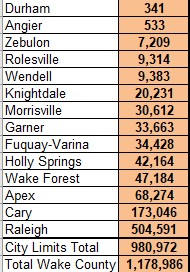
Well Wake County estimated 499,983 a year ago. So probably a day or two after that estimation they surpassed a half million… at least based on their estimates.
Wow! These estimates are generally way higher than the 2019 Census estimates that have Wake Count at 1.111 Million and Raleigh under 475,000. It will be interesting to see whether the county or the Census was closer after the report of the 2020 Census.
As a reminder Wake County bases their estimates on the actual residential structures and basically uses the same vacancy rate that the Census used 10 years ago. Still an estimate but they know what has been built.
These are exciting results and with the decision maybe to re-emerge Durham-Chapel Hill MSA back into the Raleigh-Cary. That could could make us the largest metro in the state!!!
As I understand it, Wake is growing slightly faster than Meck, and as long as current trends hold up we should remain ahead of them for the foreseeable future, especially since Wake is significantly larger geographically.
Wake does have more land. But also Wake’s incorporated communities are already denser than Mecklenburg’s. It’s Cary and Raleigh and Apex where Wake caught up, not Zebulon or Wendell.