That pretty much the opportunity zoning I was talking about.
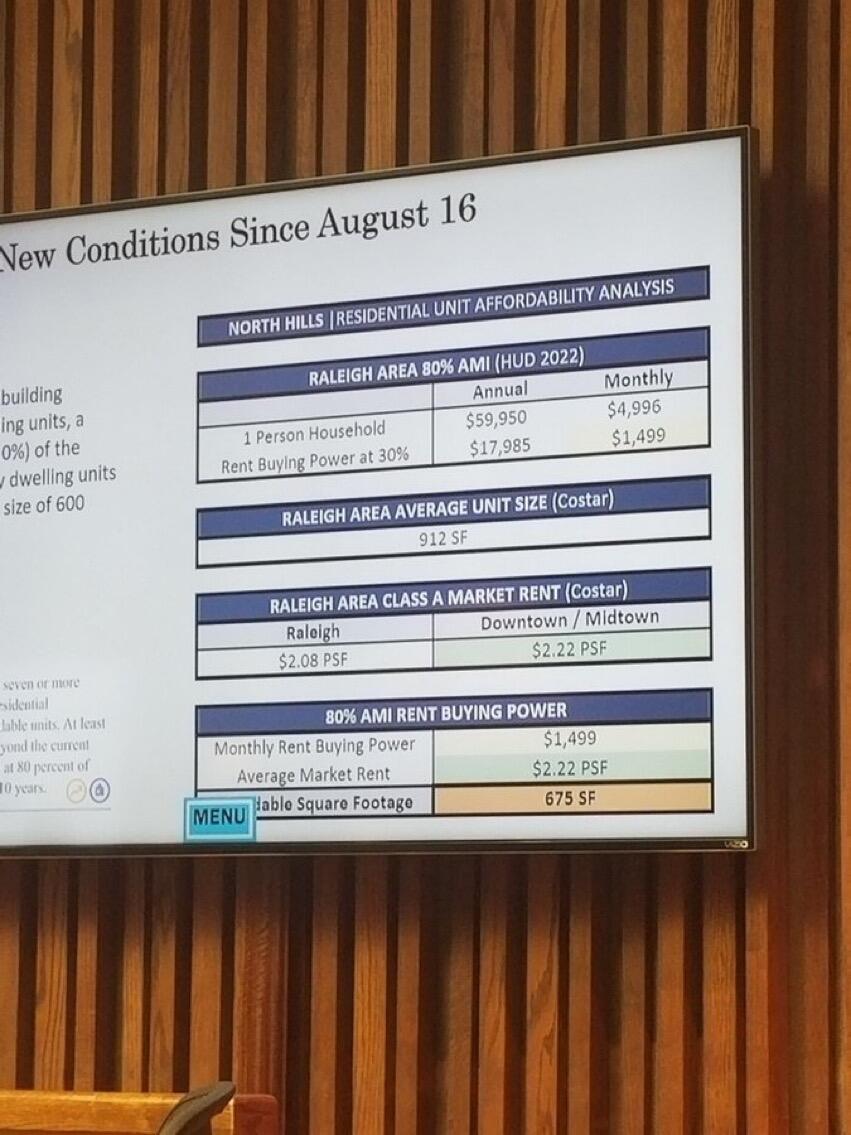
Here is the hilarious metric they used to justify the “affordable” units. If $1500 for 600 square feet is affordable we are in trouble.
1 Like
Yep, it’s crazy and the ‘bomb drop’ was the fact that similar sized micro units already rent ‘across the street’ for $2400! Also, there’s only affordable housing built here in this rezoning IF multi-family gets built. If Kane builds only office / hotel - which seems crazy but IF, there’s no ‘affordable’ housing…
Then, the discussion devolved back to traffic, leading to a vote on a traffic impact assessment built on theorizing what’s gonna get built. Whew!
Mr K@ne is not gonna get the rubber stamp here without a lot more skin.
1 Like
Looks like there old Ed’s is hurting their IQ.
perhaps you are now a may-BY
I know it’s not done yet, but this is a wasted opportunity if Kane decides to throw the towel in. A lot of the main district is already zoned to 20 stories, he can easily back out and we don’t get the transit station, bike lanes, or for fire house and still have multiple new 20 story towers and 40 story zoning across the street. Need to take what we can get here. If he was taking away affordable housing like the Navaho development I 1,000x get the affordable housing component, but when replacing a bank and a gas station, what’s the hang up.
12 Likes
-mayberry tale alert - but my SFH life in longview regularly consisted of bike rides into 80s downtown raleigh. with improved bike lanes and the amenities there now numerous short trips without vehicles can likely be done safer and the journey can be enjoyable as well as the desitnation.
3 Likes
Yep - Kane could very well say eff this and take his ball and go home. And we are left with the parking lot and gas station, zero housing, and no transit center, as you said.
1 Like
And most of those opposing would feel like they won. 
3 Likes
True, and that’s the sad part 
1 Like
Wait, I’m not arguing against bike infrastructure or arguing that Raleigh growth to this point has been a net negative. As I said, I’ve rooted it on and tried to help get people involved in that pro-density/ discussion. So the nice bike rides you’ve been having bc of the bike infastructure is awesome, and thanks to density reaching a point where stuff like this gets traction with city/council.
But getting some bike lanes and approving 40-story buildings at every turn isn’t the same thing. I’m not arguing against what we’ve done to get here. I’m just voicing an honest opinion that I feel like it might be going a little unchecked lately, and I’m worried if that continues we may wake up one day and wonder where we went wrong (my team for work is from Austin and most of them feel this way).
And I just don’t see that side of the argument on this site very often. In fact, I see anything that questions large-scale development usually criticized. And that’s just concerning to me. We don’t have to be all or nothing. We don’t have to be NIMBY or YIMBY. We can be for some projects and against others. We can be for growth, but want slower growth or want infrastructure/amenities (like transit) to catch before throwing up something else.
7 Likes
my understanding was that the 1500 dpm rent wasnt guaranteed…the 1500 was arrived at by some odd federal govt calculation based on square footage and other nearby units. its likely they will be closer to the other small units?? did i hear the lawyer wrong on that?
At the end of the day, affordable housing can’t be delivered in our market in prime locations without some sort of public assistance or subsidy. The land and costs of construction are just too high for it to work from a market only perspective.
Drive until you qualify has traditionally been the mechanism that the new housing market alone has used to make housing more affordable.
When our aging mall areas are redeveloped, we are definitely ending up with many more units, but those units are ending up costing residents substantially more money.
2 Likes
Yes, the ‘applicant’ lawyer was using a derivative formula based on 80% AMI to drill down to an ‘affordable’ number for the sake of presentation / condition. The part that was somewhat disingenuous was the fact that (former mayor McFarlane called out in a letter to Council - timing that one!) 600sq ft apartments are renting for closer to $2400 across Six Forks in Kane’s other properties, likely signalling the reality that the ‘market’ price of these is NOT $1500. Not surprising that North Hills is not 'A’fforadble.
This kinda thing is how/why affordability is used as a wedge issue amidst the complexity of development challenges - (magnified at sites like this one in North Hills because of the drastic change the area has seen, which is stressing infrastructure and patience if you listened to the meeting last night…) because every citizen can respect the dream that there SHOULD be some affordability for service people to live within a growing city but the free market struggles to support at best or damn near ignores it at worst and as @John states, our laws don’t functionally subsidize the building of it in the best of times — and these are certainly challenging times to have development financing pencil out in the midst of inflationary pricing and housing supply limitations. The stresses that growth causes all of a municipality’s citizens are different, but they are felt nonetheless - that was also evident in last night’s meeting proceedings.
2 Likes
I wrote something about this a few years ago:
For the hook, I contrasted two sides of a single ZIP code in southeast DC. I still think it’s a great introduction to the mechanisms of how prices interact with construction.
For a more rigorous review, I recommend these:
They aren’t, but that’s not their role: their role is to absorb housing demand and prevent much more insidious displacement and price escalation. See the section in my article beginning with “Prices can stabilize,” and the discussion above about micro-units.
That’s another good way to look at it: the demand to live there is incredibly high, so we’re going to have to ration it somehow - and, in our society, that’s usually by price. It’s much easier to ration 200 than 50.
10 Likes
np…i was responding to your “having kids” wondering. my dad and i would ride bikes downtown from the longview area and often i would ride to meet him for lunch as a youngster out of school. i enjoyed downtown as a yongster. it had a busy-ness that the neighborhoods didn’t have seeing - lawyers out for lunch, etc. and on weekends it was serene. i think younger people would enjoy the new architecture now and i also keep seeing a soccer court on FSM.
2 Likes
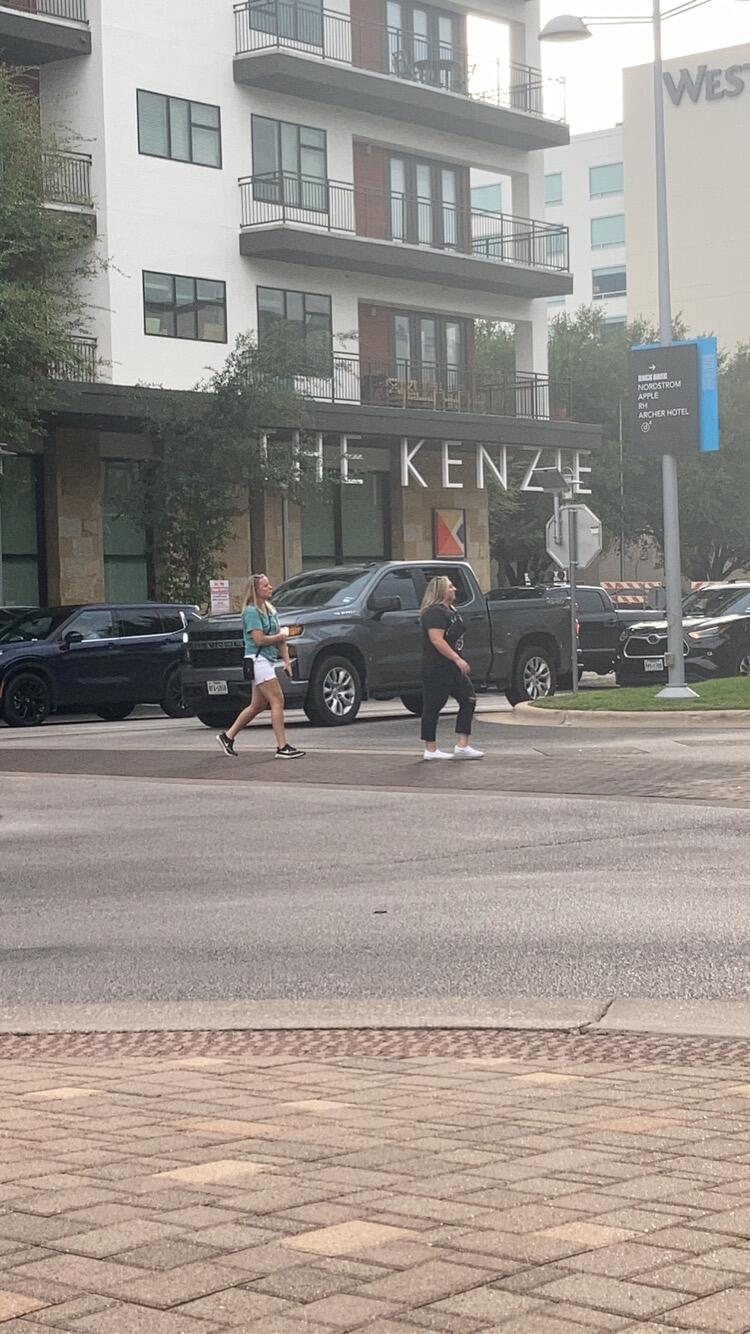
I was gonna say because of inflation that probably why cost may be high. In Austin I went by the Kenzie which is at the domain a room might be about $1,895, or $2,307 but that might be off demand also location, and the current economic situation it may not be worth that. John Kane probably gonna have to explain that.
1 Like
I’m not. (I assume that I’m older than you.) But do consider how your own demographic lens could cloud your view, and prevent you from seeing that the changes you’re seeing might work better for other people, who have their own wants and needs.
-
Only about 1 in 5 US houses is occupied by a married couple with children. High-rises, in particular, are very expensive to build, and because of that they’ll generally have expensive units - and small ones, to keep that price somewhat down. They’re not really “affordable large family housing” anywhere - note that highly urbanized, high-rise cities the world over tend to have low birthrates, even in places like Singapore where the government widely subsidizes large high-rise units.
-
Consider that the cool businesses you treasured in your youth may just have run their natural course. Let’s not fall into a nostalgia trap and refuse to recognize that change is a necessary part of life. There are lots more retailers in DTR now than there ever have been.
“The years people said the city was at its best almost always coincided with when they themselves were at their hottest, typically in their late teens or early 20s… The neighborhood hasn’t stopped being cool because it’s too expensive now; it stops being cool for each generation the second we stop feeling cool there. If you’re complaining about the [city] being dead, I think it’s worth considering the possibility that, yes, it is over — for you.” - Ada Calhoun, who grew up on the Lower East Side and wrote a book about the generations of cool kids who inhabited St. Mark’s Place
https://www.nytimes.com/2015/11/01/opinion/sunday/my-city-was-gone-or-was-it.html
Yet there’s a new generation who’s already taken your place, without you realizing it, and we should be happy for them.
11 Likes
Great article and very true. Cities are awesome, and they are actually at their best when they change.
I mourn when bars/restaurants I like close, and especially when they are places that I frequented during my “glory days”.
But if other bars and restaurants are going in those places, it isn’t a death so much as a reincarnation.
3 Likes
Except if Garland is replaced with yet another brewery. Then that’s just wrong.
Before reading the post by @paytonc I had been thinking along those same lines on a personal level. I was thinking about how there is a lot of stuff happening in DTR now that I can’t get excited about because it doesn’t interest me - like breweries. I’ll ride my bike by a brewery on a Saturday afternoon where a bunch of people are, but I won’t ever go to one. BUT then I thought - if that’s what the people in the city want, then great! Add more breweries. It just may be that over time, this is not the place for me if there aren’t more things I would prefer to do, due to age or interests or whatever. When I moved here years ago, I would never have considered Durham. Now I can appreciate it because it and/or I have changed over time.
2 Likes