Re-imagining the R-Line

Okay, that is a much stronger reason to go back to a separately-branded R-Line, but…

Is this a serious question?

This is a genuine question, by the way. I assumed it was intended as just another bus in downtown Raleigh that happened to be free and also marketed to visitors. …but I didn’t realize that this purpose was never explicitly written anywhere.

Also, click here for an open word of caution for Leo and any civil servant who sees this!

You’re doing what we call a root cause analysis in the engineering and business consulting worlds. This can be a powerful technique, but it’s easy to misuse or abuse if you don’t do a good-enough job at taking a long, hard look at yourself in the mirror.

I think you need to be really careful about what questions you’re asking. If you don’t lead yourself down a path where you can name the problem you’re trying to solve instead of baking your solution into your supposed “problem”, you’re trapping yourself into doing what makes you ~feel~ good instead of actually doing what you need to do.

As we all know, American public transit has a long, shameful history of doing just that. Please don’t repeat those same mistakes.

If you ask me, I think the use case of choice riders and city visitors makes much more sense for who the R-Line should target.

2 Likes

My problem with this is that the route is connecting (and I imagine will continue to connect) the two busiest transit centers (I have to think RUSBUS will be busier than Crabtree Valley Mall or Triangle Town Center) in Wake County and thereby also being some of the busiest in the triangle. I also pretty firmly believe that people already riding a bus are the easiest to get to ride a bus. So I struggle with the idea that we should have a daily fixed route service, for the benefit of people not riding the bus.

I’m a big fan of the meat and potatoes of transit service. Frequency, span, speed and route. Does it take me where I want to go, when I want to go, without wasting my time? The R-Line fails almost all of these metrics for me. If I’m going to Union Station, I’m better off taking the 9, the 100 or walking. The only time it might make sense is going to Seaboard Station, but I’d probably take the R-Line or the 3, whichever came first, but I can’t wait for both at the same time since the R-Line doesn’t serve Moore Square.

I think we should turn it over to and brand it with the DRA, as like a Raleigh Nightlife Connector or North Carolina’s Main Street Trolley and only run it from 7pm-2am on Friday/Saturday (potentially only during the school year) and Special Events with The Great Raleigh Trolley vehicles.

3 Likes

Same here. But also, I believe in meeting people where they’re at - and that makes me feel conflicted about your take.

Dusting off some concepts from intro-level college marketing classes, let’s think about this in terms of user personas, or who are the kinds of people who might use the R-Line. If you look at any random person who is downtown, I can there’s quite a few reasons as to why they’re in downtown Raleigh - and, thus, need to get around in it:

  1. Local people who live and work downtown
  2. Workers who live elsewhere, but still work downtown (maybe at different hours)
  3. Civil servants who work for the city, county, state etc.
  4. Workers for local businesses
  5. Regional visitors to “big” shows at the Red Hat Amphitheater or the Martin Marietta Center
  6. Regional visitors who are in Raleigh for “a day/night on the town”
  7. Regional visitors to downtown attractions like Dix Park, museums, or Glenwood South
  8. Tourists (incl. business travelers and event attendees for the convention center) who used buses or Amtrak to get to Raleigh
  9. Tourists etc. who got to Raleigh without passing through Union Station
  10. Non-local workers, public servants etc. who are in Raleigh for some one-off, unusual business or civic reason (protests, court dates etc.)

Unless our example person belongs in the first four categories, they’re not really guaranteed to have ever used GoRaleigh before. And to that point…

…I think this becomes a complicated value proposition. In some cases like this real-life issue, people may not ride buses since they may not be predisposed to think that they’re options in the first place. And in some of those situations, no amount of practical improvements in GoRaleigh’s services will improve the perception of GoRaleigh buses.

it only takes a quick look on Reddit to see how many people note that the Triangle doesn’t have local trains - and jump to the conclusion that, therefore, we have no public transit here. Obviously, some of the reasons for negative views of American city buses come from deeply-ingrained classism, decades of government failures, and harmful vibes from the media. I get the vibe that you think those are fuck-ups of character, and it should be the responsibility of individual people to correct that in themselves (if so, I’m sympathetic to that idea).

…but if that’s the case, wouldn’t a separately branded R-Line be a better gateway to warm people back up to the idea of GoRaleigh buses? A sort of necessary evil for image rehabilitation (and possible advertising venue for GoRaleigh buses beyond the R-Line and BRT)?

1 Like
  1. People who took GoRaleigh Downtown and now need to change to GoTriangle or a different GoRaleigh Route

I think this is one place I disagree. Safety is a real life issue. Also practical improvements to GoRaleigh services will slowly change the perception.

I also have the idea that if we were to convince every one friend of every existing GoRaleigh rider to ride GoRaleigh, that would double ridership and that would be equally, if not more valuable than convincing the people who keep ahold of this perception regardless of practical improvements.

1 Like

Something I haven’t seen brought up yet is that the riders the R-Line is supposed to be targeting are probably less likely to carry small amounts of cash and are less likely to have the Umo app needed to pay the fare, so if the R-Line is to charge a fare, GoRaleigh should probably consider modifying their contract with Cubic to enable contactless payments on buses? The hardware they’ve installed supports it already, as far as I can tell.

2 Likes

My understanding is that either they don’t or that Cubic is unwilling to enable said functionality. They date back to 2020 or pre-2020, probably in the midst of the Delerrok/Cubic Acquisition. Since we were going to deploy Umo/TouchPass during 2020, but instead went fareless. (TouchPass rebranded to Umo once Cubic acquired Delerrok.) It is my understanding that we are in the midst of negotiating with a different vendor to enable contactless.

1 Like

For what its worth, I’m a lifelong Raleighite and state student, and I don’t think I’d ever heard of the R-line before this forum (and I go downtown pretty frequently). I think I’d be safe in assuming that’s also true for basically everyone I know (obviously not very representative). Definitely think some better branding and easier use could be helpful.

I’d be very curious to see what the uptake is on the free yearlong bus pass State offers, I bet it’s very low

5 Likes

Maybe they’re an old model then? The current Umo marketing materials definitely suggest that their current solutions are contactless-capable. Hopefully going with another vendor doesn’t add too much complexity to the system.

1 Like

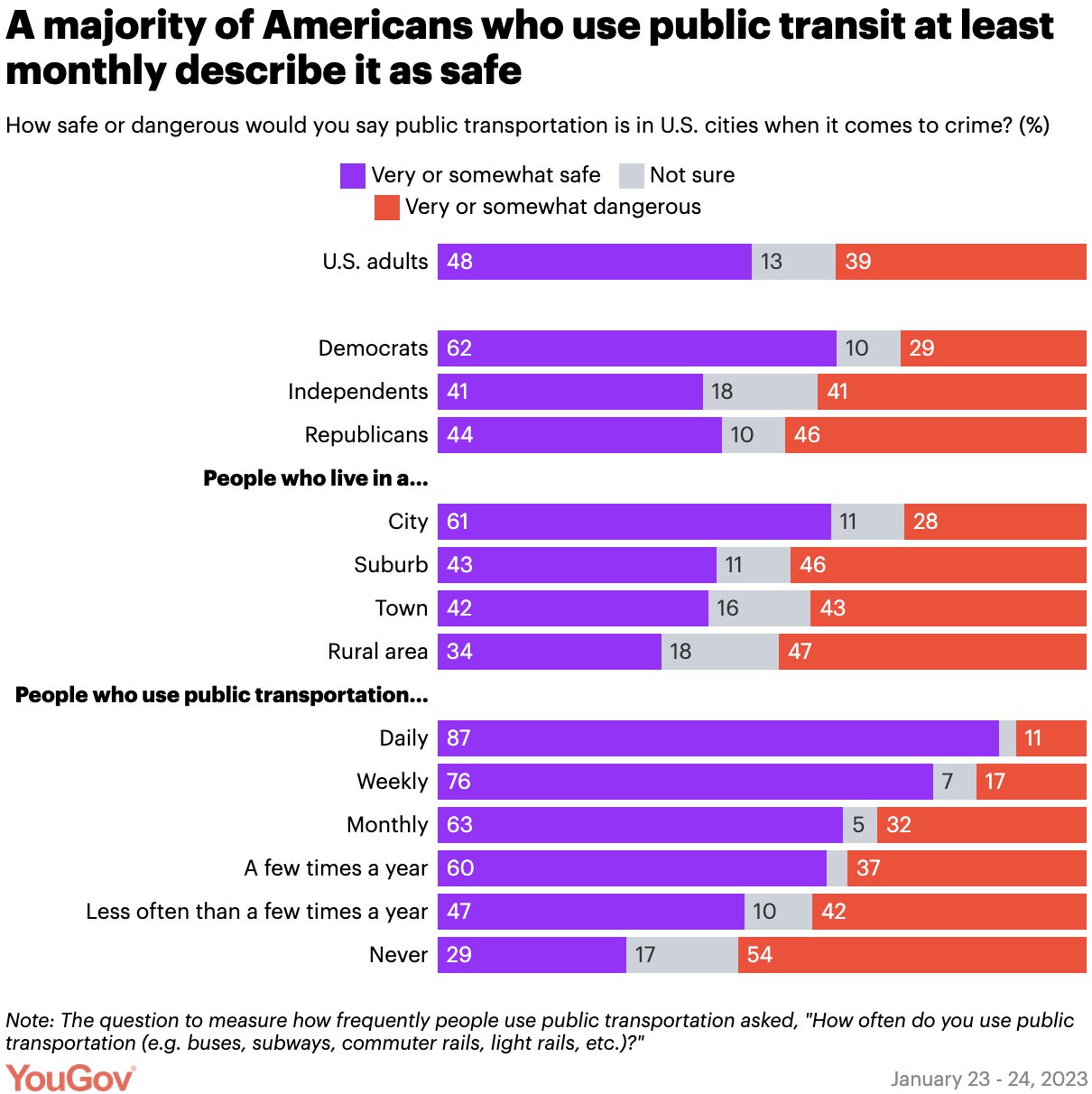
That’s fair - and I don’t disagree with you on that; investing in things that make bus-riding and driving safer definitely doesn’t hurt. But even then, I think the perception of safety goes beyond whether you are safe - or, in other words, everything can be okay for you as a bus rider, yet you can still feel like you’re in danger.

Click here for some additional thoughts and cool data.

As a matter of principle, I don’t like to dismiss people’s feelings even if their views don’t match the data. Sure, you’re around 28 times more likely to die as a car driver than a bus passenger (you could un-normalize that data using the numbers for billions of passenger-miles traveled in 2023 if you’d like). But despite this, there’s a big self-selection bias around perceived public transit safety based on if you already ride buses.

If you start asking why people feel too unsafe to take buses, I’m sure some people will mention obvious crimes that happen onboard (e.g. sexual harassment, drug use) - but if I weren’t a broke graduate student, I’d bet real money that a larger share of complaints would be about legally murky “antisocial behaviors” like people playing loud music from their phones, arguing with profanities, or smelling offensively bad while on board buses.

I know this is a common right-wing talking point, but more respectable outlets like the pro-transit think tank TransitCenter, Governing Magazine, Jarrett Walker’s blog (the transit planner who also consulted on GoRaleigh’s route redesigns), and this academic paper from the US Dept. of Justice recognize this as real problems, too. Plus, even in seemingly-unrelated places like this paper on barriers that people with disabilities face for using public transit, the idea of rudeness (in part of drivers or passengers) does come up as a subtle theme.

Besides, just look at the threads on public libraries or homeless people around Moore Square. Actual safety is a real concern in those places, too, but that’s not what drove the strong opinions behind those posts - and it’s those sorts of opinions that I think is relevant for the R-Line.

Yeah, absolutely. But I read the original question as an ask for ideas that the city could take (and measure results) in the short-to-medium-term that doesn’t demand massive, new investments right away.

Click here for some additional thoughts.

Raleigh Transit Authority advisory board members serve in two-year unpaid appointments, and I don’t want to blindly assume that Leo wants to serve multiple terms. So if we want our community to get things out of Leo’s work in a decent timescale, I don’t think it’s reasonable to just wait things out for 5~10 years - at least, as far as his goals are concerned.

Maybe this is pessimistic of me, but I don’t think I could convince most of my friends towards this point if I tried, and I’m having a hard time imagining that I’m in the minority. I could maybe make the case for taking buses to a small fraction of nighttime events or weekend bar crawls, but I’m not convinced that it’ll translate to any lasting changes in daily habits - and that’s what really matters, right?

To your last point, downtown Raleigh sorely needs bigger, longer-term infrastructure improvements like new sidewalks outside of downtown, more crosswalks, slower car traffic, traffic signal priority, and maybe even exclusive bus lanes beyond those for BRT. But, again, those things take time and money - not exactly something you want in tactical urbanism.

Wait, really? That’s news to me :eyes:

Even if that’s true for undergrads (especially if you live on-campus), that’s definitely not the case for us graduate students.

For those of y’all who didn’t know: the minimum guaranteed stipend for PhD students doing research for pay at State is $20,000/yr, which translates to like $9.62/hour. Try to convince me that you can survive a car-dependent lifestyle with that kind of paycheck :upside_down_face:

1 Like

I’ve had two experiences on transit I consider truly shitty, in all of the riding I’ve done. One of which was at Moore Square, the other was in Miami. However I realized later that none of the bad things I experienced have truly felt aimed at me. I did not feel like my physical safety was threatened, more that someone was self-harming near me. I talked with my partner about her experiences on GoRaleigh, and she had a similar realization. It’s hard to be around people self-harming, but at the same that’s more an argument for support and care towards the people, than law and order.

Here’s the thing, I don’t think any amount of special branding for the R Line or other changes will shift the wider perception at all. At most we might end up a few extra people taking the R Line. Is that better than increasing the frequency on a different route that’s at or near capacity? I haven’t seen an argument for the R Line I find compelling.

I don’t think I could either. Isn’t that a bad sign? Our existing riders should be our best champions. Then again I don’t think I look like most GoRaleigh riders but I use that statement to encourage us and be guided by our existing riders. Not people who are mad at traffic or parking.

I heard that from someone who should know but I don’t know if they understood the technical limitations of our existing readers and they didn’t want to replace those. It was also my understanding that it would be GoRaleigh going it alone, which doesn’t sound like it would actually happen. Discussions? I believe so. actually going to happen? :woman_shrugging:

3 Likes

Sure, those are factors. But aside from the R-line, what’s also a factor in GoRaleigh is the deplorable riding conditions outside of downtown. Bus stops with no sidewalks to get reach them. Bus stops with no concrete pads to stand on while waiting. Bus stops with no seating or protection from rain. Despite all the talk about transit, these barriers to using the bus haven’t been addressed sufficiently.

3 Likes

Yeah the main problem is the constant changes to bus routes. If there was a requirement that all routes needed to exist for 10 years, that would better resolve the shelter and sidewalk issues. The money is there, the strategy is not (maybe I’m wrong).

This seems to be the excuse when stuff like this is brought up in meetings that I attend at my job.

3 Likes

That’s a dumb excuse. Most of the routes in service have been around for 20 years at least, maybe 30. Especially the ones now being upgraded to 15-minute frequency. I really doubt routes like the 1, 2, 4, 5, 6, 7, 8, 11, etc. are going away anytime soon.

If the money is there, sidewalks, benches, and shelters are a must. At least on the inbound stops.

3 Likes

No, GoRaleigh has both the money for signage for new/changed bus stops (25% of them will have shelters etc., set aside for bus stops that are used more often) and a plan to prioritize where they’ll be placed.

To be fair, this does bring up a bit of a chicken-or-egg dynamic, since the city will only prioritize amenities for bus stops that are already being highly used, but what we’re trying to say is that those extra amenities are needed in order to improve bus ridership.

2 Likes

In other words, they’ll use the money for stops that don’t necessarily need the visibility.

“If they come, we’ll build it.” - backwards thinking

3 Likes

In all fairness, this does guarantee that bus stop amenities are being built in places where they’ll be used by more people.

…and beside: we, the general public, don’t exactly reward city governments for thinking outside of the box and taking risks (at least, we don’t do it in ways that affect city staff as much as when we blame and criticize them for getting things wrong).

I agree that it’s backwards - but also, this isn’t limited to bus stops; that’s a problem with local government in general.

5 Likes

I agree with this. I used to ride the South Beach local bus. It simply ran a clockwise and counterclockwise route around South Beach for a quarter or 50 cents. I can’t remember which it was, but that’s not the point. In any case, they started messing with the route, then they switched to a trolley system (which is fine), but they really started messing with my mind when they decided that there would be multiple routes of it just in South Beach alone. Now when a Trolley comes along, I have to know which route is which, and none of them are simple. They are complex and wind in and around South Beach and may or may not take me close to where I want to go. Despite the Trolleys being fare free, I avoid them because their routes are too confusing.

1 Like

I forgot that Cary recent launched their “R-Line” does anyone know how it’s doing?

2 Likes

I didn’t know that was a thing. I’m intrigued.

1 Like

The GoCary DL: New GoCary Downtown Loop Service Begins June 1st | GoCary

Operates every 25 minutes, from 12-10 on Thursday/Friday and 8-10/9 on Saturday/Sunday. No service the rest of the week. The map is kinda hard to read with the one-way loops: https://gocary.org/sites/default/files/brochure/gocary-rt-dl-info-sign-june24-prf2.pdf

I can’t find GoCary data broken out by route, but it only started operating in June, so might not be available yet. I’m curious how the feedback goes. I think it’s probably more to make downtown businesses happy than to be useful transit, but that’s my hot take and what a lot of Urban Circulators are.

4 Likes