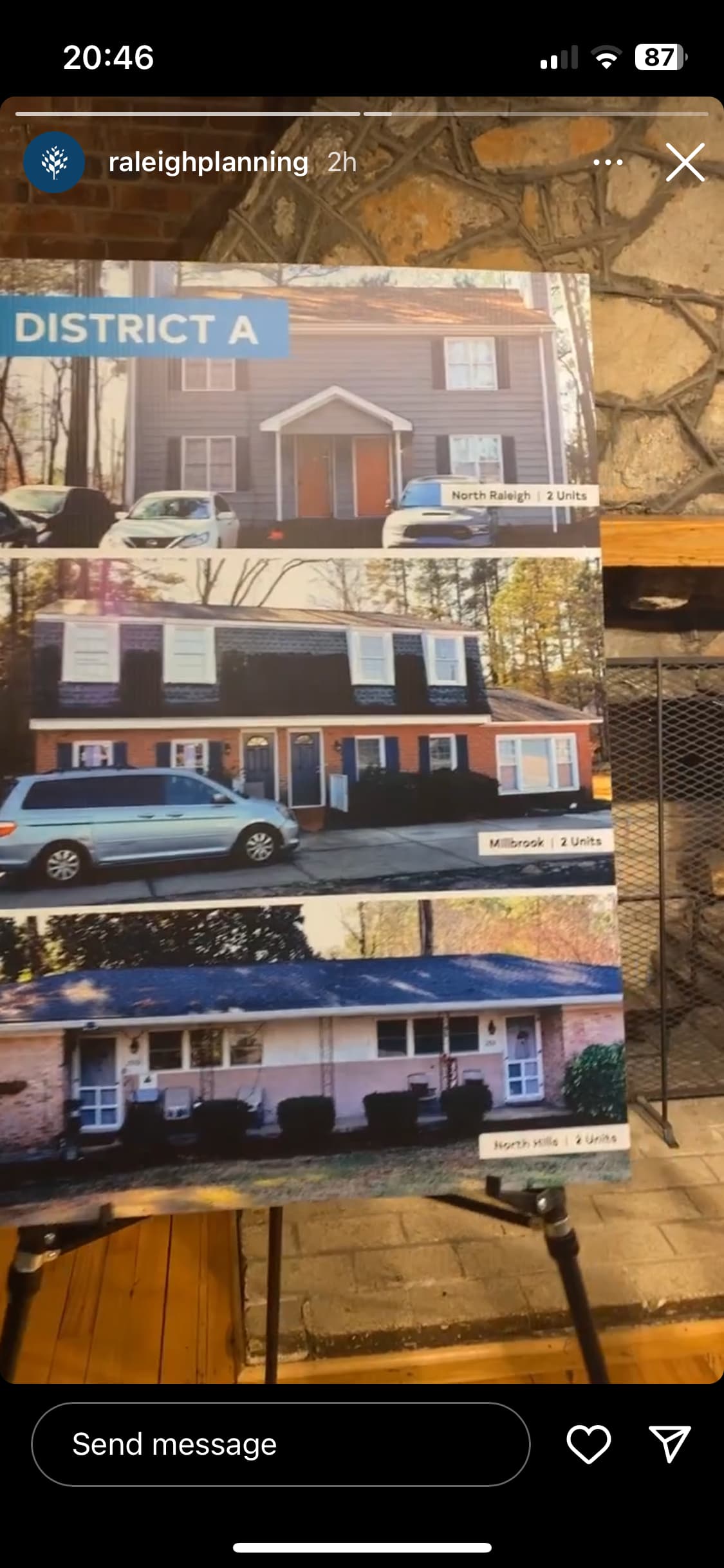
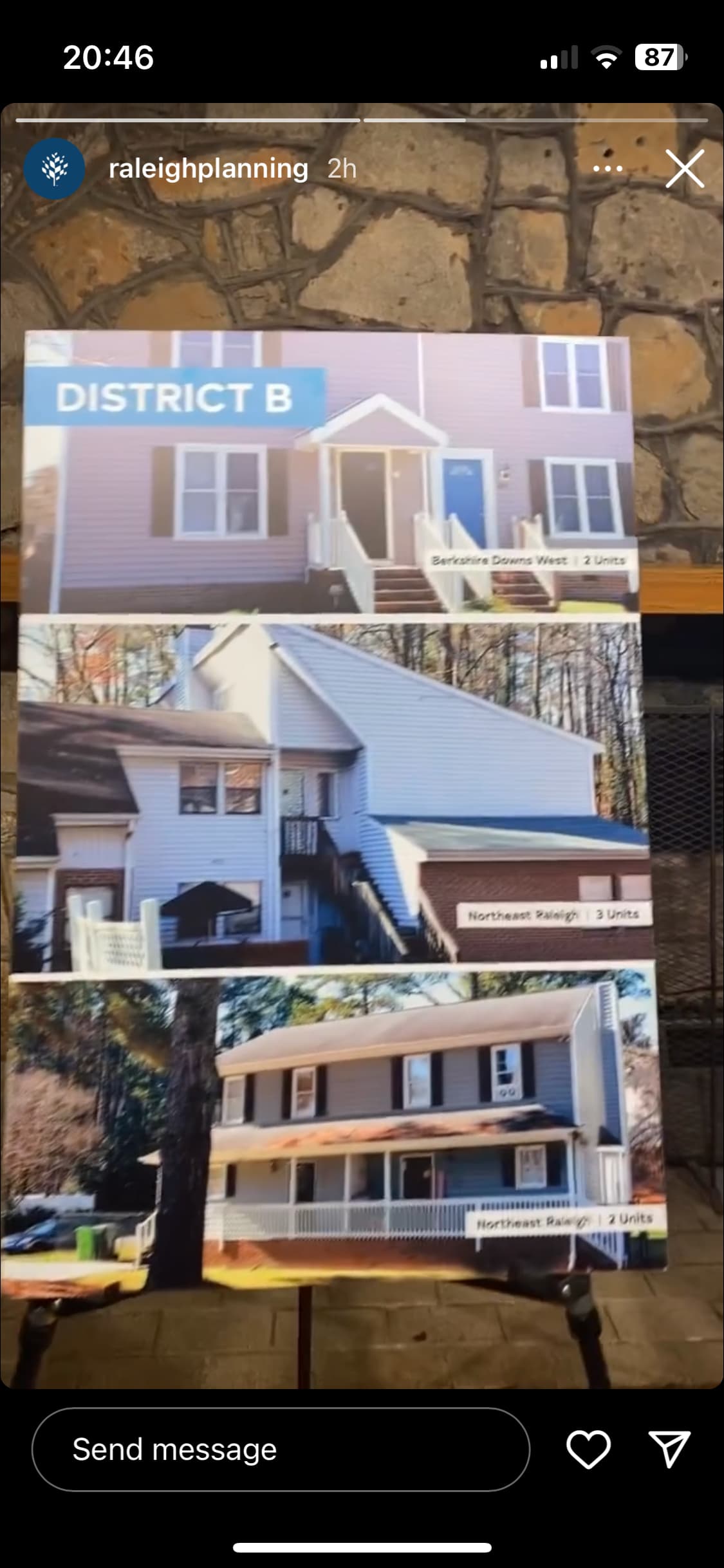
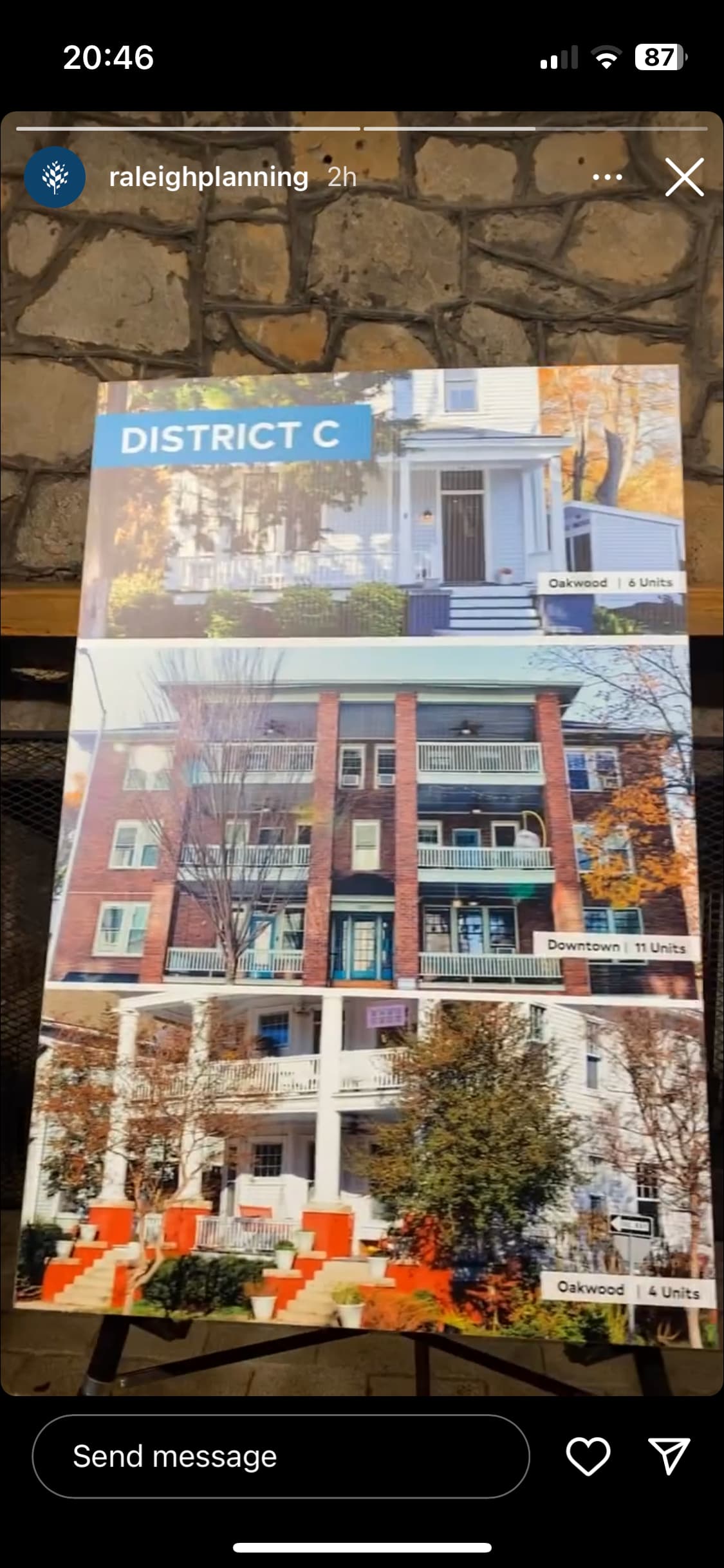
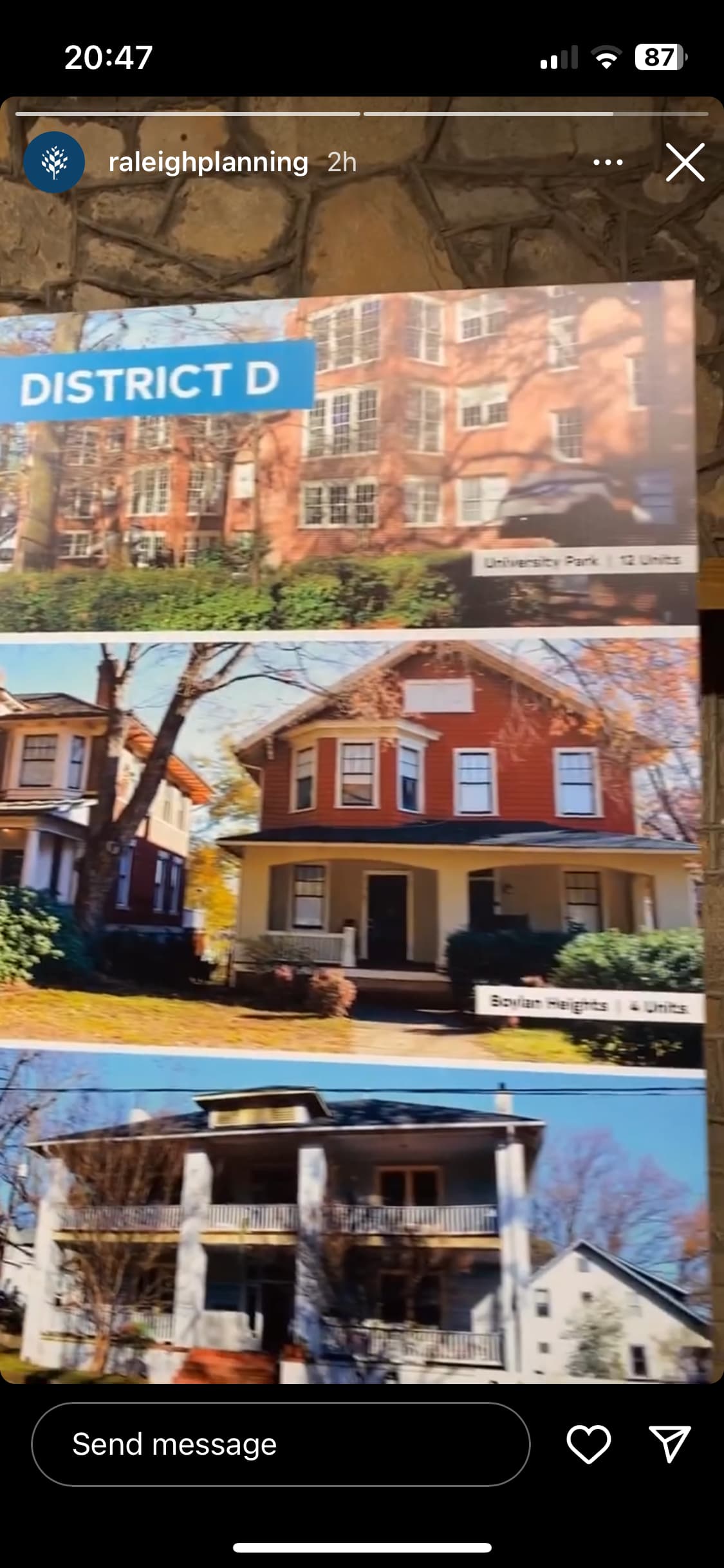
Wasn’t able to make it to the meeting so I’m just screenshotting from what they show on Instagram, but I really like the way they’re approaching this. Using examples of existing (and mostly quite charming, unassuming) missing middle buildings in each council district that would be illegal to build today without the new text change. I think this helps make missing middle more approachable and less scary to those who aren’t knowledgeable about what it actually means, but I’m sure there will still be plenty of people screaming about density and shadows nonetheless. Anyone able to attend tonight’s meeting to report back on how it went?

15 Likes
Exhibit A, from the article:
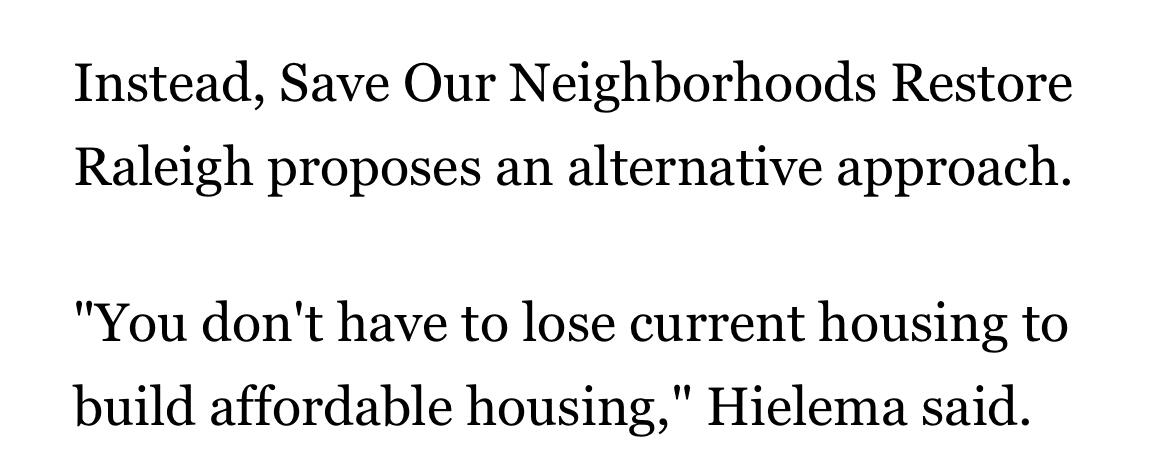
That’s a slogan not an approach, and it’s disingenuous of the article to portray it that way.
14 Likes
Here is the city’s presentation on missing middle housing and it’s a great resource to reference. It has all the efforts the city has done (ADUs, flag lots, townhome changes, etc.) describes each one and shows a map of impacted areas around the city for each one.
There’s also a slide, slide 22, saying that housing price does filter down so older homes are naturally occurring affordable housing. The takeaway it seems would be that decisions now matter decades from now and it sure is a long-term game we need to play.
19 Likes
I don’t see a problem. This is the future of density.
Haven’t seen any of these before: a “flag lot subdivision” (lot split) application to build on a backyard on Oak Road in Carolina Pines:
Existing lot is 0.19 acres in an R-4 (i.e., once 1/4 acre lots); new lots are 0.11 and 0.08 acres. New lot can only have a “tiny house” (<1200 sq ft).
Also for @ADUsSomeday, a Freq Transit Area application for a duplex on Milburnie behind Enloe:
Looking at the site plan, it might’ve been a good candidate for your idea of moving an existing house onto a new flag lot; the existing house is <1000 sq ft.
A cottage court on Blue Ridge near Glen Eden: instead of six McMansions with garage snouts around a cul-de-sac, there will be 9 houses surrounding a 1/4 acre green
Interestingly, this is by a larger local homebuilder which has done a lot of teardowns. They have a conventional, front-loaded R4 subdivision across the street where houses are pre-selling from $1.6M; will be an interesting contrast to see the pricing on the cottages.
5 Likes
Wow! This is really interesting there is already a duplex under construction at 716 Brighton.
1 Like
The thing is, what is called “naturally occurring affordable housing” is usually:
- an older home or apartment, built at least 50+ years ago
- that has been a rental for the past 20+ years
- that has not been renovated for the past 30+ years (just putting paint on the walls doesn’t count)
So, sure, keeping that kind of “run down property” will always be more affordable, even if a house the same size was being rebuilt today.
Old houses that have been properly maintained and updated will keep their value (and benefit from the land value increase as well).
3 Likes
A well-maintained unit in a 40 year old building that was renovated 10 years ago, will still not rent for as much per square foot as a unit in a brand new building. For SFH, new consntruction commands a premium over resale, all else equal. For new construction to help affordability, something more is needed.
What helps affordability is when you take low (or zero) density stuff and build high density. It is unfortunate when zoning regulations severely restrict where and how much multifamily can be built. Eg, when you wind up tearing down the 40 year old 100 unit building to build a new 200 unit building because that’s the only place you can do it.
It would be a much bigger win for affordability to leave the old 100 unit building in place and let it filter down for a couple more decades, and instead tear down the 10 SFH next door to build the new 200 unit building.
7 Likes
A policy analyst says “Naturally Occurring Affordable Housing.”
An accountant just calls it “a fully depreciated, fully amortized asset.”
Your great-aunt calls it “this rickety old house was paid off years ago.”
14 Likes
Basically any time a single family structure is demolished and replaced by a large multifamily one, it’s a win for affordability on a regional (though often not hyperlocal) scale.
However, re what the accountant says above:
I am sure you understand real estate and asset management better than I do, but that is a cliff-like simplification of depreciation that can be confusing. My understanding of depreciation is that the amount something depreciates is supposed to be the amount of money you can expect to invest in maintenance over time to keep it in servicable condition indefinitely.
If you are actually maintaining a building, you may fully amortize the initial investment, but it will never fully “depreciate” because you are continually reinvesting in it through maintainence.
Eventually the value of the land under the building will appreciate to where an older, smaller structure is no longer a worthwhile use of the capital tied up in the land - but even then, the lower hanging fruit for redevelopment is the land developed at lower density to begin with.
If your land use regulations create a condition where it makes sense to maintain older, larger multifamily buildings for 50, 75, even 100 years, while still allowing plenty of opportunity for redevelopment of lower-density (Mostly old SFH) into higher density multifamily, then you are probably on the right track when it comes to affordability.
3 Likes
I agree with you guys. Just pointing out that those advocacy groups solution is basically “do nothing”.
And sure if you have a simplistic view and you just look at the raw numbers, if a developper buys a tear down property for 500k and builds 2 townhomes that sell for 1M+, this is less “affordable”. But creating affordability is not the goal #1 of missing middle.
I’m sure there is some jealousy there where some folks see it as easy profit. In the mean time they don’t seem bothered when a SFH is replaced by a bigger SFH and it’s happening all over five points and Hayes Barton constantly.
1 Like
Went to the Missing Middle meeting in Five Points last night. Staff had these pictures you posted on boards and tables for information on affordable housing. Hardly any of the ~100 attendees looked at either. Most were just there to loudly complain, and there were a handful that were literally yelling from the back of the room while staff were trying to collect feedback from the rest of the people at organized tables. I did hear someone from across the room shout back at them once to ‘shut up’. A number of the attendees also, unironically, referred to Hayes Barton as their ‘urban neighborhood’ while decrying anything other than their large-lot SFs. So the meeting went about as expected.
To @Vic 's point, there was one person that did point out that large, 3-story McMansions were going in across the street from her and pointed out that a duplex/triplex/quad weren’t really much different so they shouldn’t immediately be dismissed.
7 Likes
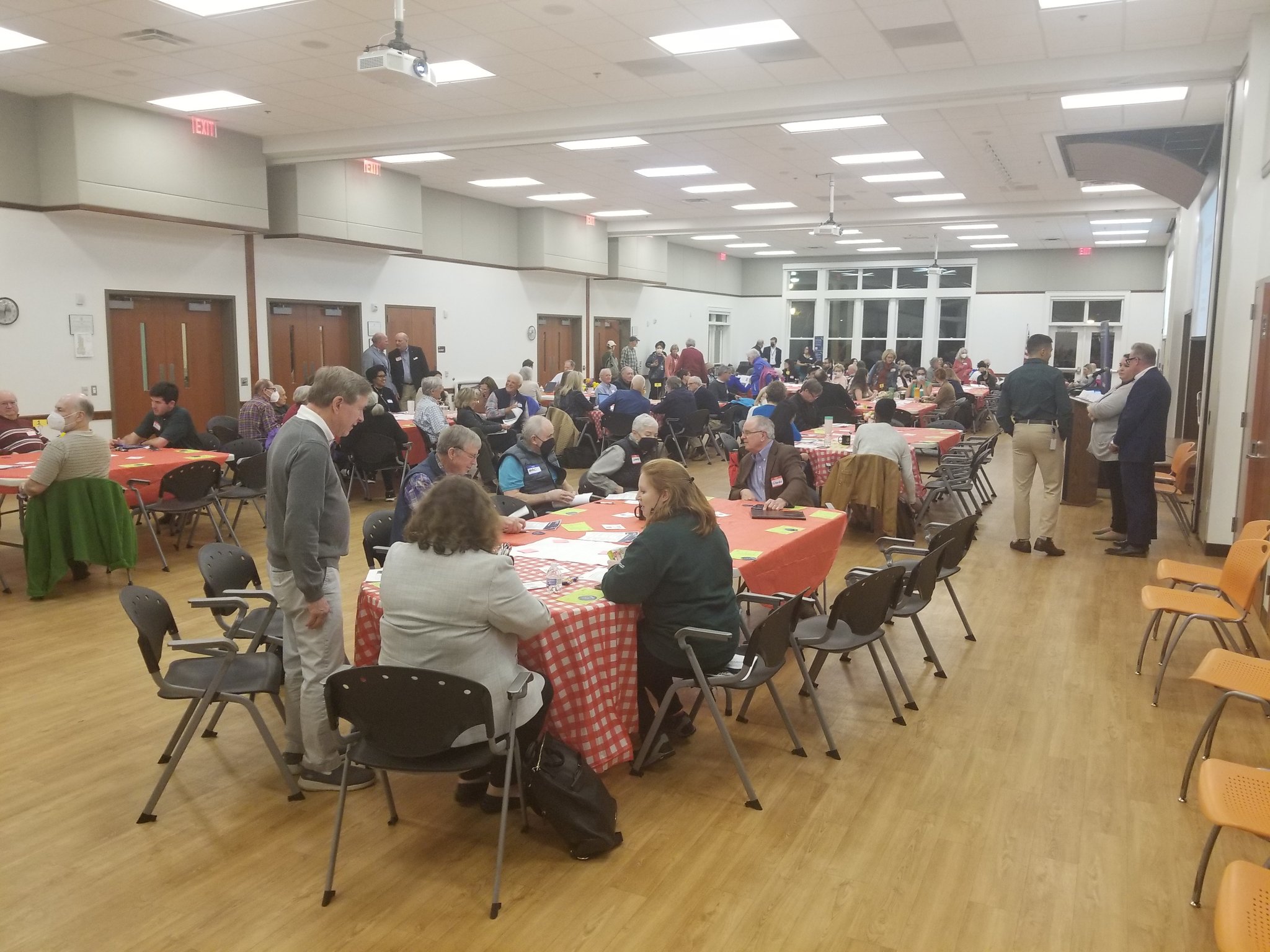
The funny thing about 908 Williamson is that the existing house was bought for 3.7 million and they plan to sell each townhouse for 2 million so it’s actually more affordable  . But shhhh don’t tell them that!
8 Likes
It’s helpful to think about the stock market as a housing proxy.
In order for a stock price to fall, there have to be more sellers than buyers. You may have someone selling 100,000 shares at $100, but if there are over 100k shares worth of buyers at $100 or more, they will sell into those buyers, which will absorb the selling and do nothing to the price except support it and make the next viable transaction at $101.
Most homes in Raleigh are existing. I’d be curious to know what the average age of homes are in Raleigh, but I’d guess that it’s at least 30 years old. What has happened to the value of those homes over the last 3 years? We all know they have increased 80-120%. A 1:1 SFH tear down and replacement simply takes away 1 share of common stock and replaces it with 1 share of premium stock. What we need in Raleigh is a stock split. We need to sell shares that don’t yet exist in the open market. For every housing transaction that takes place outside of the existing shares, regardless of price point, removes one buyer from the open market where everyone is competing for the same shares, and allows the price to fall by that degree.
Buyers vs. Sellers.
Of course there are other factors, like investors buying houses, induced demand for relocation (relatively affordable housing market creates demand from other locations), and such… Not the greatest analogy but I like thinking of buyers and sellers in terms of a stock market because the price of the underlying stock is solely determined by that balance against inventory.
2 Likes
Brentwood West Apartments - 3800-3839 Brentwood Rd Raleigh, NC | Apartments.com i dont know when these were renovated but they are much different/nicer than the early 80s. 2 Bedroom$1,269
Wow. This quote from that meeting.
“We’d like for the missing middle to go back to being missing again,” said Elaine Gordon.
https://www.newsobserver.com/news/local/counties/wake-county/article271409047.html
5 Likes
Reading that article almost made me vomit.
Unless these sessions are representative of different residents with different needs, they are all just going to be boiled-over, in your own bubble events.
4 Likes
It’s really a ‘no thanks, we’re full’ approach guised under a neighborhood character argument…
The horror of $2MM townhomes here reducing quality of life is beyond laughable. Of course, there’s little ‘naturally occurring’ affordability in Hayes Barton and it seems beyond disingenuous to frame this particular discussion around anything other than evidence of folks’ difficulty adapting to change / density, regardless of demographic.
Councilor Jones is gonna have a fun cycle trying to balance all the hullabaloo at both ends of the spectrum in that district. Just imagine if there was a real program to develop ‘affordable’ housing in every district across the city that had teeth — you’d really begin to see people’s true colors 
11 Likes
Another problem is that people will generally attend meetings and speak out if they are against something. There will be a lower turnout of those who are less involved if they don’t have an opinion or are for something. So these meeting are not the accurate representation of the entire city and even neighborhood in some terms.
I hope the city councilors keep in mind on what they campaigned for and stick to that when they work. If they won while campaigning for missing middle, then they should advocate for that. A few vocal few are not the majority.
On a separate note, if there’s arguments about the cost of housing, then let’s build public housing in these areas where complaints are made. I’d like to see Hayes Barton’s reaction when public housing is put there. In either case, then we are sure that affordable housing is built.
Why aren’t they complaining about $5M houses being put up?
5 Likes