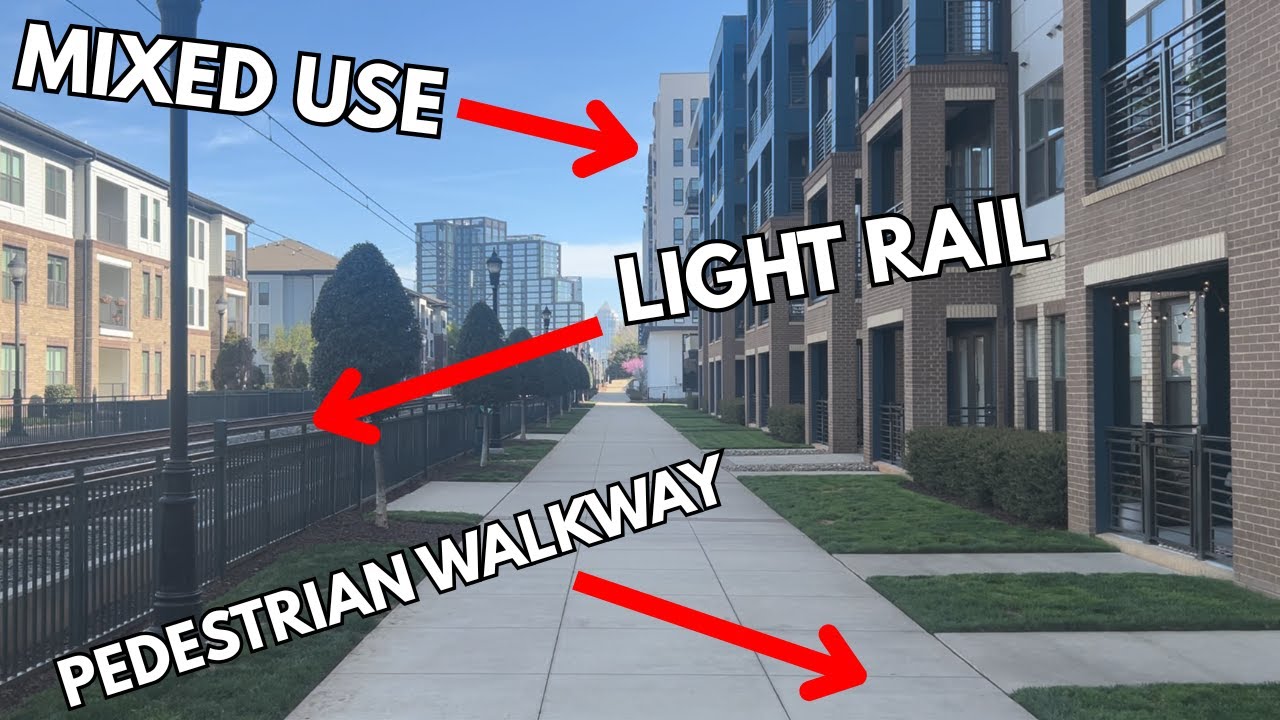
I watched an urbanist YouTube video about Charlotte’s recent growth and the creator brought up a really good point that I had not considered.
He argued that while high-rise buildings look great for the skyline, they run the risk of stagnating growth. In essence he suggested it’s better to have every plot developed even if that means mostly 3-7 story buildings rather than a dozen or so high rises surrounded by vacant or under utilized lots.
Take the Pendo building for example, 20 story building next to a vacant lot. or Skyhouse even. 20 story building, again, next to a vacant lot. (obviously I know there were proposals but they fell through: further supporting his point.)
And before y’all come for me, I wish every property in dt+ had a 12, 20, 30 or 40+ tower on it; but that’s (probably) decades away if we’re lucky and I would really like to walk around an urban Raleigh before I’m too old to walk at all. (said humorously)
Here’s a link to his video. Skip to the 4 minute mark if you only want to hear that segment but I highly recommend watching the whole thing!
You can’t have every single plot of land with a 20 to 40 story building on it, but there are definitely key sites that should be slated for taller construction.
Raleigh is already NOT Paris or Washington, DC, and our downtown footprint is tiny & surrounded by NIMBY single family neighborhoods. The parcels that have been rezoned higher are clearly the right places to build higher, and the proposed rezoning across the street from the Peace St. Publix is another one that makes sense.
While I’m happy that there are hundreds of housing units at the greater Platform area, I do think that it would have been a better development if part of that site was zone higher instead of being just full block 5 over 1s. Likewise, this triangle shaped parcel would be best if it was a mix of heights among a few buildings, with internal and external “sidewalk” activation.
I don’t really understand what a cities smaller footprint has to do with having low rise, dense development? Charleston for example is small and dense with a low rise downtown, but it’s way livelier than DTR. NIMBY’s would love low rise. I’m all for development, short or tall, but street activation is what makes a city work and feel vibrant. Not a skyline.
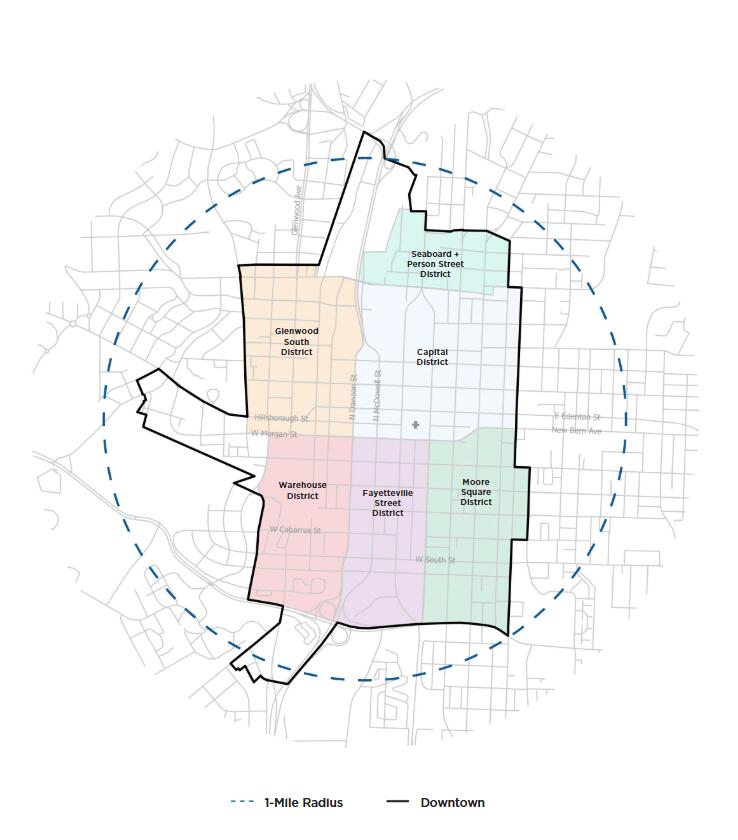
Cities like Paris, and DC to a certain extent, have much/most of their land area available for higher density development. Raleigh’s downtown boundary is barely a square mile. That’s not a lot of area to work with in the core, and much of downtown proper is surrounded by single family neighborhoods who not only resist densification in their neighborhoods but constantly work to restrict densification and height in downtown proper near them.
As for street activation, I couldn’t agree more. However, street activation relies on feet on the ground. There are two ways to get those feet. 1) drive people in & 2) have more people living in the immediate walk shed. The problem with the first option is that folks who drive in to downtown aren’t doing it every day. It’s heavy on festival weekend days, and both late Friday and Saturday nights. That sort of activation shapes what is and what isn’t viable in our retail storefronts, and it’s why downtown is covered with cheap bars that largely stay empty except for weekend nights and special occasions. That isn’t to say that having such establishments is bad, but there are just too many of them to make progress in activating the sidewalks during the daytime and on weekday evenings.
Option 2 provides more feet on the ground to activate the sidewalks in a more robust way with residents accessing services and retail by foot by day and weekday evenings. Combined with folks who also come into the city for special events, etc., it paints a much more successful urban experience. To that end, Raleigh needs to identify key areas where we can densify strategically to support that second vision, and it’s done so with rezonings that are starting to bear fruit like at the creamery redevelopment. Another key reason to rezone and go higher is to provide more residents at walkable locations to proposed transit stations. We need to be pursuing transit and creating demand for it at the same time.
There are many office/government buildings on Fayetteville St that have massive lobbies and little to no street activation. I ultimately believe that development energy will eventually move eastward from Glenwood South and the Warehouse district, resulting in the possible remodeling of office towers into residential buildings and adding commercial space along Fayetteville St.
Most developers do not want to fight the nimbyhoods surrounding DTR. We have seen how they lose it over a few townhomes.
The true difference in population density by building type was eating at me, so I spent (wasted) my morning running the numbers. I compared 3 different buildings in Raleigh that I felt were pretty good examples of their type: The Metropolitan for 5-over-1, the Alexan for true mid-rise (6-9 stories with no central parking deck), and the Maeve for high-rise with a podium.
The Metropolitan
1.83 acre site
5 floors, all residential
241 units
141 1br
100 2br
341 total bedrooms
186.3 bedrooms (people) per acre
The Alexan
0.91 acre site
8 floors, 6 residential
187 units
134 1br
53 2br
240 total bedrooms
263.7 bedrooms (people) per acre
The Maeve
1.1 acre site
20 floors, 19 residential
297 units
204 1br
90 2br
3 3br
393 total bedrooms
357.3 bedrooms (people) per acre
So yes, there is a clear difference between the population density high-rises can provide when compared to a 5-over-1 (91.7% increase). That advantage of a high-rise is much less impressive over a mid-rise though (35.5% increase).
Here is the really interesting thing though. Let’s do a comparison to Manhattan. ChatGPT give the average population density of Manhattan as ~112 people/acre. For context, the area of DT Raleigh according to the DT Raleigh Alliance map is about 1090 acres, which at Manhattan densities is 122,000 people. That is about the population of the city of Wilmington. Accounting for the fact that the average downtown is about 1/3 streets by area (also from ChatGPT), here is the percentage of developable land that would need to be turned into each building type to reach Manhattan densities:
5-over-1 => 90.6%
112/186.3 = 0.604
0.604/(1-0.33) = 0.906
Mid-rise => 64%
112/263.7 = 0.427
0.427/(1-0.33) = 0.64
High-rise w/ podium => 47.2%
112/357.3 = 0.315
0.315/(1-0.33) = 0.472
My takeaways: You can absolutely build an incredibly dense urban environment with only mid-rise buildings, even in a place like Raleigh. Having high-rises helps, especially if they are taller than 20 stories, but they are not necessary. Texas donut 5-over-1s won’t get you there and are more of a fit for high-density suburban node type development (North Hills, Village District, Fenton). Ultimately, most actual cities will have a mix of all of these types plus town houses and garden apartments, which is great for giving more choices of home types while staying within the urban form. I will never turn down a high-rise building, but I will also continue to celebrate mid-rise buildings. Especially when they replace undeveloped urban land.
I’d say Charleston, SC wants a word with you. It’s not exactly a model city for long-term sustainability, especially because its economy leans heavily on tourism and they make development very challenging, but its pattern of dense infill has created countless corner stores and small businesses that thrive without being buried inside massive commercial centers with high foot traffic (that’s the missing middle at work).
In Raleigh, we’re starting to see the same trajectory. More developers are adding higher-density housing, and the natural next step is the rise of neighborhood-scale retail, which in turn supports even larger and denser projects. An early sign of this progress will be when neighborhoods begin to notice more on-street parking, an indicator that density is doing its job!
None of this transition happens overnight either. It’s the kind of slow incremental change that unfolds over years, even decades - but projects like the DMV redevelopment, Exploris school, and others are nudging Raleigh in that direction. I’d argue with most anyone that they could find any credible data suggesting that the missing middle isn’t fundamentally strengthening the city’s growth.
Creating data is clearly not a waste of time in my book, and I really appreciate the effort.
That said, your highrise number is baseline because you are counting a 20 story building. How many more units can one get at 30 or more floors? We’ll soon find out one example with the delivery of The Creamery tower and its 306 units. I can’t find the exact breakdown of units, so I didn’t even try to figure out exactly how much land area is being developed for this tower.
I am not claiming that missing middle isn’t contributing. We will not and should not have a city filled with just towers. I thought that I was clear about that, but perhaps I wasn’t?
Saying we should strategically have locations for towers isn’t an attack on missing middle or lower/mid rise multifamily housing. It’s about balance.
As for cars on the street, and while they are an indicator of densification happening, I would hope that we could find ways to grow the housing faster than the demand for for parking by putting more and more people into the walk shed of active retail/services corridors.
Glad that people are finding this interesting! I pulled the number of bedrooms for each building from the ASR, it very helpfully gives both the site area and the number of each unit type.
I was wondering the same thing vis-a-vis taller buildings, so I looked at Creamery, 330 W Hargett, and Vela, among others. Vela was shockingly high density, while Creamery came in a little lower than expected. Vela is 524 people/ acre, Creamery is 431 people/acre, and 330 W Hargett is 426 people/acre.
I sampled 10 buildings of various heights in Raleigh, which is by no means comprehensive, but enough to project a rough trend. My data suggest that, on average, a 30-story building will have 14% higher density than a 20-story building, while a 40-story building (warning: extrapolation) will have 24% higher density than a 20-story building. Overall, you start to see diminishing returns as you get taller, my assumption is that taller buildings need more premium and therefore larger units to make up for the additional cost.
To get 25,000 people living in DTR, we’d need an average of about 33 ppl/acre but those 755 acres includes all of the roads, parks, municipal buildings, businesses, etc. that don’t have any people living in those places. I’m not sure how much (%) of Raleigh DT core is available for housing, but I wouldn’t be surprised to find out that it’s only 10 or 15% of the total land area once you take out all of the business, government, parks, roads/infrastructure, uses etc.
Clearly parking becomes an issue in how much land is used for a residential project. A tower built on top of the parking instead of next to it is going to pencil out at a different density than one that’s sitting beside it.
curious here….basic google search states, “A 2024 RaleighNC.gov city profile listed a lower median household income of $75,424, while other sources provide different figures,….” where are the ‘median’ people moving into? existing SFH stock? townhomes out near Triangle Town? median cant afford downtown can it? is the stock and density of ‘housing units’ entering downtown creating more housing for a few while still sedning the ‘median household income-rs’ to Knightdale or somewhere?
I got the downtown area as shown in the DRA State of Downtown report to be about 1090 acres when I measured it in Google Earth, so that is what I’ve been using, but I’m not claiming it as the definitive boundaries.
I did my best to estimate the land uses in those boundaries using google earth, and I got it’s about 5% railroad RoW, 3% park, 10% government owned of any kind (state, local, etc.). If you conservatively estimate that roads and the corresponding RoW makes up about 40% (higher than ChatGPT guessed, but it does contain big interchanges for MLK and Capital), that leaves about 42% of the land or 268 acres. That is the area for all other uses, both commercial and residential. At this point I just started making up numbers. Say that half of the remaining area (229 acres) is residential. You could get a downtown population of 50,000 by covering that land in 6-7 story mid-rises. To get Brooklyn level density, you would need that same area to be all 10 story buildings.
I don’t really have a specific point, other than I think 50k people within a mile of downtown is eminently achievable without covering everything in skyscrapers. Maybe that’s naive, but according to DRA there are already 20k with 10k+ bedrooms in currently under construction or proposed projects.
Raleigh controls the water & sewer for all the towns except Cary/Apex. If it isn’t in Raleigh’s financial interest (site contiguous to existing inside City tracts) they most likely won’t annex it. If large development they might. If Raleigh would have to provide water/sewer/fire stations/garbage then it’s debatable if it is worth it for smaller tracts. Raleigh can annex areas and not be responsible for the streets. There are areas like Carolina country club that is inside the city that the City annexed but didn’t take over the maintenance of the streets since they were not built to City standards. The patch but never resurface and/or add curb and gutter. Now they make you ask to be annexed and Council with staff advice can say no and you can connect to water/sewer with no city taxes but charged outside rates and those rates are double the inside rates with no trash/fire service. There are areas that have City water service only like Springdale Estates but are on septic. If you are outside better take care of that private well & septic.
Correct. If you have existing well/septic and there are public water & sewer in ROW, you can connect if you want but don’t have to. You will still be charged City taxes. Those connection fees go up every year! But you have the ability to connect if well/septic fail.