I am not being disingenuous… it’s just that you (and Jack) are taking the word “want” too literally because I assume it fits your narrative not to agree with me. Nevertheless, the point that you are missing is that people ARE moving to the Wake County suburbs at a higher percentage rate than moving into Raleigh (not just downtown Raleigh). You can make your own assumptions as to why that is. I am willing to listen with an open mind as to why you think it is happening.
2 Likes
I personally would not want to live in burgs. I prefer either city center type location (would not be oppose to North Hills but prefer bigger) or out in country side as I live now. Center city appeals as lot’s of activities within walking distance and not a lot of responsibilities (such as repairs and cutting grass), or county side where do not have nosy neighbors or HOA telling me what I have to or can not do. Maybe just my bias being I’ve never lived in burgs. I have lived in city centers but now where can not see neighbors.
3 Likes
Does anyone know of any good unbiased sources for info on housing preference by age?
If you believe the National Association of Homebuilders, millennials actually want to live in detached SFHs more than boomers do, and with more square footage and more rooms. http://www.nahbclassic.org/generic.aspx?genericContentID=249797&channelID=311
The majority of buyers (65%) would like to buy a single-family detached home. A majority of buyers in all generations have the same preference: Millennials (68%), Gen X (72%), Boomers (63%), and Seniors (55%).
Millennials and Gen X’ers want over 2,300 square feet; Boomers and Seniors less than 1,900 square feet.
About half of all buyers want a home with three bedrooms, but 30% want at least four. Over 40% of Millennials and Gen X’ers want the latter, compared to only 20% of Boomers and Seniors.
The NAHB seems to be primarily a lobbying group, so it’s safe to assume one would need to take anything they say with a grain of salt. However, I wasn’t able to find much information about their stances except that they are against federal regulation. Obviously they are pro-building, but building what I couldn’t confirm. Do they represent large MFH developers, and lobby for relaxed zoning? Or do they primarily represent SFH-builders, and actually want to keep or increase SFH zoning (but with more lot splitting so they can build more SFHs)?
1 Like
I’m not a fan of the burbs by any means, but plain and simple economics is that your housing dollars go a lot farther if you are not in the city center. When you have a limited income (as do we all) and responsibilities to take care of, you have to make the most efficient use of your funds. Living in the burbs allows money to spent supporting my family, even if it means giving up my personal dream of living in an urban environment. Our 2100 sqft townhouse in suburbia would cost at least 2, maybe 3 times in a downtown location. Maybe even more if it were in a highrise condo building. There is no way I could ever swing that kind of mortgage while also supporting a family.
4 Likes
Yeah I think so too. I call this low density urban. All the trappings of urbanity with a small yard to boot.
@cxbrame points out that this is the key difference between the old and the new. Everyone likes to talk about SFH as all the same thing and they are not. You can get very dense, very livable SFH areas if urban aspects are built into the area (compare this to dense suburbs aka North Hills or Tyson’s Corners in VA). Notably this is a huge underpinning to the affordable housing crisis in that there is an absolute need to have a car to live in the organically affordable areas.
2 Likes
I can’t decide whether this thread is productive or has gone off the rails. (people are barfing apparently)
Quick reminder that housing choice and affordability is kind of a complex topic. Maybe sprawl is a result from Raleigh’s downtown mismanagement, under planning? Maybe it’s from transportation choices? Who knows and I bet there’s an article supporting every opinion.
Let’s keep that conversation going in a macro sense rather than sharing personal preferences and considering yours the standard.
13 Likes
Worth reading …
3 Likes
Very interesting story; thanks for sharing it.
Using the example in the story, it would seem that answer lies in something more comprehensive than in just a singular parcel in a de facto town center.
As for some of the NIMBY comments, I had to laugh about the ones related to parking. When you look at that aerial shot of the area, the thing that you see most is parking. Of course, that parking isn’t a shared resource in the burbs, and we’ve ended up paving paradise all over the country because “you can’t park in my empty parking lot” sort of mentality. It’s rather sad.
3 Likes
FYI for readers of Strong Towns—they’ll be coming to Asheville on 4 Oct. and Pittsboro on 6 Oct. as part of the Strong America Tour in support of Chuck’s new book.
5 Likes
Attended a Home Builders Association meeting/discussion today on Raleigh infill development regulations, and the common consensus was astounding. Builders and developers overwhelmingly agree that Raleigh is the most anti-growth, overly regulated municipality in the Triangle with the most convoluted permitting process that adds thousands of unnecessary dollars to each and every infill development. Rules are becoming increasingly anti-growth under this council as you can imagine.
An example. There is a UDO text change in the board of adjustments right now proposing that minimum lot sizes within a new infill subdivision (increasing density within an existing neighborhood) are subject to avg. lot sizes surrounding the subdivision, not the by-right minimum lot size dictated by the parcel’s zoning
The biggest concern was regarding maximum height. In R-10 zoning, it supposedly used to be across the board up to 40 ft. or 3 floors from the street facing side of the structure to the top of the roof. Now there is an “average of the averages” building height rule that creates inconsistencies within neighborhoods and makes some lots financially impossible to redevelop. The rule now looks at the height of all 4 walls from grade to peak of roof.
An example of this from 5-points: A streetscape slopes from left side of street to right. A house on right side is torn down and rebuilt with a daylight basement. Because the walk-out basement wall is much higher than the street facing side of the home, it brings the avg. height of house over the limit and forces the builder/homeowner to eliminate a floor. Now the house on the left side of the street (higher elevation) towers over the new home on right side. Plus this forces builders to eliminate 2nd floors or modify roof lines to meet requirements, and make the whole project financially unfeasible.
There is an active survey that is intended to capture the attitude of the city regarding infill development. We need to flood this survey with pro-density responses. Have at it DTR-COMM!
6 Likes
Funny how this suburb ‘wants to grow its tax base’ but can’t grow out any more. It’s more like a tax liability when you grow outward. More intense usage provides a better ‘base’, like a nice stable pyramid. The ever outward growing suburbs are more like a pyramid scheme (upside down, unstable pyramid)
1 Like
Can you also put this link in the surveys on surveys on surveys topic?
3 Likes
Lol incredible amount of entitlement and NIMBYism on display right now on the live feed. “We’re not opposed to development and density just not here.” – Rich North Raleigh citizen.
1 Like
Where is this feed? 20202020
Let me try to verbalize what’s going on in their heads…
“but we bought our way out of density by moving to the edge of the city”
2 Likes
Drawbridge mentality. They got in early and now they want to pull up the drawbridge and make it harder for others.
7 Likes
FWIW, it’s definitely not that I’m opposed to Stef Mendell or David Cox sitting on any council anywhere. I’m just opposed to them sitting on a city council here. Why can’t they go sit on a city council in Wendell or Wake Forest, or even better, maybe somewhere in Johnston County? I would be totally fine with that. I just don’t want them here.
14 Likes
Just in case anyone was planning to go . . . the Pittsboro date has been rescheduled for this Saturday, the 5th, from 7-9p. Also, they added a stop in Davidson that afternoon.
2 Likes
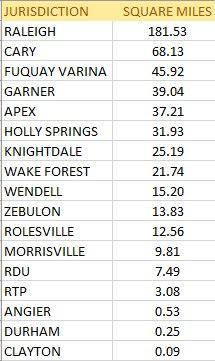
Fuquay Varina has just added 9995 acres to their ETJ. They have now moved up to the 3rd largest jurisdiction in Wake County. This is one of the reasons that I believe that Fuquay Varina will eventually move up to the fourth largest city population wise in Wake County.
2 Likes
Does that mean they’d have an easier time annexing? Because Apex and Wake Forest still seem like safer bets given their locations. Probably Holly Springs as well given the route of 540.
2 Likes