What I’m getting at is that I’m not convinced that the cost of living has much to do with our city’s largely suburban footprint, and I’m still not convinced after this exchange. You made great points about the influence of the suburbs being tied to our region’s success, particularly here:
the Triangle rose to prominence at this time in large part to a large suburban office park and culdesacs at an affordable price.
and here:
history would have still struck with a vengeance. Namely people still would have fled to the suburbs and the health of our region would have depended on us capitalizing on that fact.
But I still don’t understand how that proves your claim here:
You mention cost of living as a dominant factor, while ignoring that historically that is coded for suburbia
Particularly since for the better part of the last few decades, suburban housing was more expensive in our region than it was in the historical core. I simply think we grew in an era where suburban development was the norm, and while you’ve convinced me that this helped our current success, I don’t see how it led to a lower cost of living compared to other cities. But back to the main topic:
Regarding your last paragraph about parking, I don’t think anyone’s proposed a “tunnel fee to Manhattan” or anything as drastic as what you’re implying. This entire discussion stemmed from @orulz stating that he’s okay with parking rates going up to incentivize transit via the reduction of public subsidies for parking, and others taking offense to the idea. The reforms being proposed in Raleigh are completely reasonable, and our movement away from free parking and unreasonable parking minimums has been gradual and should continue to be. Donald Shoup provides a great model:
To distill the 800 pages of my 2005 book The High Cost of Free Parking into three bullet points, I recommended three parking reforms that can improve cities, the economy, and the environment:
- Remove off-street parking requirements. Developers and businesses can then decide how many parking spaces to provide for their customers.
- Charge the right prices for on-street parking. The right prices are the lowest prices that will leave one or two open spaces on each block, so there will be no parking shortages. Prices will balance the demand and supply for on-street spaces.
- Spend the parking revenue to improve public services on the metered streets. If everybody sees their meter money at work, the new public services can make demand-based prices for on-street parking politically popular.
Each of these three policies supports the other two. Spending the meter revenue to improve neighborhood public services can create the necessary political support to charge the right prices for curb parking. If cities charge the right prices for curb parking to produce one or two open spaces on every block, no one can say there is a shortage of on-street parking. If there is no shortage of on-street parking, cities can then remove their off-street parking requirements. Finally, removing off-street parking requirements will increase the demand for on-street parking, increasing the revenue to pay for public services.
Assembling support for parking reform is like opening a combination lock: Each small turn of the dial seems to achieve nothing, but when everything is in place the lock opens. These three reforms can open the parking combination lock.
Some critics argue that removing an off-street parking requirement amounts to “social engineering” and a “war on cars.” Instead, off-street parking requirements are a socially engineered war for cars. Removing a requirement that restaurants provide 10 parking spaces per 1,000 square feet of floor area is no more a war on cars than removing a requirement that everyone must eat in restaurants 10 times a month would be a war on restaurants.
Also, the issue has already been studied extensively – it’s basically urban planning best practice at this point – but yes, we can study its specific impacts in Raleigh to confirm that it would have the same impact that it has in other cities.
Another quote:
UCLA professor Donald Shoup, the godfather of parking reform and a keynote speaker at CNU 27 in Louisville this coming June, predicted that 2019 would bring a sea-change in parking reform. Shoup cites a recent editorial by Bruce Belmore, international president of the Institute for Transportation Engineers, recommending that cities get rid of regulations requiring off-street parking.
John Anderson, an urbanist and a founder of the Incremental Development movement, posted a list this week on Public Square of 15 municipal reforms to promote small-scale, walkable development. At the top of the list was the elimination of off-street parking requirements.
The recommendation is not just for big cities. On Strong Towns , Aaron Qualls reports on the experience of Sandpoint, Idaho, (population 7,365) which eliminated minimum parking requirements in 2009. “Since that contentious decision by the Sandpoint City Council, millions have been invested downtown—projects that would not have been feasible, but for the elimination of parking requirements. Several jobs, building renovations, and expansions by local businesses were essentially made possible by adding a single line of code,” Qualls writes.
It really is that simple. The City of Buffalo, New York, eliminated minimum parking requirements throughout the city in 2017 with one sentence: “There are no provisions that establish a minimum number of off-street parking parking spaces for development.”
Qualls explains the motivation for city officials to act. “The 2009 approval of a 60,000 square foot, 3-story bank headquarters in the heart of downtown ended up requiring 218 parking spaces. Because only 110 were provided (which was plenty), the bank was subjected to in-lieu parking fees totaling over $700,000. Well, being bankers, they soon realized the cheaper alternative was to buy up adjacent properties and demolish the buildings for surface lots. Consequently, small businesses were evicted and the much-beloved downtown historic development pattern was diminished.”
In Sandpoint, Buffalo, Atlanta, San Diego, and many other cities it is now possible to build urban mixed-use buildings without constructing a huge parking lot that does not make sense economically. That means the area that would have been the parking lot is now available for more mixed-use development, filling a hole in the urban fabric. Too many cities have such holes that damage economic development, walkability, and the environment. Momentum in parking reform is a welcome trend.
Another interesting read is this interview, which discusses how Seattle and San Fransisco used data to help tailor their approach to parking reform. Of course this needs to be done with a balanced approach… I just think most people in this forum feel that the current balance is skewed in favor of parking and is overdue for a correction.

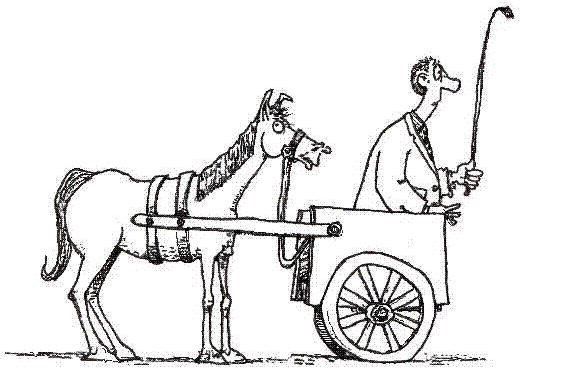
 But there are some who always keep trying to put the horse before the cart.