My problem is the prospect of the elimination of parking spaces in order to force people to use buses. This could be seen by the City introducing new lower maximum allowed parking totals, redeveloping City owned parking decks as other uses, or not allowing plan approvals for expansions or change of uses with parking totals that exceed the new lower maximums.
We have not prioritized development around bus routes, and the population isn’t adequately served to try a forced transition. I can’t imagine taking a kid to daycare on a city bus and then waiting on the next bus in order to get to work, then taking a bus to a meeting or a jobsite. It would literally add hundreds of hours to my transportation time on an annual basis. Buses are not at all efficient from a time standpoint.
I think that AEV’s and autonomous ride share will end up changing how transportation works in this country. To that end, I think that parking minumums should be eliminated with the City offering parking recommendations rather than absolute max and min totals. There is a huge incentive for developers to spend their money on building area rather than parking spaces. If the transit, AEV, bike or pedestrian access is adequate you’ll start to see parking numbers come down organically rather than through over regulation. No cart before the horse for me please.
This whole discussion is a classic chicken and egg scenario. People will not give up cars unless there is a viable alternative. But getting to the point where public transit is a viable option for most people is difficult because current ridership numbers do not support improving the system.
One could argue that the city still subsidizes parking downtown because they are sitting on very valuable land that could be sold for redevelopment if not for the parking garages.
I think this is a reasonable comment, but just wanted to respond to this bit about lifestyle changes through personal examples:
I can’t imagine taking a kid to daycare on a city bus and then waiting on the next bus in order to get to work, then taking a bus to a meeting or a jobsite. It would literally add hundreds of hours to my transportation time on an annual basis. Buses are not at all efficient from a time standpoint.
They are efficient if you live on a direct route that is close to your office. I had a dentist appointment last week. I took the car to my appointment in the suburbs, dropped it off at my apartment, and hopped on the bus to get to work. An inconvenience of 5-10 extra minutes max.
If I have an off-site meeting, I’ll either drive to work and pay for parking that one day, or if my wife needs the car and I can’t carpool with a coworker, I’ll uber to my meeting. I still save thousands a year compared to owning another car, and I don’t contribute to the parking and traffic strain downtown. I recognize that this is only convenient for people who live fairly close to work. But part of the issue is that even people like me are choosing to drive.
Or is that why we pay taxes so that the various governments provide service’s that are needed. You can almost say nearly everything is subsidized if you want to go down that road.
Pun intended? (as in going down that road)
Clearly choices have been made, and continue to made by the city for the health of the city. At the time that DT was really coming into itself and the city wanted to encourage people to come downtown, they pulled the free parking lever to help that happen. That was a decision by the city for the city. There was even a report that I read from Jacksonville, FL that compared what Raleigh was doing to what they were doing at the time, and free parking was one of the notable levers that Raleigh pulled to kick-start its core.
The way that the city has turned on and off and on again fees for parking is example of how the city makes changes over time to deal with where they are at that moment in time.
As a city’s core grows with more business and more residents, it’s more than likely that priorities and intended outcomes shift from supporting people coming into the core to supporting people already in the core.
What the core of the city doesn’t need right now is more parking. It has plenty of it. What is needed is a new way of looking at how to leverage the parking that we have. For example: why oh why do we think it’s okay to let a ginormous state employee parking garage sit empty at night? Charge for its use after hours, weekends & holidays, and make the state some money to maintain that garage! Let employees park for free during those times if you have to, but don’t let it sit practically empty. Put a RLine stop at the deck and shuttle folks around the core to their destinations and take more cars off the downtown grid at nights and weekends.
Apparently Raleigh doesn’t believe that there is enough parking spaces. Note this quote in the attached story… “The City is actively pursuing other opportunities to increase the available parking supply in Downtown as well as provide lower-cost alternatives to our current parking program”. This page was updated just two weeks ago.
That’s because the state is sitting on a massive amount of parking and they aren’t working with the city to make better use of it. My earlier comment is that we have enough parking downtown; we just don’t maximize its use. The same is true for every church, daytime business, etc. that has a sign warning drivers that they’d be towed if they dare park in their lonely empty lots after hours.
Many of the state surface lots are open I believe after hours and weekends, around the Science Museum/Governors residence at least. They don’t seem to be utilized by people visiting downtown at those times outside of large events based on my observations, anecdotal, which goes back to the do people know that or does it fall into the not convenient enough camp.
That’s interesting. I wonder if people know that these are available. I’d also wonder if these lots are mapped to RLine stops or not. If the lots are available, and if the city made the stop/wait for the RLine more pleasant (covered stop), then it’s probably a quick win. Thanks for bringing this to the conversation!
At work today I processed the survey results after a small town in western Massachusetts decided to implement paid parking (and they did it like it should be - higher prices for convenient on-street parking vs. garages/parking spots farther away). After reading hundreds of negative comments later…sigh haha
Miami Beach charges a lot more for convenience parking on the street, with much lower fees in its garages. They used the reduced demand for higher $ parking to start implementing more bike lanes and stations. It’s slow going on the removals but it’s moving ahead.
I agree. It’s hard to get people to buy in to a transit system that they’re not really going to use. I’ll probably never ride the BRT other than to try it out because the nearest stop will be too far away to be practical. But, it should get more people downtown without parking. And if a compelling development gets built on the line I could see myself moving to a TOD in the future. The BRT is good for so many reasons. I don’t know if it’s the chicken or the egg, but I think it will be productive.
The city bus system is the reactive option. It’s probably going to find it’s highest use by serving existing neighborhoods where people have trouble owning cars and paying for parking. The BRT is proactive if it spurs development geared towards people who could afford cars and parking, but make the lifestyle decision to not rely on an automobile for their day to day.
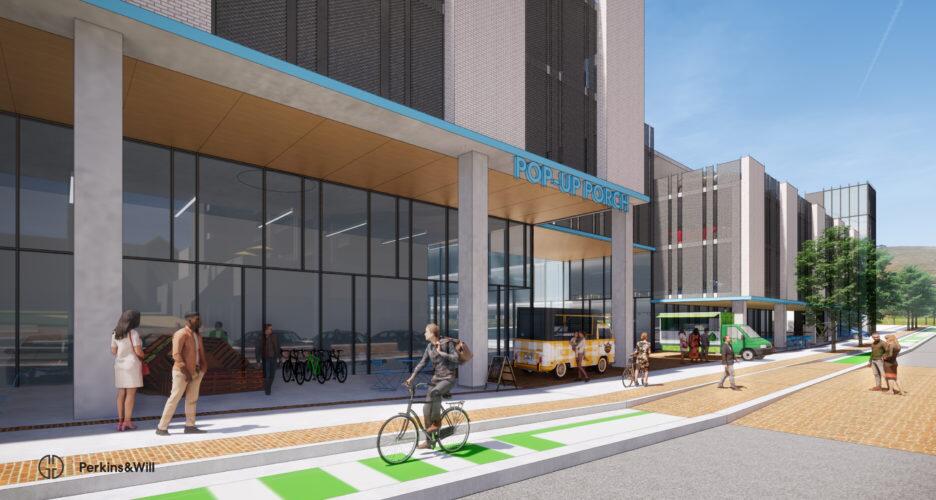
I’ve posted a lot about ways parking decks can be made more palatable for pedestrians in an urban environment. Just wanted to pass along some early concept renderings of something I’m working on as part of a large development in Chapel Hill. This is a very early rendering, so don’t pay attention to the facade design. We’ve only been focused on layout and massing so far.
The original intention was for ground-floor retail, but it doesn’t look like we’ll get it, so we’ve instead removed one bay of parking to widen the sidewalk and create a deep overhang. The intention is to create an opportunity for food trucks, market stalls, artists, and other “pop-up” vendors to set up shop on a short-term basis. We’ve also been purposeful in breaking up the massing so that it’s not a flat facade along the street. There’s a public atrium in the middle that houses the elevators, which creates a clear entry point to the garage and a natural break in the mass. We were also able to push back one bay of parking on the top floor (the right side of the rendering) which gives the appearance of a step down in the building height (so from the street, 2/3 of the deck appears to be 5 stories tall, and 1/3 of the street front appears 4 stories tall, with no impact to parking counts).
If designers were more thoughtful about making these kinds of small moves that benefit the street experience, it would work wonders in making parking feel more integrated into the built environment and less of an eyesore.
Atrium: probably not. We’ve got buy-in from the town and developer, and when it looked like we may need to take it out at one point, there was push back to add it back in. It’s also got a practical function, because it’s functioning as a 30’ wide easement for an existing sewer line that we’d need to reroute.
Glass: quite likely to be VE’d, but I’d be okay with that. It’s more about the setback than materials, and I’m not even sure glass makes sense here if you’re just seeing into parked cars on the other side. I could see it being glass in places – maybe where there’s bike parking – and some other kind of screening in others.
You mentioned food trucks, but I’d also love to see some of these deeper sidewalks house cart vendors like you see in NY, Philly, Chicago, etc. They are also natural places for outdoor festival vendors because they are protected from the Sun and the rain.
When we became resigned to not getting the Capital/Peace intersection at grade, I then wanted to see something similar under the new Peace St. bridge. Perhaps we’ll eventually see this as that neighborhood matures and the pedestrian activity along Peace increases?