didnt jarrett walker do something similar on a plan…in greensboro or somewhere else? essentially it scaled back the H n’ S and inegrated more crosstowns? i and my parents for a few years did use the mini-hub at the corner of WF road NB for connectors. she even made a deal wiht a local cab company that would pick her up there (behind the applebees) and finish the remaining two miles of her commute. otherwise she would have been sent downtown, waited for a perod of time to get the ol’time capital blvd bus back to roughly where the greyhound station is now. raleigh had discounted cab fares for the handicapped at the time. it worked pretty well for her. just an option.
1 Like
i read a portion of the article stating the private security option was ‘unsustainable’….mulitple millions more a new station? and with what? brighter leds…ai face recognition cams for evil doers? cant that be done now with a perhaps scaled down moore square and more crosstown routes?
Larger cities don’t focus bus transfers down to a single point. Transfers can be split across multiple transit interchanges across town; they can occur across an entire grid; or they can be focused along several blocks of downtown streets, perhaps intersecting or parallel.
4 Likes
Relocation has the benefit of a better informed geometric and operational design. A second chance at getting it right.
However the current station could seemingly be enhanced operationally at far less cost.
Lessen the load with a combination of crosstown routes and dispersed transfer points. Shift the X routes that run during commuter hours to the Martin Street frontage of Moore Square.
Further enhance security (and social response) presence to the point that one cannot turn one’s head without seeing a deterrent. Arm them with non-lethal devices. Foot patrols along the perimeters.
Much better lighting. Much better.
Costly, but not nearly as much as relocation would be.
2 Likes
I don’t like GoRaleigh Station. I don’t like that we have a lot of people scuttling into downtown underneath a giant parking deck, with a facility open to the elements and all of the surrounding streets without the ability to close at night. The bathrooms are disgusting and unclean. My second worst experience on transit happened while waiting at GoRaleigh station for the 100. GoRaleigh Station is often at or over capacity for the number of buses it serves and with more routes, increased frequency and more it’s only going to get busier.
I also feel like some of the discussions around the moving of GoRaleigh Station can sometimes come across as a little yikes. People or property owners uninterested in the transit that is supplied there and only relating to it due to the safety concerns that happens there. The article specifically spends more time wishing that choice riders will ride Bus Rapid Transit, than considering what a move of the station would do to the existing routes and network. Honestly, I kind of hate the framing of choice riders and captive riders and feel like it’s kind of elitist.
I live nearby, and I do feel some of those safety concerns. I also value the convenience. When I hear only one valued, I get uncomfortable. I don’t want another situation like the Greyhound Station, where the well-off push the city to push the operator out of downtown and now it’s much less relevant.
14 Likes
I have to disagree that the current station could be enhanced by far less cost. Based on the article the city is already spending $1 million+ per year to provide security and deterrent operations around the station and STILL the crime continues to increase. At this point, the reputation and past on-goings at Moore Square may be past repair with current business owners. The station move appears to be the option that gives this area the sigh of relief it needs to move forward.
If the quote (below) by Sandreuter in the article is an accurate and sustainable financial plan, this would be the most cost effective solution that removes the root cause of the issues.
Sandreuter has done the math, and—with time—closing the current bus station and building a new one would largely pay for itself.
For instance, he suggests a $20 million transportation bond as one workable path forward to purchase a new site and build a new station. Selling the existing Moore Square property could bring in ~$12 million, leaving $8 million in bonds to be serviced. A new development on the site, he says, would likely generate upward of a half-million dollars in property tax revenue to the city, which—combined with savings from reduced security costs—could cover original investment.
“This won’t pay for itself immediately,” maintains Sandreuter. “But in four years it all works out—[the city] has to make the investment.”
Also, I think the City of Raleigh needs to weigh not just the immediate, but long term opportunity cost of keeping the station where it is. Are the developments in the area going to be less than their full potential, are the quality of the businesses going to stagnate, and are the future residential projects going to be minimized due to the location? I would put forward a yes to each one of these if the station stays. Flipping the narrative if the station were to move the chances of an explosive downtown renaissance is a major possibility by minimizing the unknowns.
6 Likes
I don’t use GoRaleigh Station that often, since it’s easier for me to change buses on Hillsborough Street anyway. But when I do come into the bus station, I found that the sketchiest parts of the bus station aren’t the bus platforms themselves, rather they’re the alleyways connecting to Wilmington Street and to Blount Street/Moore Square. There’s a good number of staff, security, and police at the platforms (at least during the day and early evening, can’t speak for after 10 PM). The problem with the bus platforms is that, at rush hour, they’re crowded and chaotic (a different problem than crime/homelessness). Does stuff happen on the platforms? Yes. But more often than not it’s the alleyways that make me look and go “nope”. If I have to exit the bus station, I exit via Martin or Hargett Streets.
Personally, GoRaleigh Station should complement RUSBus. There has to be a way to retrofit the former with gates to close the bus station at night like at the latter (though, frankly, it’s time for Raleigh to consider night service with buses after midnight, at least on Friday and Saturday nights). But mainly, for the routes going into downtown, routes coming from the west (+northwest and southwest) should serve RUSBus before terminating at GoRaleigh Station. Routes coming from the east (+northeast and southeast) should serve GoRaleigh Station before terminating at RUSBus. Convert either Martin or Hargett Street to a bus-only transit mall akin to Nicollet Street in Minneapolis and have most buses going between the two stations on that busway, with a few stops in between.
And crosstown routes need to be beefed up. No reason for the 23L and the like to stop running at 6 PM and have only hourly service. Have crosstowns run the same service hours and frequencies as the radials. Given Raleigh is about to dial its 15-minute frequency route count (IMHO, actually decent bus service) to 11 in March, they seriously need to consider a crosstown route that runs every 15 minutes or better, from the fairgrounds area, past the Museum of Art, Rex Hospital, to Crabtree Valley, then to North Hills (still amazed there is no bus route connecting the two), to Capital Boulevard, and then New Bern Avenue. This would go a long way to giving riders a chance to get from one part of the city to another without having to go into downtown. The hub-and spoke system can and should work for Raleigh if planned out right (we only have a street grid in Downtown Raleigh, elsewhere the city has a hub-and-spoke road system to begin with).
8 Likes
This is the part that doesn’t get talked about enough. The problem is compounding.
Moore Square district is at 76% of pre-pandemic sales while the rest of downtown has already passed 2019 numbers. That’s less sales tax. Property values in the area stay depressed because nobody wants to invest next to a station the Police Chief says he can’t secure. That’s less property tax. Businesses either close or never open in the first place. That’s less commercial activity, less foot traffic, less reason for anyone to be there. And the cycle repeats.
Downtowns are supposed to be the tax engine for a city. This one block is dragging down an entire district. Meanwhile the city is spending over $1 million a year on security, getting worse results, and sitting on $12 million in property value that’s generating zero tax revenue.
At some point, not moving the station is the expensive option.
7 Likes
We’re absolutely nowhere close to getting rid of 30 minute bus service in this city. At that level of service, a timed pulse is the only way to stitch the routes together into a network.
Getting rid of the facility and having these transfers happen on-street downtown is not an improvement. For all the shortcomings of GoRaleigh Station, at least it does actually exist.
Trying to run high-frequency routes through downtown with minimal layover could cause delays to propagate. Not saying that doing this with a few routes would be impossible, but it’s not great for resiliency if a wreck on Hillsborough Street causes service disruption on New Bern Avenue, or congestion on Capital Blvd causes frequencies to get out of whack on S. Saunders.
In summary, I think that every route that goes downtown, had ought to terminate at one of these bus stations or the other.
All is not lost, however. Given the relatively good performance of many true crosstown routes, there appears to be a case for more. Perhaps we’re at the point where most new routes that get added to the system should be crosstown routes.
3 Likes
I don’t see anyone advocating for transfers to happen at random bus stops. The point is that if someone’s destination is downtown, bus stops already exist there.
But for the riders who are just passing through downtown to make a transfer, what’s the actual difference between them transferring at Moore Square vs a purpose-built facility somewhere else? If their endpoint isn’t downtown, there isn’t one. They don’t care where the transfer happens as long as it works.
And if the current facility is one the Police Chief says he can’t secure, that’s costing the city seven figures a year in security, and is dragging down an entire district’s economic recovery, then we’re paying a massive premium just to keep transfers at this specific address. A new station nearby, built for modern operations with proper security, does the same job without the baggage.
The point about crosstown routes is a good one though. That’s exactly the kind of thinking that gets us away from forcing every trip through one building.
1 Like
Also, not related to the bus station, but GoTriangle #100 is moving to 15-minute frequency in March!
5 Likes
since this has everyone talking, i somewhat selfishly want to see all your ideas for what the goraleigh route map should look like! i am artistically unqualified
This is when an agency should have busses on standby, where if they know that a portion of a route is going to be delayed you add a short trip starting somewhere, in our case probably downtown.
VIA Metro Transit in San Antonio has separate route numbers for the side of a route heading towards downtown and the one turning away from it. They then market the change, so that it’s clear to riders what route, turns into what other route on the other side of downtown. GoRaleigh could say, Route 9/15 in marketing, so that it’s clear that if you stay on the 9 after it passes through the transit mall you’d be on Route 15. If the 9 gets significantly delayed, you insert a 15 and vice versa. GoRaleigh does this to, but they don’t market it or make it predictable, so you end up with a chaos once you get to GoRaleigh station to understand what route you’re on.
I do think that most routes will and should go downtown for the foreseeable future, to make riders go out of direction in order to prevent people like them from being downtown, feels bad to me.
3 Likes
I am absolutely in support of this. Somewhere on here I made a suggestion for building this facility where the aging City Hall parking deck is. Actually this wasn’t my idea to begin with, I picked it up on here years ago from somebody else, although by now I’ve forgotten who it was.
As far as security is concerned, co-locate the RPD downtown district HQ next door, or perhaps right upstairs - relocated 3 blocks north from its current spot at Dawson & Cabarrus. While they’re at it, they could also relocate RPD HQ itself back downtown. The move out to Six Forks Road back in 2010 was never meant to be permanent.
3 Likes
Yup, I’d be 100% in favor of all of that. Dawson and Cabarrus are also the two primary nodes for traffic in and out of downtown. Would probably speed up bus service and decrease trip times across the board.
The streets around GoRaleigh, Hargett and Martin, go back to the 1700s. They were laid out for horses and carts, not 40-foot buses. Better road access would help with operations too, not just security.
I hear you. I’m not talking about pulling routes out of downtown. It’s really just the building itself: open air, four access points, impossible to secure. The roads around it bottleneck everything. A better facility would just mean quicker transfers and a safer wait. It could be downtown too.
I think most riders would take that trade.
5 Likes
Found the receipts, it was @Francisco back in 2018.
6 Likes
If a move is to happen, the city needs to explore best practices elsewhere. As noted in the article and by many here, the current setup at Moore Square simply allows for too many places for bad actors to hang out and is difficult to monitor and patrol. The overhead garage creates a dark environment for much of the station and the overall design forces people to cross the busways, with too many people having little regard for bus traffic and creating a safety issue.
Two cities in Upstate New York built downtown bus facilities in the 2010’s to replace former on-street transfer locations. Rochester’s Regional Transit Service opened a fully enclosed terminal with 26 gates:
In Syracuse, the Central New York Regional Transportation Authority (Centro) opened an open-air downtown hub that features a large center platform used by the system’s busiest routes and an indoor waiting area. Its open design allows police and security patrols to monitor passenger flows, with a focus on reducing loitering:
Any downtown transit facility needs to be thoughtfully designed and located with respect to the surrounding neighborhood, both from the perspective of the potential impact on local businesses as well as passenger safety and accessibility to walkable destinations nearby.
6 Likes
Here is Winston-Salem’s Transit Center:
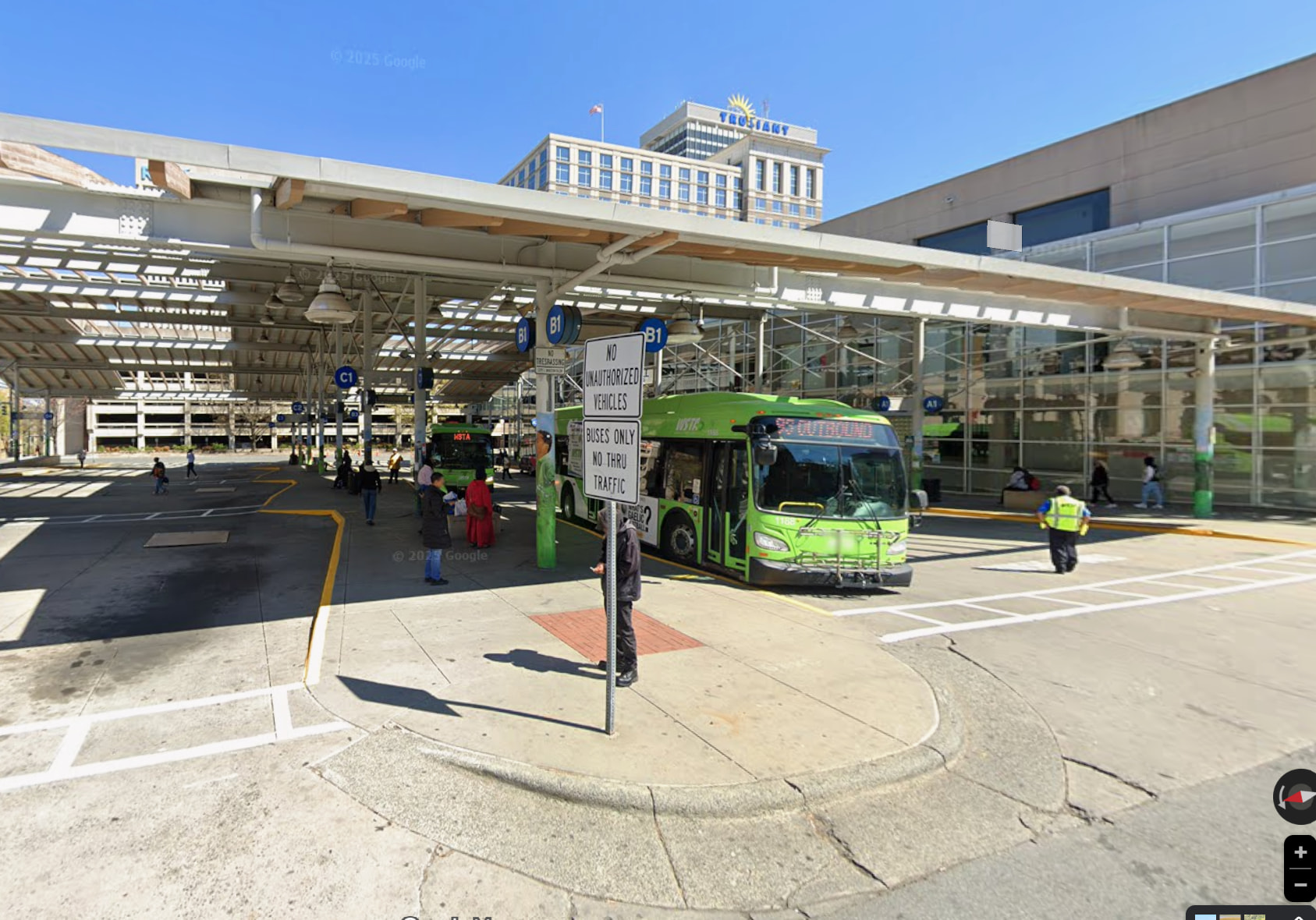
It is fully open on three sides to the adjacent streets, with shelter only above the waiting area and bus bays. This design clearly prevents any vagrancy or loitering since anyone would be in the way of actual transit users. There are also no hidden areas one could hangout at.
As others have expressed before, I believe the best relocation option would be at the Municipal Campus, with the demolition of the parking deck and a return of the RPD HQ next door. The city should adopt a hub-and-spoke bus system, with smaller transit centers at places like DTS, North Hills, Crabtree, etc. An agreement could also be worked out between developers/landowners and the city for them to be on private property to prevent the previously mentioned problems.
7 Likes
Nothing will happen until the Moore Square/Bus Station issue is resolved. I know of 2 law firms that are exiting Downtown, both citing the bus station area as the reason. Same issue for Beasley’s though she never actually stated that was the reason but i know through sources that is the reason along with the Trophy Brewing restaurant/downtown…..& Clyde Coopers.
2 Likes