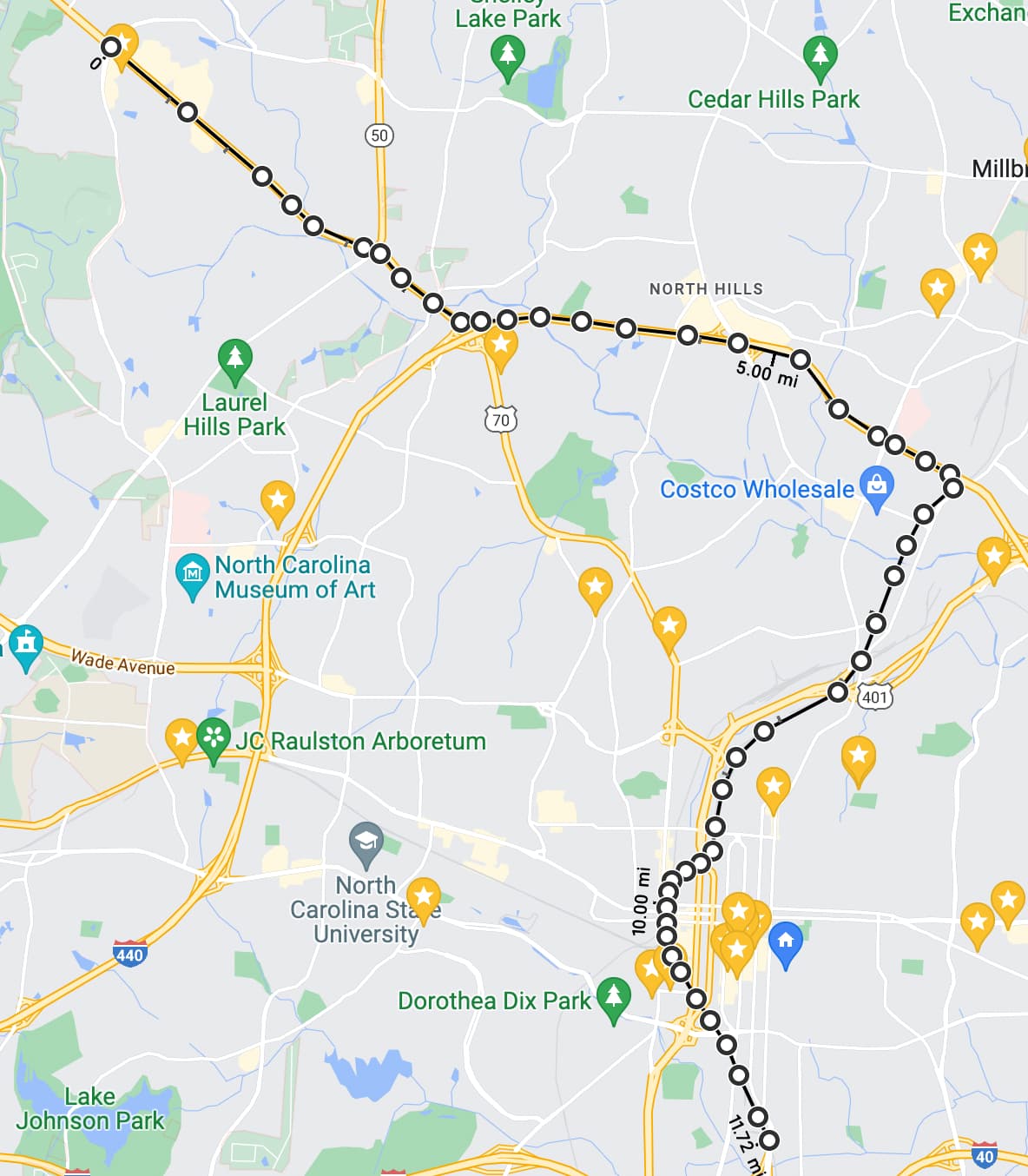
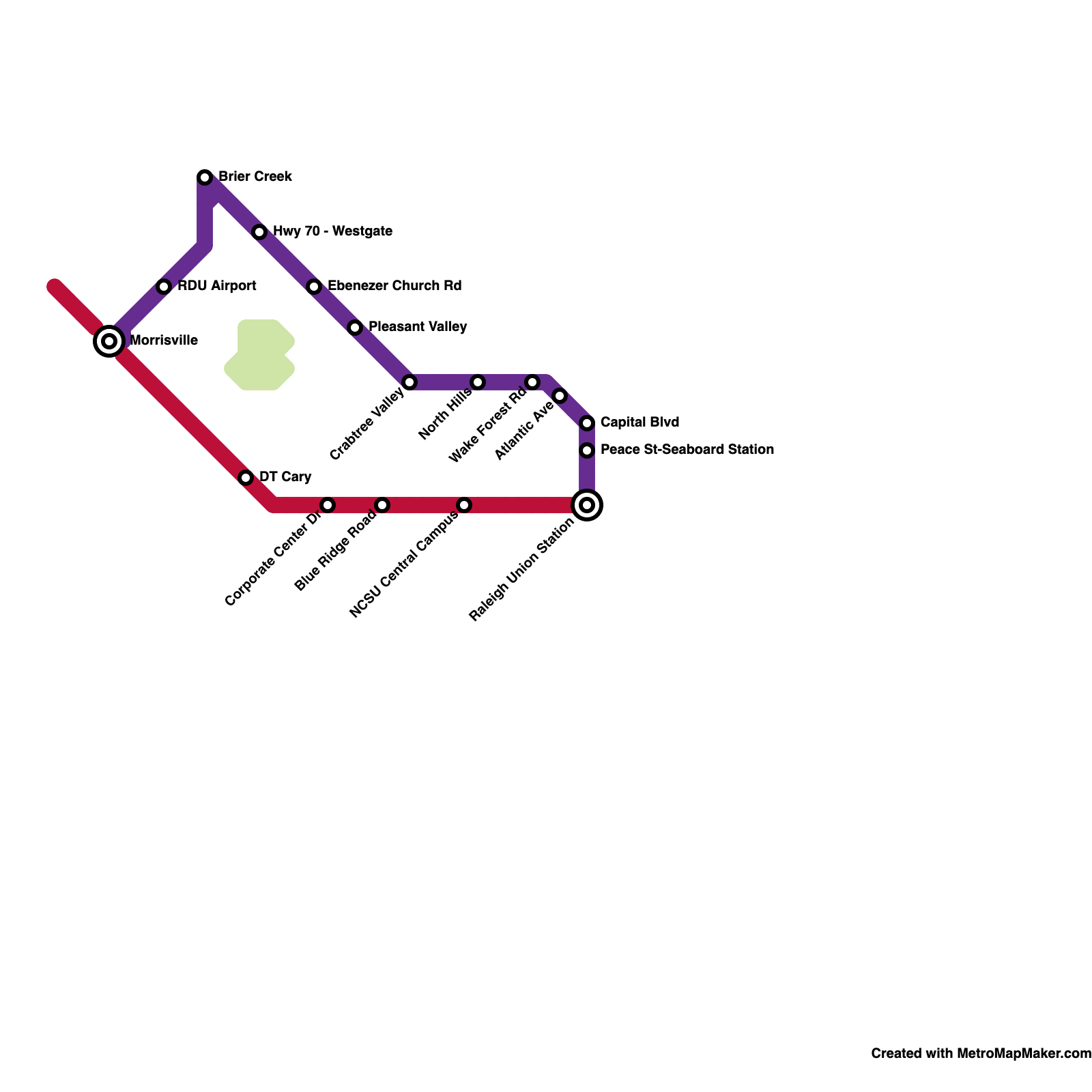
Fantasy map of a phase 1 12-station rail-based metro system for Raleigh (light rail or metro whatever as long as it’s grade-separated).
This routes goes on existing highways either below or above like on the 440 distance between Crabtree, North Hills, and Midtown and in some places rides along the existing rail lines like from Midtown through downtown/south Raleigh. Easily to expand this line eventually if there’s a need. It covers all the Raleigh density hot spots existing and in the future.
Not sure if this is the right thread, but I was browsing the NCDOT draft STIP and noticed project TE-4903a: FIXED GUIDEWAY - LIGHT RAIL SERVICE - CARY/RALEIGH.
Any idea what this is about? Maybe leftovers from the Durham-Orange LRT somehow?
I wish it were a real project, but I feel like we’d have known.
This is probably a leftover from the Cary-Raleigh light rail project (which was studied alongside the Durham-Orange county one in the early 2010s before it got shot down by a lack of local support and funding). You can tell that this is an old placeholder since the funding source (expecting federal funding) and construction timeline (start building in 2020) doesn’t make any sense, and the operating agency is still listed as “Triangle Transit” instead of “GoTriangle”.
Maybe we could use it, for BRT since it can be converted to light rail at some point. Houston’s BRT they building it but can be converted to light rail.
Still hoping going for light rail if low support was the doom of it then commuter rail should’ve been down by now. I thought it was a safety complaint thst killed light rail. @keita And even with that most light rail goes on road look at LA.
You know Houston BRT lines they say in the future it could be converted to light rail or streetcar any thoughts on that. Cause if this commuter rail implodes Raleigh cut put some back in that or studying if.
Just throwing ideas out there for how to get RDU connected to BOTH commuter rail and any light rail attempt in Raleigh.
It’s no doubt in my mind that the Hwy 70 corridor in Raleigh will get very urbanized in the future as there’s a lot of land but stuck between a park and a development restricted watershed. Basically ripe for a high density corridor that is perfect for mass transit.
Below is how I would do it, note that the station distances are about 2 miles between stations until you get closer to downtown–2 miles I think is ideal as most metro stations that reach this far from the urban core has similar setups.
Assumptions:
RDU is willing to participate; an incentive for a RDU entrance surcharge like FJK might sweeten the deal for RDU.
Find a reasonably economic solution to connect RDU to Brier Creek and Morrisville. I think you can do mostly surface rail but some trench work at the airport (less than a mile). Morrisville corridor can be entirely above ground.
This will also provide RDU users with two ways to reach Downtown Raleigh: 1) Light rail north via Brier Creek and North Hills (estimate 45 minutes to downtown). 2) Light rail south to Morrisville Triangle Commuter Rail Station and then transfer to the commuter rail train.
Great idea, the next transit bond is in 2026 I believe it’s need to be like Austin expand commuter rail to wake forest, and Fayetteville already seems to be happening. Trams on Hillsborough Street, and one for North Hills, and PNC Arenas.
I like everything before crabtree, but I think it would make more sense to have a rail run all the way down Glenwood through Glenwood South to union and an alternate route running from the top of Six Forks down, and then an east/west corridor connecting the two north/south routes. Just continuing straight down Glenwood would probably be a much faster route into downtown.
Just following the existing highway and rail corridor since those are generally selected so it would be up to the planners on the route. I just made the map to Union Station but assume both rail lines go further.
Different governments have been looking at this, yeah, but it hasn’t been taken as seriously as the Durham-Garner/Clayton route (plus extending that to Hillsborough). And keep in mind that GoTriangle doesn’t think all of that can be funded and built until around 2050, let alone any new routes.
The state is looking into bringing some sort of passenger train service to the CSX S-line (which runs through Sanford, Raleigh, and Wake Forest), but we don’t know if this would happen in the form of commuter rail or Amtrak. The feasibility study for connecting Raleigh to Fayetteville is even more explicit about this:
That study also only did ridership and schedule simulations for up to 6 round trips per day.
6 round trips for that commuter rail seems appropriate for that area. Compared to the twelve here.
I just want the Fayetteville-Raleigh to happen because I’ll probably be faster to build and cheaper. Now what’s a push-pull operation.
I heard the 2026 rumor on Twitter should be earlier because of how fast growing the region is and like I said Durham-Chapel Hill, Raleigh-Cary MSAs need to be merged if we want more funding GoTriangle if they were smart should go to the government along with the Raleigh mayor and plea for the togetherness so they can get the bread for this project.
You don’t need to sound so indignant when Google can help you… but anyways, push-pull trains are controlled by one locomotive engine (or one set of them) regardless of which direction they’re going. This diagram is the first thing you’d find if you looked this up on Wikipedia:
From the Twitter of someone with power or influence that actually matters here? Because that’s a big deal -especially since that hasn’t made its way in any MPO or transit agency board documents- if you’re actually right.
As for your spiel about the Triangle’s MSAs merging again, we know. You’re preaching to the choir -but even choirs can get tired of always hearing the same tune.
If this were 1922 in Raleigh, we would be fully equipped with streetcars for all of downtown and beyond. Would love to time travel back to experience that.
Streetcars are on the ride in America and I think we need them here in Raleigh. If light rail too hard Trams is similar we really should push y for some we have some good corridors for it.