I think would be a good Idea. Just think of the savings by eliminating all the duplication in the various city governments. Also would lead to much better collaboration on goals and on gov projects. Wake is becoming an urban county and in long run combining city and county as one could be a good idea. Lot’s of issues that would have to be worked out but towns consolidation and even city/county would be worth looking into.
1 Like
If anyone wants to read the 100+ pages of this law review about the annexation battle in NC.
http://scholarship.law.unc.edu/cgi/viewcontent.cgi?article=4591&context=nclr
1 Like
I lived in the county growing up, and annexation was a big conversation topic for my parents and their circle. It was always presented as a choice (inevitably about septic tanks and taxes). I don’t remember any talk of forceable annexation, which seems like it would have been a big deal particularly for my dad. I’ll ask my mom about it sometime.
(Spoiler: We ended up in the city. Though you can get whiplash from all the “Welcome to Raleigh” signs you see in the Swiss cheese that is North Raleigh.
2 Likes
That’s an interesting view, from one of the legislators. The author doesn’t strike you as a big-city model advocate (rural Republican), but it’s consistent with his viewpoint as a naturalist as he was a trustee for the John Muir Foundation and was the national president for the Sierra Club. He’s got a long list of other environmental groups and sustainable efforts that he’s lead. So it can be hard to pigeonhole the motivation for some of these people.
1 Like
Most of this change in law was brought about by the Fayetteville mass annexations back earlier in the 2000’s. “For nearly a half-century, North Carolina was one of only three other states left in the nation that allowed a city to annex private property outside its borders.” Since then Tennessee also has changed their law. So don’t make it seem like it’s a political party thing as it justifiably provides home owners with protection that almost ALL other states already offer them. North Carolina was an outlier. In the ten years prior to the change in law very very few annexations were forcible and those that were done was by Raleigh (most of those was for more charitable reasons as to provide services for some poorer neighborhoods in Southeast Raleigh). But anyway, accept it or don’t accept it.
3 Likes
The more suburban and rural spots Raleigh annexes, the less likely pro-downtown people will get elected. I’m ok with the geographical size of our city. 
6 Likes
Yep. Raleigh needs to grow up. Not out.
I always find it odd that Raleigh extends all the way into wake forest and brier creek.
5 Likes
I am of the understanding that Raleigh got Wakefield basically because Wake Forest could not provide the water necessary for the new community. This was before Wake Forest became part of Raleigh utilities.
1 Like
No doubt that city is better off not growing ad infinitum in a suburban model. The Charlotte/Nashville/Jacksonville/Oklahoma City model of huge city limits will be interesting to watch as all of that suburban infrastructure ages within one municipality.
It’s taken until just recently for the city to learn to grow up instead of out, and the election of our new council may be a watershed moment for the city going forward. There’s no reason why Raleigh can’t plan for 600,000 in its current footprint. Just north of 4000ppl/m2 still puts us on the low end of density metrics nationally, especially when compared to legacy cities and those that are geographically constrained. However, Raleigh has dozens of square miles that are so low density (all those lovely 1/4-1/2 acre lot subdivisions), that it’s going to take some serious density in nodes to reach 600K. Then again, that’s good too because density in nodes throughout the city supports transit!
7 Likes
I think the city ought to prioritize annexing the enclaves of county land entirely surrounded by the current city, but otherwise agree that it would be best to focus on densifying within the current footprint.
The city cannot initiate those annexations anymore. It’s not up to them. All they can do is prioritize density.
1 Like
So, NC picked up over 106,000 in the year ending July, 2019. If growth percentages persist, that means that the Raleigh MSA went from 1.362M to about 1.394M, and is surely well over 1.4M today. Meanwhile, I suspect that the CSA went from 2.043M to about 2.083M, and is likely over 2.1M today.
10 Likes
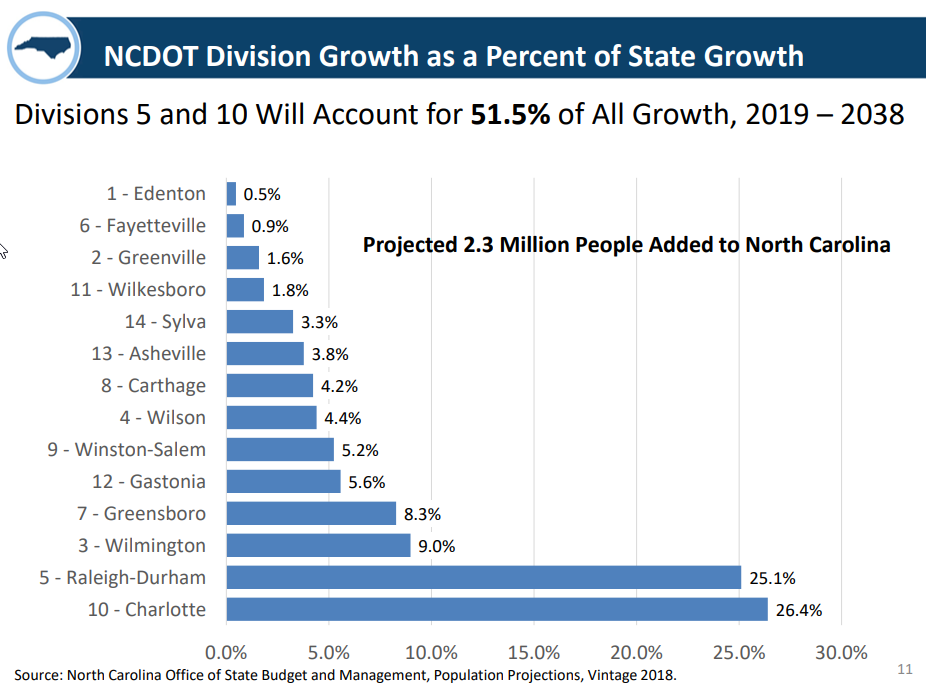
Another 100K. Wow. Had to check the googles. This doc shows how Raleigh-D and Char-town are blowing away the state at over half all growth.
8 Likes
I wonder if they are just taking the NC portion of the Charlotte metro into account, or if this represents the growth of the entire metro including the SC portion? I’m not convinced that Raleigh-Durham’s growth hasn’t been more impactful to the state’s growth. Let me do some investigation and I’ll finish this post.
Through 2018’s CSA estimates, the Triangle has added 302,551 since 2010 while Charlotte USA has added 351,226. That means that Charlotte added 48,715 more people than the Triangle. BUT, if we just look at York Co., SC alone, it added 48,045 people last decade through 2018. Lancaster County also added nearly 19,000 people. Both counties are in the Charlotte CSA. Chester Co., SC lost nearly 1000 through 2018, but aggregated, it doesn’t add up to Charlotte contributing more to NC’s growth than the Triangle.
If my math is correct, the Charlotte metro only contributed 285,342 to NC’s growth between the 2010 census and July, 2018. That makes it lagging the Triangle’s contribution by over 17,000.
https://www.citypopulation.de/php/usa-combmetro.php
Edit: After looking at this some more, Gastonia is within Charlotte’s CSA, so these NCDOT numbers make no sense at all. #sloppydata Charlotte’s total & percentage should be even lower if it excludes Gastonia.
3 Likes
That means Charlotte added roughly 44 people per square mile (351,226 people over 8,067 sq. mi. [urban square miles according to Wikipedia]) while Raleigh added roughly 76 people per square mile (302,551 people over 3960 square miles, including Wake, Johnston, Franklin, Durham, Orange, Person, and Chatham counties). Now, if I added Harnett, that would bring the people per sq. mi. of the Raleigh-Durham CSA to roughly 66 people per sq. mi. Raleigh is still getting denser while Charlotte continues to sprawl even more.
6 Likes
Well that’s interesting for sure, especially since the folks in Charlotte USA like to talk about the Triangle’s sprawl and use the term Sprawleigh. That said, we have to be careful with the data. Charlotte has many far flung counties in its CSA that aren’t growing at all. The one I mentioned in SC actually lost population, which I think is true for one of the Triangle’s counties as well. It would be interesting to really understand how the urbanized areas stack up against each other regarding that density metric. Certainly both metros continue to sprawl out, but Raleigh’s more recently suburban development means more compact suburbanization, or as I like to call it: “the worst of both Worlds” or high density, car dependent suburbia.
4 Likes
Thoughts on any possible changes to the CMSA of Raleigh-Durham after the 2020 census? Or do you think all will remain the same for the foreseeable future?
It only gets re-evaluated every 5 years, and was last done in 2018. The next opportunity is 2023, but I’m not holding my breath. Raleigh seems to not care, and Durham definitely cares about having its own Metro area. Some will say that wanting/caring doesn’t matter, but I think that everything is political to some extent or another.
6 Likes
Vance County was the one that lost population, though I did not include that in the metrics. Lee is also one that I left out as well. As for Charlotte, I would not consider Iredell; Chester, SC; Catawba; Stanly; Anson; Cleveland; or Rowan as part of their CSA. So with that in mind, there is Meck; Union; York, SC; Gaston; Lincoln; Lancaster, SC; and Cabarrus with a total area of 3,462 sq. mi. I will estimate that around 100,000 of that growth is in counties that should not be listed as Charlotte’s CSA, so that is 251,226 people in 3,462 sq. mi., so that is a growth of roughly 73 people per square mile, just barely behind our growth in our CSA.
2 Likes
Both Lee and Harnett were removed from the Triangle’s CSA in 2018 and given to Fayetteville. This wiped nearly 200,000 from the Triangle’s “official” population. Had those two not be removed, the Triangle would have been nearing 2.25M as of 2018, and pushing past 2.3M as of the upcoming Census. Alas, the Triangle will likely land somewhere near 2.1 in the Census.
1 Like