Hey John, where are these conversations happening on City-Data? Can you link me?
2 Likes
Here you go. There is a lot of talk in this thread about the Triangle, even though it’s not a NC or Triangle specific thread.
4 Likes
I remain skeptical that OMB will hold to their Register notice because we’ve yet to see the ACS commuting flows released, and the Census Bureau has not indicated that they will be released next week.
OMB starts from the Census Bureau’s Urban Area definitions when constructing MSAs. The 2020 UAs are already released.
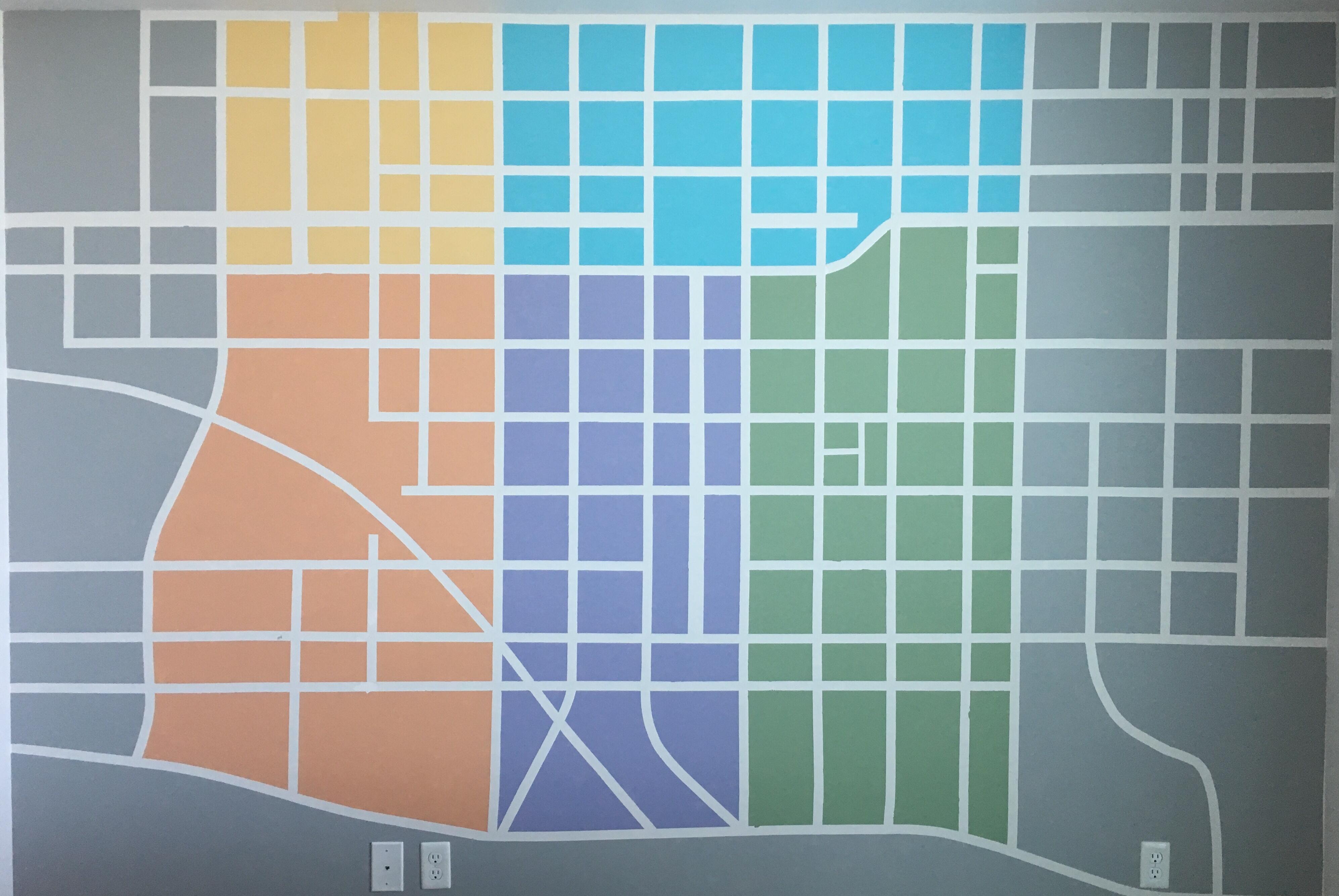
Here is a giant wall map of 2020 Urban Areas. More detailed maps should be available later this year, but this map is enough to see that Raleigh UA and Durham UA have a long border and are basically divided along the county line. As long as this remains true, OMB does not have to combine Raleigh and Durham.
Check out Charlotte on this map: Gastonia, Concord, and Rock Hill have separate UAs, too, with long borders with Charlotte. Hickory, on the other hand, includes Morganton and Lenoir under a single UA. These are all the same kinds of problems that existed with the previous urban/rural definitions. If the bureau followed their own rules, Charlotte, Gastonia, Concord, and Rock Hill would be a single UA, as would Raleigh and Durham, Greensboro and High Point, etc. But they’re not. I’d like to hear the bureau’s rationale for this but I’m not holding my breath it will ever be made public.
So we have one strike against recombination already evident.
OMB will use the 5-year ACS county-to-county commuting flows to define MSAs and CSAs. This data has not yet been released; typically it’s released at the same time, and typically that happens in December every 5th year. We’re already into year 7 since the last release so who knows what the real timeline is. My personal bet is for this December, and the delay is because the ACS data from 2020-21 is probably horribly dirty and throwing everything off.
But there are actualy two sources for commuting data! The second source is the Census economics division. The Longitudinal Employer-Household Dynamics Origin-Destination Employment Statistics (LODES) asks employers to provide data regarding their employees, including where the employees legal residence is, based on payroll data. ACS asks individuals where they work; LODES asks employers where workers live. Both methods have their own limitations and therefore won’t produce identical outcomes, but they’re usually close enough.
You can play with the LODES data at On The Map. (In the Analysis Settings, click Home, Destination Type Counties, year 2020, and “All Jobs”.)
If we assume the 2020 LODES data will be similar to the ACS data whenever it’s released…
Harnett County should become part of Raleigh’s MSA. Of workers who live in Harnett, more of them work in Wake than in Harnett. More Harnett residents work in Moore County than Cumberland, so I can’t imagine any way they stay with Cumberland.
Sanford should remain an independent MSA in Lee County, but it seems likely that Sanford would be part of Raleigh’s CSA.
Durham, however… by my math, 23.9% of workers who live in Durham Co commute to Wake, just under the 25% cutoff OMB uses. (13.6% of workers who live in Wake commute to Durham.) It’s close, but it’s definitely no slam dunk here. That’s strike 2 against recombination.
Now, there is no Strike 3; indeed, logic and reason would dictate recombination, but we aren’t so silly as to assume logic and reason will carry the day, are we?
Worth noting, more Chathamites work in Wake than in Chatham, but even more than that work in Durham/Orange combined. So Chatham still probably remains with Durham-Chapel Hill. For Alamance, the sum of Durham and Orange is bigger than the number for Guilford, so Burlington should join the Durham CSA (and hence the overall Triangle).
The main caveat here is that these data may not reflect workers who worked from home during the pandemic, but the 5-year ACS data will. This could lead to much higher amounts of workers reporting that they work in the county where they live than would be reflected in the LODES data, meaning many MSAs may lose a large number of counties. Until we actually get the ACS data it’s impossible to say. I remain hopeful for Raleigh and Durham to be combined, but not confident.
12 Likes
You had me at giant wall map. 

3 Likes
Vying for my affection I see. 
1 Like
I’m nervous too my heart is beating however, hopefully if this merger happens Raleigh-Durham MSA is combined it might be smaller size and what I mean by that Wake County, Durham, Orange. Johnston, Harnett County are in it but surrounding CSA must be Alamance and the other countries over there. But I want to know could urban area help tie us together I’m trying to figure out the current information? Also another question could they lower commuting threshold because of the rise in WFH?
2 Likes
Honestly I can see the Wake County commuting data of people from Durham, Chatham, Orange coming to Wake being high. But hopefully they overlook this, perhaps they could lower the ACS threshold can they do that?
I also wonder if @anon8787296 thinks for this I know the city has no control over this but I ask his reaction.
I’m sure that Jonathan has opinions on this like the rest of us but he doesn’t have any influence over what the OMB does.
2 Likes
I’m worried that the merger won’t happen.
None of us have any control over it. It will be what it will be.
7 Likes
Wake and Durham have the most communication of any two counties in the state, plain and simple. If there is a persnickety way of cherry picking commuter data to arbitrarily keep the counties separate, that does not change the reality that everyone living in Orange/Durham/Wake routinely travel to the other counties for shopping, or socializing, or recreation, and that the rate of this is on another level compared to counties outside a metro.
5 Likes
i guess what i wonder is who makes the decision to merge or unmerge these things…if majormarket investors were looking into an area is it possible their own research as far as number of people, ease of city limit crossings, etc? my delivery jobs were all over the triangle… it was just a big blob to me.
2 Likes
Makes this decision more nerve wracking.
The Brookings report above showed that they have the highest commuter interchange of any two metros in the US.
But OMB, who’s in charge of this, hasn’t made its determination – which, again, is entirely based upon whether >25% of Durham’s workforce is from Wake as of the latest ACS. We don’t have that info, we have no say in what they do, and they are late in telling us.
2 Likes
Booking I hope it’s tied to the Census perhaps they’re using their information to help make their decision. I hope that true because that give us a real possibility. We can only wish.
It probably more than that because of people who work in RTP, we keep forgetting that area is shared by both metros.
1 Like
I wouldn’t hold my breath on that prediction. Wake County is growing at a faster clip than RTP employment.
1 Like
True but I’m talking about employment and commuting they are a lot of people who work there.