I wrote a thing about what parts of the Triangle lost population over the 2010s even as the region grew. Map is here, article is paywalled:
Seven Census tracts in north Raleigh
Ten tracts ITB, notably N/E/S of downtown
Four tracts in Cary, including Kildaire Farms and southeast downtown
Four tracts in north Durham
Six off-campus tracts in CH-C, or 30% of those towns!
Note: the 2020 Census was very bad for campus areas, since by April 2020 many local colleges had sent students home from dorms.
Areas with shrinking populations have no excuse to say that their infrastructure is being “overwhelmed by growth.” Indeed, their transportation and utilities were adequate for larger populations, and certainly far more adequate than the exurban areas that are growing. To the extent that their roads are overcrowded, it’s because people are driving from further out, through the inner ring, to jobs closer to the core.
How much of this can be attributed to the natural aging in place of homeowners, and the eventual turnover of the properties to the next generation that has objectively smaller households?
For example, my mother still lives in the home that my family bought new decades ago when we were a family of 6. Now she’s the only person living in that home. When she passes, that house (or its land) will be reoccupied by the next generation that is far less likely to have 6 people in the household. In fact, my mother’s neighborhood is filled with these examples. Where lots of kids used to play is a neighborhood of homes largely occupied by either widows or the next generation of owners that have fewer children.
I’d imagine that this would systematically play out across the city as development ages, and generation change occurs. I would also suspect that some of these shrinking growth neighborhoods would grow in the coming decades due to the natural generational replacement cycle.
Totally. You can see it with your eyes and feel it on the ground when you go into many neighborhoods built in the 70s and 80s in the city/county. The older neighborhoods (50s/60s) have fewer, if any, original owners.
My block in north Raleigh was built in 1983. No original owner remains. The neighborhood is indeed turning over, and there are noticeably more under-18s now than 15 years ago. I doubt the population of 27613 wil change much in the foreseeable future, although it will oscillate up and down depending on age demographics. There is no fall in demand for housing. Almost every parcel has something on it now. Pleasant Valley was to be the first instance of a strip shopping center being redeveloped with housing, but it hasn’t gotten underway yet.
As for rush-hour traffic, yes, the problem in north Raleigh is increased numbers of people living outside 540 who are zooming down the primary arteries to get to jobs along or inside 440. The City and NCDOT have accommodated this somewhat by giving preference to north-south roads over east-west roads at intersections. Heaven help you if you have to drive east-west across north Raleigh at rush hour. And, of course, there is virtually no east-west bus service without going to 440 first.
That’s really interesting. My mother and her next door neighbor are still original owners, and my family home is newer (1974). Both women are women in the 80s.
I can’t say. First you’d have to put in park-and-rides at 540. A number of us have tried to persuade the City to do exactly that, given that routes 2, 8, and 36 all terminate just short of 540. The City has shown zero interest in doing so, although they do provide a park-and-ride of sorts at Triangle Town Center mall on route 1 (and also at the Brier Creek shopping centers on route 70L, if you don’t mind incurring the wrath of the shopping centers for using their parking to catch the bus). Then you’d have to deal with the reality that when the inbound commuters reach 440, they go in different directions. Downtown isn’t the only employment center… North Hills, the medical area around UNC Rex, office buildings at Crabtree, etc.
Wouldn’t surprise me if someone at the General Assembly is looking at the NCSU farm property and wondering how much they could sell it to developers for. NCSU could get farmland farther out.
Is your triad metro supposed to be 1.789 million? Also do you include Hickory in Charlotte’s CSA (I believe it now is included)? Also, some are saying Rock Mount-Wilson is circa 200k people.
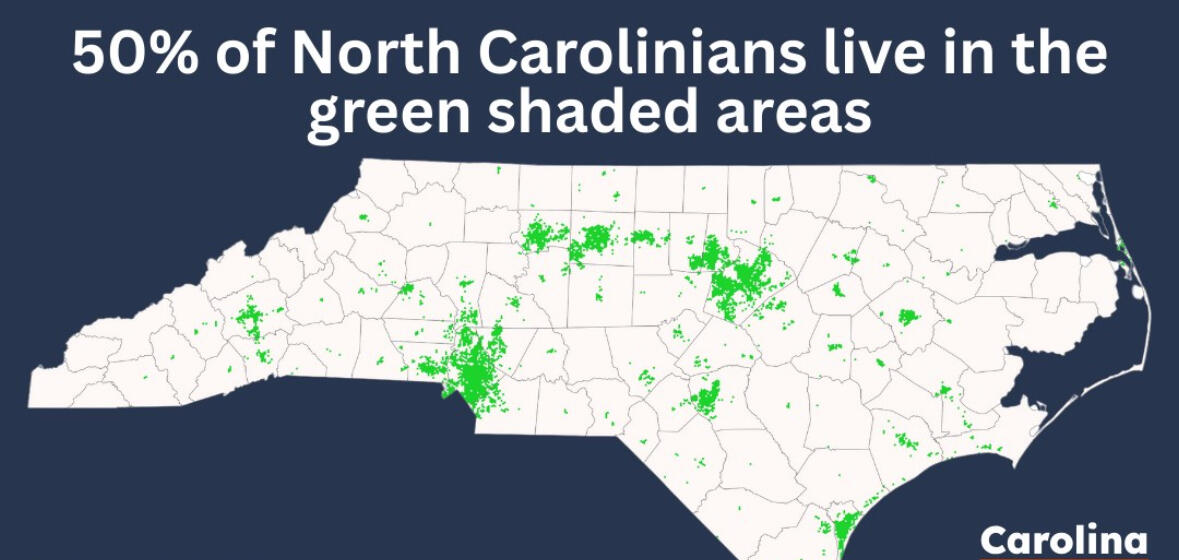
for Charlotte CSA you would need to subtract the 2 South Carolina counties which would be about 400,000 people those being in York and Lancaster if you are talking about the percentage of NC population. Over 25% of the state of NC population lives in 3 counties Wake Mecklenburg and Guilford.
 Thank you!
