If it moved to Dix, it would have zero impact on small business downtown. While I would walk to an event there from downtown, I am not representative of what most folks would do. Most would drive there, park, and then get in their cars and leave afterward. MAYBE if the amphitheater was close to the Caraleigh side of the park along Lake Wheeler, that area could support some pre/post concert activity, but that would be about it.
Anyone who thinks that an amphitheater in Dix would benefit downtown proper is fooling themselves.
15 Likes
It would also be disasterous for Dix and Boylan Heights. They would have to build parking facilities. It would be a blank unused part of the park most of the time and nobody would venture downtown from the concert. It’s way closer to Boylan Heights so the noise would be far worse.
7 Likes
To reiterate a comment I posted the other day: per my  , the Dix Park Conservancy DOES NOT WANT an amphitheater as park of Dix. It’s NOT in the master plan, and while that plan is always subject to change, they DO NOT and will not add one in. RHA can either go: Downtown Raleigh, or, in our memories of the history of a once great asset to downtown Raleigh.
2 Likes
Not sure if folks have seen this perspective on the timeline of the RHA move / CC -
TLDW: June was the first bubble up of this pivot to South St.
*Council vote likely on the South St closure 9/17, goal for community meeting first week of Sept before Council mtg
Side note : Engagement remains a challenging achilles heel for our burgeoning city and the perception of development has been skewed as ignoring and/or outright stepping over the general population - whether its private or public decision making. That was the purpose of the Block Party.
Hopefully more convos progress, the slip leg can be negotiated / confirmed w/ NCDOT and this can move forward at once with the best possible outcome - an improved and permanent RHA, maintained bike / ped accessibilty through South (after the construx) with that ‘alternate’ connection for ‘necessary’ car trips.
8 Likes
It keeps being framed as the downtown businesses vs this 1 neighborhood but its really the entire City vs the interests of 1 neighborhood. Sorry but you live next to downtown, you deal with downtown type of things.
19 Likes
I’d go as far as to say that they’re fighting against an entire region. I believe RHA is the only downtown amphitheater in the region.
4 Likes
Definitely Wake County. DPAC and some auditorium at UNC may serve those regions.
But yeah, RHA is the only downtown walkable amphitheater for 1m people.
2 Likes
The interviewer says, “We can’t present it if it’s going to do real harm to other citizens.”
What?? I’ve missed something in this new proposal that will do harm to citizens. Does anybody know what this is??
(I’m not asking this seriously)
1 Like
I really and truly don’t understand a Council who has done away with parking requirements for new developments; promoted biking and pedestrian infrastructure; big talked a walkable downtown; surveying more greenway connections; allowed more dense development; tried to bring in a business community; said they want a vibrant downtown where people want to live and work - would seriously let a group of people take away Red Hat “because it could do real harm to other citizens”…like what…inconvenience them to use another route harm?? What am I missing? And ok I get that a curve ball got thrown on closing South instead of Lenoir. But we all knew change was coming. South Street in front of Heritage Park was closed for months. People just went around it. The city is going to hit some growing pains. I guess it comes down to - are we moving forward with project that make DTR unique and fill our mission or are we bending to those that don’t want anything to change. One thing that was apparent in that video from Councilwoman Jones - Red Hat feeds a lot of businesses. What a loss if we start losing old and new businesses because we lost Red Hat. That would be a triple tragedy. You will never make everyone happy and I think the Council has a tough decision to make because this is one of those cases. It comes down to what’s best for the city overall. I hope they make the right call.
14 Likes
If they decide not to move Red Hat to South Street then the best option would be to cancel the convention center addition and leave everything as is.
3 Likes
Eh, Red Hat is an aggressively temporary venue in artist and spectator amenities and the convention center is too small for a city of our size. They both need to be upgraded.
7 Likes
Still love it as it is today. I’ve seen probably 15 shows at Red Hat. Walked to about 10 of those shows from my apartment. Even if it’s currently a temporary facility, I still enjoy it as it stands. I’m not mad at all if we keep Red Hat where it stands and cancel the convention center addition. Tho I know that solution will never happen.
5 Likes
Interview host gives me Livable Raleigh vibes…(besides the odd dialect)…anyone else think he’s a NIMBY? I know NOTHING about him or his “show” or podcast or whatever…
The council member seems thoughtful. Do we like her or nah? (as far as “getting it” for the city to grow?)
I came up with an interesting re-do idea. What if (for extra cost, i know) they covered the somewhat elevated RR tracks so that resulting “foundation” of the train tunnel or covering could be used as a slope/hillside/bleachers for a bigger seating area / lawn area? Then the stage is in corner the closest to the shimmer wall behind (and to the left) as you are viewing from the audience. You’d have a chance to make RHA bigger or have more lawn. Service/food/bathrooms would move . South Street still closes, audience gets too enjoy shimmer wall during concert.
Lame attempt at what I mean illustrated here.
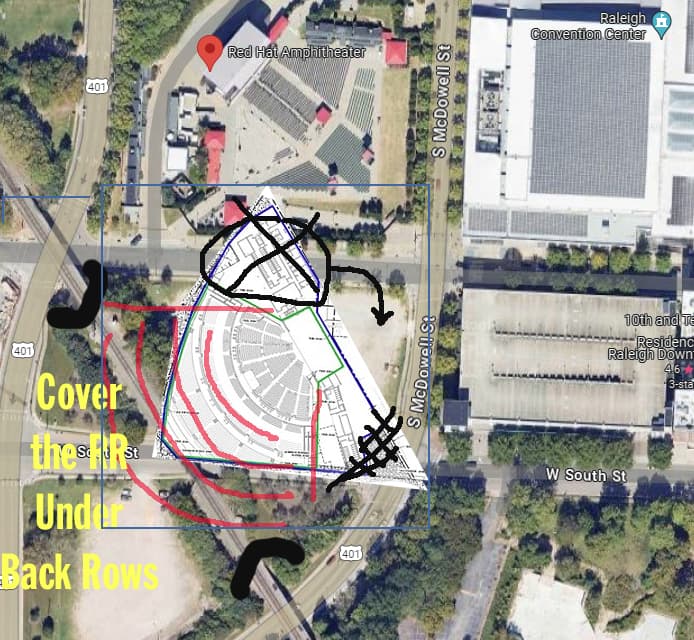
added bonus: less RR noise during the concert, too.
3 Likes
I think the YBY group is LR adjacent but maybe not directly connected.
I think the interviewer definitely wants ‘incremental’ change rather than ‘BIg Steps’ change.
I think it is pretty easy to empathize with the overlooked populations of Raleigh not having a full conversation in the change happening on the development front.
I think it is harder to think about growth with the totality of Wake county population factored with the folks who must live through that change in greatest proximity.
I think Council must do what is best for the region on the whole while balancing the best outcome for their district for political longevity.
I think political longevity more often than not does not factor the portion of citizenry who is most likely to deal with the greatest disruption for the greater good.
I think the 4th ward should be wary of growth that benefits the region but may not benefit them in the short term. I think the city should have a comprehensive plan that illustrates how this / that or the other decision might create opportunity for the citizens of the 4th ward.
I think the Amphitheater is a wonderful amentiy for the entire region and we should take all steps to both improve and make it permanent.
I think we should give folks the chance to voice their opinion and attempt to illustrate the cost / benefit to the South St closure and illustrate the multi-modal transportation outcomes that could be enacted from this decision.
Couple that with the the economic benefit of an expanded convention center, high level downtown walkable amphitheater and adjacent hotel / meeting spaces within the Omni complex -
Do the ends justify the means…? What does obstruction cost ? Who does that benefit?
Is there a commonly understood boundary for what constitutes the 4th Ward?
Also, we have wards? Like Dick Grayson?
3 Likes
I was having New Orleans vibes myself. Guess you can tell I haven’t lived here long enough.
1 Like
4th ward : It’s now what most of us would call SE downtown. Essentially it encompassed south of Oakwood Cemetery including Idlewild, College Park out to Tarboro Road and stretching down to South St. It was slated for urban renewal by the Raleigh Redevelopment Commission in the 1960s. Many reference the name today to recall / recount the manner in which the residents were pushed out in the name of progress and that struggle echoes in the mind of many as progress continues to press forth…
It seems worthwhile to reference the historical context, if nothing else, in an attempt to hear another perspective and meet other citizen points of view on the impact and cost of change.
1 Like
Houston for me. It’s a very Southern word in terms of city development.
Fourth Ward was the quadrant west of Fayetteville St. and north to Hargett - obliterated with the MLK/Dawson/McDowell connectors and various urban renewal programs. Third ward was east of Fayetteville - and also north to Hargett.
Here’s a great page that breaks it down:
6 Likes