The redlining map is the same divulged propaganda as always.There are way too many interconnected social factors that have trampled the generational economic success of the “gentrified people..” Remember, Colonialism is still in full effect! Unfortunately most people are blinded by engineered social “entertainment” technology.
Raleigh is a decent place, but no different than Jackson MS or Boston MA. Durham and Chapel Hill have suffered from this issue as well.
Please don’t presume that I am not aware of systemic discrimination and exclusion.
Redline maps created in the 1930s were done so for all cities over 40,000. At the time of their creation, Raleigh’s 1930 Census population was 37,379 while Durham’s was 52,037. This is why an official redlining map of Raleigh didn’t exist. This doesn’t mean that exclusionary covenants, etc. didn’t exist in Raleigh, nor does it mean that targeted minority & immigrant populations had easy access to financing a home: they didn’t. It simply means that Raleigh wasn’t one of the cities included in the HOLC (Home Owners’ Lending Company) set of mortgage lending risk maps: known colloquially today as redline maps. This is why anyone looking for such a map won’t find one. A few years ago I searched and searched and searched and searched for Raleigh’s redline map until I realized why I couldn’t find one. That was ALL that I was saying in my post.
Raleigh simply never had the large population in its core that could’ve been displaced by gentrification. Same for Durham. It is true that both cities committed huge planning mistakes motivated by racism. The MLK/Saunders loop and the Durham Freeway destroyed black communities. That is in the distant past at this point.
Housing displacement isn’t a thing though. Downtown’s population was only a few thousand in the 80s. People getting displaced can be counted in the dozens, and it was to make room for thousands. I just don’t think it applies. NIMBYs weaponize progressive language to protect a very privileged minority at the expense of the very people they pretend to advocate for. It’s disgusting.
The situation in Durham is even more clear-cut. Pretty much everything built has replaced a parking lot or a car dealership. We still get people complaining about gentrification. It’s a standard knee-jerk concern but there was nobody to displace because nobody lived downtown three decades ago. Those parking lots were not doing anything for the social fabric.
Let’s not disregard the fact that new developments raise the property values of all nearby properties, often enticing landlords to raise rents, and causing property taxes to increase. There are even instances where new parks have led to displacement.
Rents and leases have risen in the whole Triangle almost uniformly in the past two decades. The downtown residential market is less than 1% of the Triangle’s whole market, and the rate of increase in the downtowns isn’t greater than anywhere else in the metro.
Raleigh saw its first rent decrease since the great recession last year because it actually built housing. Building Class A rental units still takes pressure off the whole market. Old class A becomes class B, and old class B becomes class C, and the more we build the more affordable B and C we get.
I was thinking about including this point in my last post.
While I can see where you are coming from with regard to more recent development in the two cities, I know that there was displacement in what was originally Smoky Hollow (before it became a development). Smoky Hollow was a poor shotgun home neighborhood of the Black working class when the Cotton Mill was, well, a cotton mill. That neighborhood was obliterated by the construction of (then) Downtown Boulevard, now Capital Boulevard.
I would suspect that Durham has more displacement stories as well, other than the destruction caused by the Durham Freeway. Before the car dealerships and large surface lots were there, there had to have been something destroyed, and I suspect it included working class housing.
Today the stories are definitely different, but as money has moved back towards the downtowns of both cities, people have more quietly been displaced and priced out over time.
You’re oversimplifying how housing markets actually work. What your describing only only happens when a small number of new developments dramatically transform an area and there are also restrictions on additional housing supply afterward.
New development and the continuation of new construction dilute scarcity, not intensify it because the market absorbs demand, stabilizes prices, and prevents the kind of upward pressure that landlords or sellers might otherwise exploit.
But I will add this, when an urban neighborhood is made up primarily of single‑family homes, the introduction of new higher‑density housing (apartments/condos) creates a very particular market dynamic. Because the new housing type doesn’t match the existing stock, it doesn’t necessarily relieve pressure on the homes, and prices for that product type can continue to rise. These new units offer a fundamentally different living experience and urban residence have to contend with the physical limitations of the neighborhood, but allow for housing at its core to not have excessive escalating cost.
I’m curious if in places like east Raleigh, where a lot of the inventory is single family housing, if new missing middle inflates the land value of the single family houses? Do you know anything about that dynamic? It would seem to me that those land values go up because assembling a few of them could turn into 3 or 4 times as many townhouses.
Its happening in Five Points where 2 lots are being combined to make 8-10 townhomes in several locations. Although I’m not sure if the lots are selling for any more than they already are for tear down and new mcmansion
@John I’m replying to your post because you mentioned original redline maps not existing, but this is relevant to the larger conversation for anyone who is interested.
The Wake County Register of Deeds launched the Racially Restrictive Covenants Project as a volunteer-driven initiative to identify, map, and catalog historic property deeds containing racially discriminatory language. Launched in October 2023, the project aims to document how these covenants shaped the county’s social and physical landscape.
Oh, that’s really cool that folks aren’t ignoring that history. Thanks for sharing. I’ll dig into it!
While I haven’t clicked on the link yet, I am fairly aware of many of the neighborhoods within Raleigh that had restrictive covenants. None of them were surprising to me, and most of them continue to be among the most desirable neighborhoods within the city today. Again, thanks for sharing.
There is “invisible” restrictions by the UDO that are not apparent to the average resident, specifically land area per unit. Take for example Five Points which is mainly R-6 FTDO, if the combined properties are ~14,000 SF - that means they can build 11 town homes. The way building codes work in NC, these can be build under residential code and with phased financing, so they are developed for the same cost/SF as single family, but you get the “density” of urban. What I mean by this is say it was 3 lots, you could put 3 single family mcmansions/3 duplexes, say each duplex is 2,500 SF, you end up with 15,000 SF of sell-able real estate, with the townhomes, say you build these at 1,900 SF which totals around ~21,000 SF total of sell-able real estate. Here’s the kicker, with condos you could only also build 21,000 SF as well because you are limited to 51% max of the land area can be impervious.
We’re starting to hit theoretical pricing limits in East Raleigh based on current market conditions. Since density is technically capped relatively low (even with missing middle), so if someone assembles parcels to build townhomes, the land value can’t rise much further unless there’s strong demand for very large units with high price‑per‑square‑foot (aka 2,700 SF at $550)
The difference is that land value has been high there for decades and decades. There’s never been a time in my lifetime that you could consider it “affordable”.
if i recall correctly, before what Kane has done with what he as done there at NH….there were modest apartments destroyed, i expect with various racial occupants…i know a blind couple lived there. im not sure where they went. Raleigh and i expect other cities have been doing this for awhile. not always racial. Avent Ferry made several houses sub street level 50 plus years ago.
This is true for the downtown core but less so for the residential neighborhoods that have benefited from close access to a revitalized downtown, e.g. Old North Durham, Walltown, and Old East Durham (and I could imagine it also being true for Raleigh’s equivalents).
This study actually looked at how historically redlined neighborhoods evolved demographically.
The Black share of residents in census tracts falling within the boundaries of these neighborhoods remained close to 100% until 1990, and all but two of the Black census tracts we study had a Black share above 75% until 2010 (see Fig. A.1). […] Since then, however, it has steadily declined, coinciding with the revitalization of downtown Durham, and a rise in rents as well as home values (De Marco and Hunt, 2017). The year 2000 was the last time Black residents constituted a majority.
Almost all of the historically black tracts no longer have that demographic. Walltown, which was around 75% black in 2010 for example, is majority white now.
I say this only to point out that I don’t think all talk of gentrification is a knee-jerk reaction. I do think it is a knee-jerk reaction when used in opposition to new development downtown specifically – that ship sailed two decades ago and the city cannot be held frozen in time in fear of indirect consequences of more growth. But I also think acknowledging the domino effects of development and understanding why some people see it as an issue of justice is important.
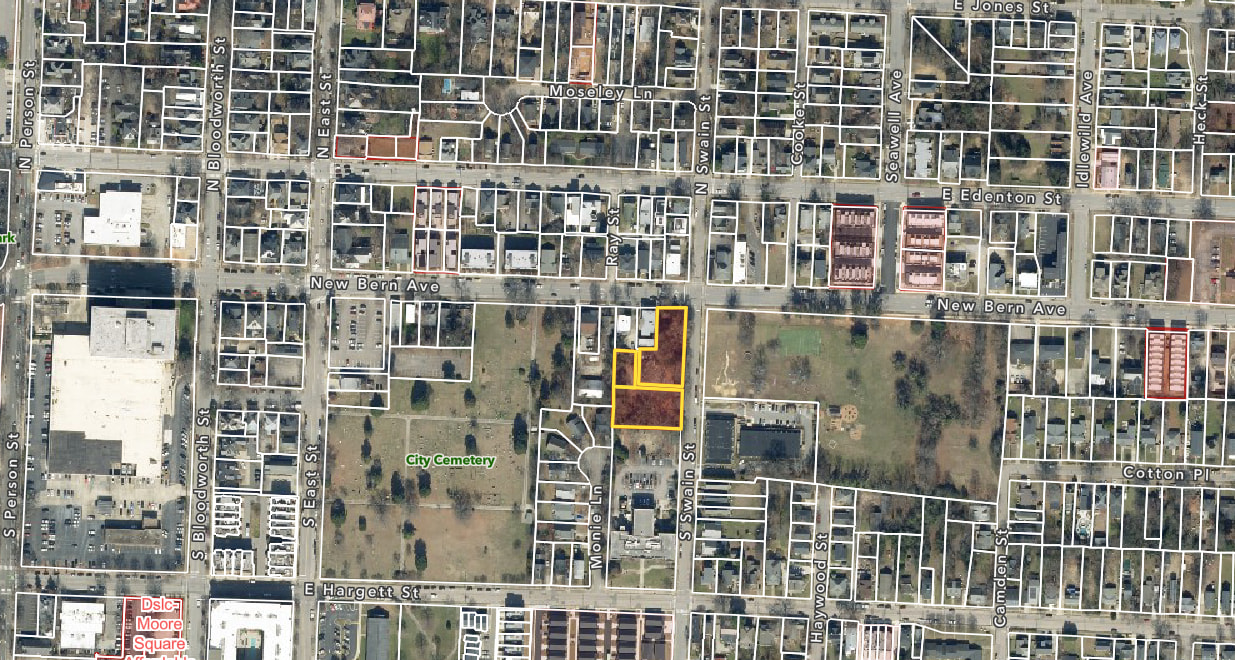
ASR-0026-2026 submitted. “Construction of a mixed use building” (currently zoned up to 5 floors, but they can get some sort of transit overlay bonus to go higher right?)
Back in 2021 there was an approved ASR for a townhouse building with 2 units facing New Bern and two 3-story residential buildings along Swain St.
Yes, they can get another 2-3 stories if they include affordable housing. Excited for mixed use here; hopefully larger site across from it will get moving soon too.