is this where the o’toole road user fee theory makes some sense? often his articles indicate that less than 10 percent of workforces work in central downtown areas.
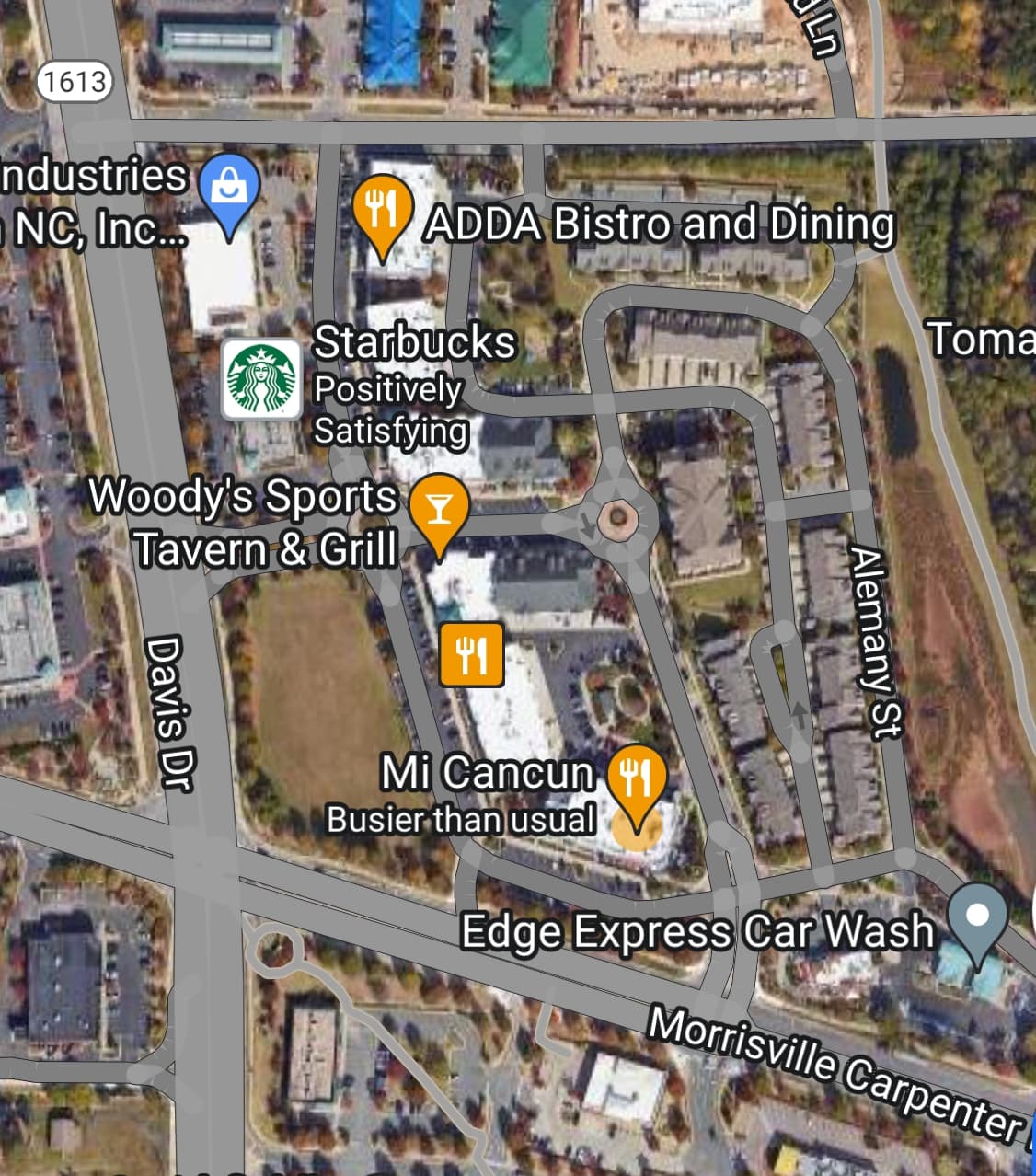
Grace Park in Morrisville is a good new-build suburban example of how this works with just surface parking. Another complement could be “live/work townhouses” of similar height, with tiny shops on the ground floor of otherwise conventional towns.
This format works for small shops, but not for big boxes, which have much wider buildings and require many more truck deliveries. Big boxes and larger chains are also more likely to want to own their stores’ buildings & parking, since they can resell those to “net lease” investors for a tidy sum; small shops don’t have access to that kind of finance.
This format could work well to infill vacant land left over at shopping centers, office parks, or maybe even replace older suburban houses marooned along busy roads. But it isn’t profitable enough to justify buying out and demolishing viable existing retail.
1 Like
Wilmington has an example of condos over giant strip retail at Mayfair. IMO it’s a model that’s sort of in between North Hills and Brier Creek.
6 Likes
There is a small section of Park West near the theater in Morrisville off Cary Parkway that is this exact building form. Lot of the retail vacant.
Just checked it out on streetview. Yeah, that’s similar for sure but not as robust as Mayfair. I can’t say that I’m a fan of either given the over abundance of surface parking that they swim in, but I can imagine the conversion of smaller, older strip centers that find themselves “dying”.
1 Like
Grace Park is OK but is brought down by the inclusion of “conventional” auto-oriented retail outparcels facing Davis. I go by there pretty often and always catch myself thinking it would be a big improvement if they’d do another mixed use building on the undeveloped outparcel site on the corner.
6 Likes
I’m actually impressed with Carpenter Village just near here. The density and mixed use neighborhood amenities are hard to argue with. There’s a music school, day care, dentistry, Indian restaurant, and other services all touching this one parking lot surrounded by a mix of housing types and a nearby lawn.
2200 Gathering Park Cir
2 Likes
IIRC, that stretch is being kept empty for future redevelopment, which will expand the mixed-use area.
https://www.newsobserver.com/news/business/article281635518.html
More likely that these would be scraped for 5-over-1s.
7 posts were merged into an existing topic: General Raleigh History
Putting this here because I couldn’t figure out a better place for it.
2 Likes
I’m probably more open to creating new towns than Chuck is but I do worry about towns and neighborhoods that are centralized like many New Urbanist developments are. For example we used to build townhouses where the owner of the townhouse owned the title to the land beneath it, now usually that’s held in trust as part of a condo development. So we’re kind of locking that into being a townhouse indefinitely, even if a duplex makes more sense at some future point. At the same time, townhouses are usually the highest density we build to own. Instead usually the higher density in a New Urbanist development is almost always purpose built rentals.
I’ve come to believe that lifestyle centers with housing, which is in effect what most New Urbanist developments are, are a lot less offensive to my sensibilities than without. In my mind that’s a node that we can serve with transit now, or in the future and will have some level of all-day demand but they still have many of the same problems as normal lifestyle centers. They’re often still making fake public space. Midtown Park at North Hills is still a private space, no matter how the urban design makes it feel, with the pros and cons embedded within that.
I have to think that North Hills is big enough that in 50 years Kane is not going to have the same level of control that they currently do. I’m curious to see if North Hills grows stronger or weaker because of that. I’m curious to see how things get replaced as they age there. The mall that used to be there grew weaker and eventually got knocked down to be replaced with North Hills. Will that cycle repeat itself? We don’t know yet but I hope not.
At the same time I feel like Downtown Cary Park was also deeply inspired by New Urbanism and is public with added private development. I like visiting Downtown Cary Park but it does have the suspicious clean feeling of a New Urbanist development, so I worry that it will have similar pitfalls.
In general I think the Congress for the New Urbanism tries to grapple with this but they tend to be a lot more people from the development side. They are people who succeeded in the system as it is and usually not from the elected official side. Going to CNU is awesome because they’re passionate about the built form and creating nicer places but you’d never find most of them at a dive bar to hear a garage band and I don’t think many of them understand the magic of those places.
16 Likes
They also replaced the grass field with fake plastic grass several years ago. 
4 Likes
Some unorganized thoughts in reaction to this video.
I think a related idea to this, and the video with Chuck’s thoughts, are the idea of boom and bust years for cities. Suburbs are like “your city 1.0” going through that boom phase and the reality is that a bust phase is coming in the future. Rich suburbs in California may give us some insights as to that future. I realize that an extremely rich suburb doesn’t sound like it’s going through a “bust” but when only the top 2% or whatever can afford it, I would argue that’s not what city advocates want.
Instead, you want an area where the built environment is accessible to as many people as you can, a variety of boom and busts happening all over the place. A new luxury condo building for those with means but around the corner is a 100-year-old warehouse where artists can rent space for cheap. (and things in between) Downtown Raleigh has this although the tear downs are probably a concern that we’d lose that variety of spaces in a variety of conditions.
North Hills will age. Market forces will change. Personal tastes will change. New places will be created but what seems to endure is a mix of uses or even spaces that can be used in a variety of different ways. I THINK North Hills is built for resiliency but let’s say one day, North Hills is just run by bad managers which is reflected out in their choice of shops and policy. That impacts everything in that area and it could impact their bottom line.
What makes downtown Raleigh (and other city cores) so amazing to me is how we can see things come and go in a way that feels like it’s an extension of the local population. Yes, people get all grumpy when a restaurant closes but when a space frees up, it’s an opportunity for someone else to make their mark and there’s a good chance it’s a local person, giving it local flavor. I try not to get upset that someone opened a store or restaurant, and then it closes. I should be happy I got to try it in the first place rather than it never opening up at all.
What I think I’m trying to say is that planners, builders, all of us, need to worry less about how an area is built out today. What’s more important, I think, is how we let it naturally evolve and respond to what that area needs to be in the future. It’s an uphill battle trying to micromanage a part of the city, attempting to maintain it the way it was, or the way it was intended for when built. This is tough cause it almost goes against our human emotional side.
Thoughts on this are, as always, a work in progress…
18 Likes
i guess my first looking into this was in 08 or 09. this
was from a buidler in chico ca called heh…‘new urban builders’ doe park is the name (center right). i thni in the video mahron wonders how well it will age. it looks pretty good to me. and i think more infill has occurred nearby and the collectors bordering the area have bike lanes now. while it might begin ‘as a worse suburb’ it possibly spurs more density surrounding it??
1 Like
Every block affects the blocks around it. I don’t see how you keep that at equilibrium. Naturally the wealthy will want to congregate and so will the artists. Downtown Raleigh is magical for that reason, that the luxury apartment buildings, artist studios and local restaurants all commingle but I think that’s because the luxury, isn’t really that luxurious. The real luxury has some in North Hills, some in Cary and some in a yet different place.
I often think back to going to a poetry slam in Austin, TX and them roasting the Mueller Neighborhood as bougie and a sign of gentrification. Don’t get me wrong, I love the hyperlocal politics but this is a neighborhood that literally replaced a decommissioned airport. It had a variety of building styles and most of them are on pretty small lots. It didn’t have any significant artist population. Yet I think many of the people that lived there were pretty well off, two income households, many with kids. Like Chuck makes the point all of them own cars. While there’s commercial nearby, in order to have the wealth to live there, you have to extract it from a different neighborhood.
I think that this is the one part of my argument. That if the level of consolidation at North Hills remains constant and over a long enough timescale it is inevitable that bad management will arise. The urban cores are adaptable in part because the closest thing they have to a Kane is the elected mayor and City Council of Raleigh. I feel like a lot of New Urbanist Developments have something similar to a Kane and that creates fragility.
Now the benefit of lifestyle centers when compared to indoor malls, is that they appear urban. The streets may not currently be legal but they could be comparatively easily to an Indoor Mall. So if Kane were to fall on hard times, the city could potentially step in, at least for street maintenance. Preserving at least some of the wealth in the area.
3 Likes
Firstly I think being suspicious of the downtown Cary park because it is clean is probably headed in the wrong direction. It’s new, well-designed, clearly a public park, popular, heavily used. It doesn’t feel any more sterile or spotless to me than Pullen Park for example - just newer. How bad have things gotten, so that something that is nice automatically engenders suspicion? IMO, this is something that we should strive to emulate - not be wary of.
On a broader topic, much of New Urbanism’s origin is as a way of doing greenfield development. Think Seaside, Florida or Lake Anne in Reston Virginia.
I think we need to draw a distinction between that (local examples: Southern Village, Meadowmont, perhaps Fenton, etc) and redevelopment (North Hills). Greenfield new urbanism is in some ways just sprawl wearing a “new urban” mask. Better than standard sprawl, perhaps. But still sprawl.
Infill new urbanism like North Hills is better than what was there before (a single-owner shopping mall) so I have a hard time frankly being anything other than excited about it.
Kane Realty already has substantially less control over North Hills than he did, because he tends to sell off pieces of it as it is completed. Mind you, this is not because they value diversity of ownership and management, per se, but because they do this to recapitalize in order to proceed with the next phase of the development. Motivations notwithstanding, the effect is the same. I expect the rest of the low rise portion of the 2004-era North Hills to be redeveloped into mid- and high-rises, and pieces of it to be sold off, and so on- the area will continue to refresh and update.
19 Likes
Here is a helpful kitchen analogy for sprawl, new urbanism, and traditional urbanism:
Imagine living in a massive 5,000-square-foot house with multiple levels. The kitchen is spread across the entire home: the stove is on one floor, the sink is on the opposite side of the house, the pantry is in the basement, and your cooking utensils are stored in the attic. Every time you want to cook, you waste time running between rooms to gather ingredients and tools. It’s an inefficient, frustrating experience. This is sprawl (vast distances and separation between everything, making even simple tasks cumbersome)
Now, picture a more compact 1,500-square-foot house. The stove, sink, and pantry are closer together, but they’re still spread across different rooms. While it’s more efficient than the sprawling house, you’re still spending time walking from room to room to grab ingredients and tools. This is akin to new urbanism (neighborhoods designed to be more compact and walkable than sprawling suburbs, but not yet fully optimized for convenience)
Finally, imagine a 250-square-foot kitchen, all in one room. The stove, sink, pantry, utensils, and workspace are all within arm’s reach. You can seamlessly move from one task to another, grab what you need quickly, and everything is in its place. This is the traditional model of urbanism (dense, efficient, and easy to navigate - everything you need is within close proximity, making daily tasks simpler and more fluid)
9 Likes
Edit: Sorry for the long thread.
Here’s some summary points:
- I consider Celebration to be a high end suburb. It lacks amenities that I would look for in a good development (non-car transportation, jobs for those who can afford to live there, housing for lower income residents who work in the area).
- North Hills is a better development compared to Celebration due to its location and surrounding neighborhood.
- Not all suburbs are bad. Some can be designed as well as Raleigh currently is right now. Density does still play a factor.
I’d want to hear other thoughts about other “new urban” developments outside of Celebration. I don’t know much about Celebration, but from looking at Google maps, it appears that there is no way to get to Celebration outside of driving to it via a highway. Celebration itself looks to be a new high end neighborhood with only access to itself outside of driving.
The presenter (Chuck) talks about most of the people working outside of Celebration. He also talks about people who work in the city driving in from somewhere else. The problem with Celebration is that they basically built the whole town as a new development. The new high end development is going to be expensive. This means that the workers will not be able to get there without a car. The development should have included housing that would be priced at lower prices. In looking at it, I really consider Celebration to be a suburb.
If we compare Celebration to North Hills: North Hills has access to the surrounding neighborhood. Most of the immediate areas surrounding North Hills is upper end however if you go a bit further, you have neighborhoods which are more moderately priced towards the east. This is way different than a neighborhood like Celebration.
North Hills also has a mixture of bars, restaurants, shopping, and offices. It appears that Celebration does have bars and restaurants, but is missing offices in which the people who live in the community could also work in the community (assuming no remote work). I do see some office buildings there, but given the expanse of Celebration, there appears to be a way less amount of jobs per square mile compared to NH. It appears that Celebration is also lacking a centralized grocery store. Their grocery store is about 3 miles from Celebration’s “Town Center”.
Over time, I can see North Hills current apartments/hotels getting older and becoming less expensive. Given the location, I still think they would still retain a higher cost compared to the surrounding older complexes (in which there are not many). If it’s deemed that it makes more financial sense to tear it down and build new apartments, then I can see that happening. I wouldn’t expect any of the places directly (within a half mile) adjacent to North Hills ever becoming cheap enough for the working class to live in.
I don’t really see why Celebration would be considered “new urban”. I would want to see what makes it different from any other suburb. I also don’t consider all suburbs to be bad. Some suburbs do have housing as well as other amenities such as shopping, restaurants, bars, greenways, etc. Celebration also seems be lacking infrastructure like bike lanes. For me, I would have preferred larger sidewalks which can accommodate bikes and walkers. The sidewalks look to be really narrow (similar to sidewalks here). North Hills also lacks biking infrastructure and greenways as well which is my main gripe. On the west side of North Hills, the sidewalks are wide until you walk towards Six Forks Rd. On the east side, the sidewalks could be bigger, but instead are obstructed by trees, benches, and outdoor dining. Speaking of which: why do we make sidewalks wide only to make them narrow again with the outdoor dining? I like outdoor dining, but hate having to squeeze between people on the narrow sidewalks.
On the aspect of suburbs, I don’t necessarily hate all suburbs. When I lived in California, and still lived with my parents, we lived in a suburb called Dublin. We lived on the edge of the town in an apartment complex which is now called Eaves. Even though we lived on the outer skirts of the city, we were only 2.2 miles away from a grocery store and other shopping. 2.2 miles is within biking distance. Dublin does have bike lanes which does put many within biking distance to a grocery store and other shopping. Dublin does not have a “main street” which is one thing I don’t like about it. It also does have wide streets as well (look at Dublin Blvd.). Although I don’t like the wide streets, bigger cities also have the same. A few examples of other suburbs that do have a “main street” is Pleasanton directly south.
One thing I do like about suburbs like Dublin is that you would have the opportunity to live without a car there given the bike lanes (I still prefer wider sidewalks or separated biking infrastructure, but I guess most places in the US opt for bike lanes  ). One thing that does annoy me about Raleigh is that we cannot get bike lanes (lanes not sharrows) in even the more dense parts of the city. What’s worse is that we can’t even get sidewalks near the center of the city in some areas (look at the Five Points thread). This is also my main issue with suburbs in the triangle. A quick street view look does show that Pleasanton does have some bike lanes, but it does not appear that they are on Main Street itself. If we compare it to North Hills, a suburb like Pleasanton is just as good. If we compare Pleasanton/Dublin to Raleigh, again a suburb is just as good (it just lacks tall buildings). Pleasanton does have an office park which appears to have bike lanes through it. I had experience biking from Pleasanton to Dublin after I had wrecked my car when I lived there. I don’t remember bike lanes being there at the time.
I will admit that Dublin has a population density of 4,766 people per square mile, while Pleasanton does have 3,300 per square mile. Raleigh has 3,148 people per square mile. Given the density differences between Raleigh and Pleasanton being minimal, Raleigh should have more sidewalks and biking infrastructure than what is currently in place. I do know some are being put in, but I’ve also been disappointed with some of the newer infrastructure: Oberlin Rd with sharrows; Hillsborough Street with sharrows; Peace Street with sharrows. I’ll still take what we get as it is better than nothing.
Going back to the main topic: I find celebration to be something that we should not even consider to be a good example of “new urban development”. If anything, it should be considered a low quality suburb. I mention low quality because there are some decent suburbs. CityNerd has some videos on this.
4 Likes
For reference Celebration was built right as the Congress for the New Urbanism was coalescing: The Charter of the New Urbanism | CNU by many of of the same people. I kind of think of CNU as the trade group pushing us towards New Urbanism and they mostly defined it. From my understanding Seaside, Florida is better understood as the first “New Urban” place but I believe it has many of the same problems.
I have a friend who calls themselves an “Old Urbanist” because they disagree with the CNU about what makes a good urban place and feel like they’re bringing the values of the suburbs to a building style that appears urban.
3 Likes
What I can appreciate about New Urbanism is that it seems to be offering something in between traditional suburbs and urban living. Raleigh really blew up with suburban style development in the 90s and 2000s. Imagine if all that building stock starts to get too expensive to maintain. I’d hate for it all to just be replaced with new homes, one to one. Maybe in 50-75 years, North Raleigh might double in density and look like Celebration.
3 Likes