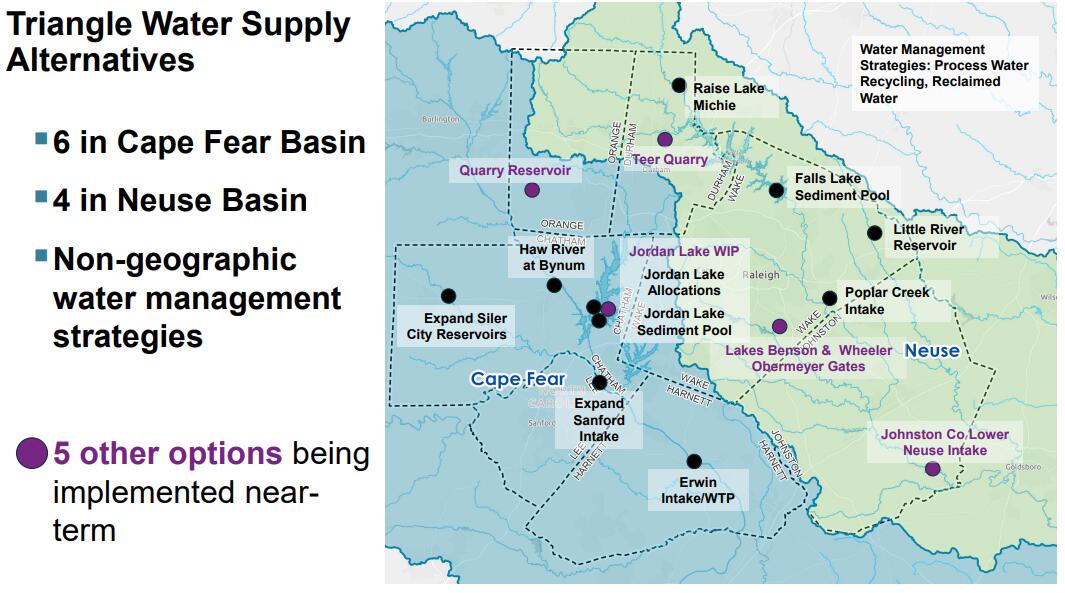
There is a Triangle Regional Water Supply Plan that’s being updated now to forecast through 2070. Quarries could be filled to provide capacity upstream of Falls Lake; existing reservoirs could be expanded.
(This map also illustrates ctill’s point about how little Neuse river basin exists above Durham.)
Raleigh and Cary both use some “indirect potable reuse” (IPR) water. Durham’s two wastewater treatment plants discharge into Ellerbe Creek (upriver of Falls Lake and thus Raleigh’s drinking water intake) and into New Hope Creek (upriver of Jordan Lake and thus Cary’s drinking water intake). Orange County’s sewage goes into Morgan Creek, which also flows into Jordan Lake. Raleigh has just started to investigate potable reuse; that may be part of the “Poplar Creek Intake” on the map above, near the WWTP. An intake there would also be downstream of the North Cary WWTP, which outfalls below Lake Crabtree.
Durham and OWASA are already working with Chatham to build a new Jordan Lake treatment plant, making them more directly circular in their water use. Cary has a long-term option to be circular and discharge WWRWRF water closer in, rather than piping it down below Harris Lake. Northern Virginia has been doing this for decades, and Hampton Roads is ramping up 50 MGD of water recycling capacity – nearly matching the 60 MGD that Va Beach purloins from NC’s Roanoke River.
The city needs to start promoting and encouraging water conservation. In particularly the incessant obsession with non-stop watering your lawn that a very large part of the population has.
Encourage / promote less grass lawns and more native and drought tolerant plants that require minimal watering.
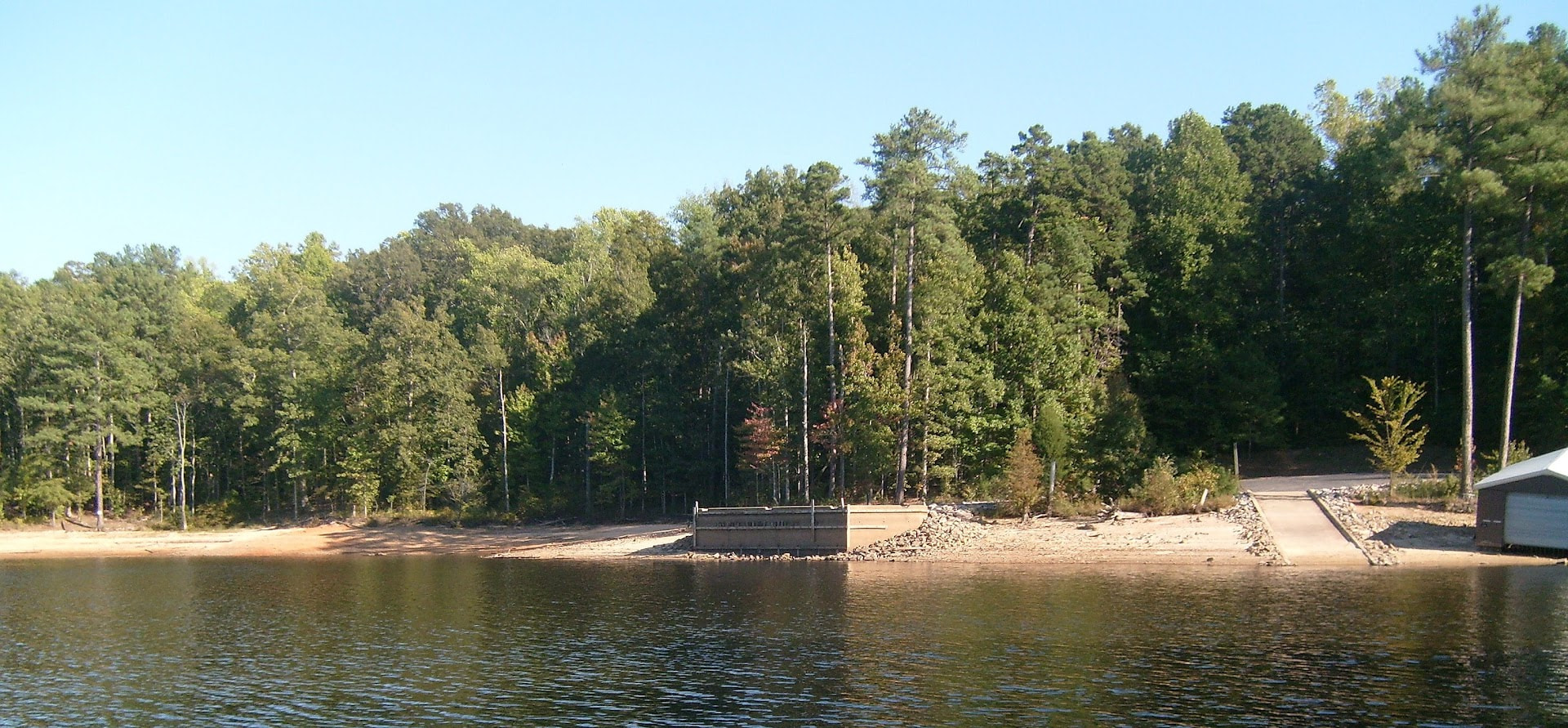
We moved back to Raleigh during the 2007/2008 drought. Falls Lake was basically a stream where it crosses I-85. There was a huge push for water conservation, low-flow faucets/toilets were strongly encouraged, and I seem to remember there was a plan to ban under sink disposals all in the name of reduced water consumption. You only got water in restaurants if you specifically asked for it and any unused water was poured into buckets and used for mopping the floors. At the time, Durham had around a 30 day water supply and Raleigh was around a 60 day water supply.
Thankfully, the drought finally broke and we returned back to normal conditions. However… because of all the conservation measures that had been put in place, the City wasn’t making as much revenue on water bills and covering the costs of the water treatment system, so they changed the billing system and you guessed it, water bills increased. As a professional in the environmental world, I am 100% for conservation and better use of our resources, but what we moved into from RVA to RDU in 2008 was an interesting scenario to say the least.
A good article from the Indy. It’s easy to forget, but all the trash we produce every day has to go somewhere, and one day we will run out of places to put it. Then what?
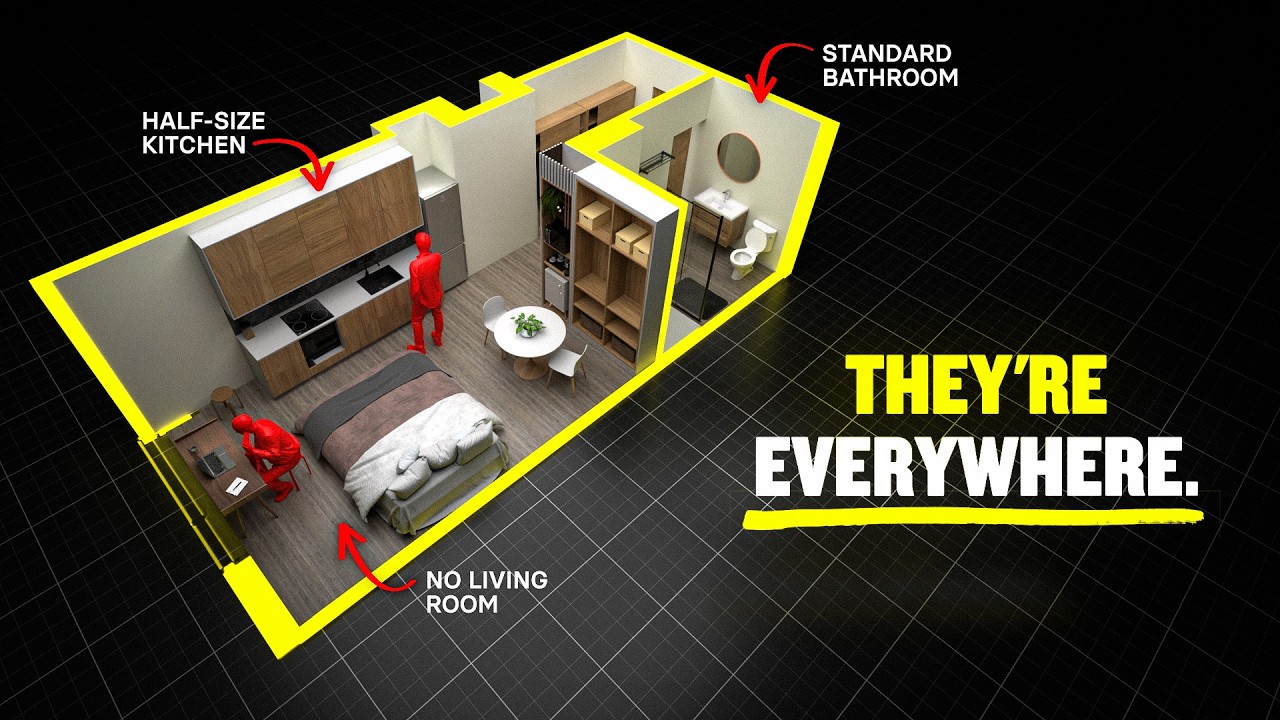
One of my favorite YouTube channels is Never Too Small. They are mostly in Asia and Europe, but every once and a while they will come to the US as well. Most of their videos are of older rehabilitated buildings rather than new construction. IF I didn’t have 3 kids at home, I would love to severely downsize, move into a more urban area and live in a much smaller footprint. That may be the plan at some point in the future.
It is nice to see that the US is finally starting to back off on square footage and transition into smaller abodes, and maybe bring back “third places” as well.
Thanks for sharing, there is micro units in Durham, but overall subtype of multifamily tend to behave more like a cyclical trend than a long‑term solution and you can typically see this with their their financial performance as an indicator of broader housing conditions. Like right now where housing costs “have spiked,” some developers will respond by delivering these smaller and smaller units either to bring down cost slightly or add more units to a site due to other constraints. This can work temporarily in the high‑cost, high‑density markets, but I can tell you when sentiment shifts and renters have more options, these ultra‑small units often become harder to lease and experience little to no rent growth compared to conventional apartments. Given Raleigh’s current and projected fundamentals, I don’t think they align well with demand patterns here, and I wouldn’t consider them a strong development choice for the foreseeable future.
Say in 2 years with our continued apartment supply pipeline, a new 700 SF one beds leases for $1,600 and I have a 300 SF micro-studio building that needs to rent for $1,100 to be profitable - that’s going to go sideways! You also have to remember if unit count isn’t a primary focus, most micro-units aren’t half the price of a regular, they are about 80-85% because the majority of cost is still in the required items (bathrooms, kitchen) and you end up paying a premium for a 18" dishwasher over a 24" among other things.