As excited as I am about South Raleigh getting some serious development interest, I’m not convinced on the economics of this one.
Someone sell me on this proposal. What do Raleigh’s tax-payers get in return for their $239 million. As an investment, how does this leave us a quarter of a billion dollars better off than without it? If the economics of it actually pencil out, why is the subsidy necessary?
Because corporate socialism = good, while people socialism = bad.
I think that Kane/Malik/others needs to demonstrate the value to the community. However, I don’t know that all of the value needs to be demonstrated financially. Clearly, there does need to be a financially advantageous story for the city like how much tax revenue are they bringing in, and how many tourism nights are they creating, etc.
Here is an experiment you can do to demonstrate whether this is a good idea. Go to a spot in the existing downtown that you are likely to go to before or after a sporting event, and then walk to the site of the proposed stadium. If you find yourself tired, or frustrated, or walking on a highway, then it’s not downtown and won’t be for some time.
Here’s another experiment. Let’s say the city funds a fully stocked, state-of-the-art stadium right downtown (not “Downtown South” or wherever else) to lure a new franchise or steal another city’s. They complete it, flip the lights on, and announce that they’re ready for a new team. Not only is there no promise that any team will appear à la field of dreams, but it’s unlikely any team would ever bite.
Kansas City did exactly this: the Sprint Center opened in 2007 and has hosted 0.0 pro franchises
Quebec City did the same, obviously gunning for hockey. The Vidéotron center has hosted a minor league team.
I’m sure there are other examples but I’m too lazy. KC has had issues with this and they don’t have a competing media market 2 hours down the road like we do.
Nevermind the fact that every serious economic study has shown that public stadium funding is a loser. Frankly, if the city funds any sports-subsidy boondoggle while the economy is in the tubes, there will be torches and pitchforks in front of city hall, and rightfully so.
If we want this part of town improved this is the only way. If you rather see it remain as is, then don’t support it. Simple as that. Even though I do not support soccer I think that the tax value of this land will increase with this development and over time it will be worth it.
I am currently neither pro nor con – but I do want to point out that with TIF financing, it works like this:
If there is zero additional investment, there are zero additional taxes and zero new development (which will provide value in many ways)
If there is 100 million additional investment, there will be NO additional tax revenue to the city UNTIL the grant is paid off. Then all taxes go to the city. Also important to clarify that there would be Zero dollars from current city coffers are used to fund this grant.
Whether it’s this project or not, I like this kind of incentive.
Offer some funding now for Malik to build a small stadium that is expandable to a larger size when he lands an MLS franchise. Approve additional funding but it only kicks in if, and when he gets the MLS team.
I think this is spot on. And I do not believe there is any broad support for MLS in Raleigh. I can’t think of a set of circumstances that would ever bring me to an MLS game even in the same city I live in, and I can’t imagine there will be a lot of people driving over from Durham or Chapel Hill for that. I’m surprised the Hurricanes have lasted as long as they have - likely due to transplants from colder climates but I’m not sure they will be here long term either.
I wonder if that’s one of those things that sounds better in theory than practice. Can you hold a future city on the hook for past promises? I mean I know that’s the nature of government, but I doubt this would be as ironclad as a pension program, so I’d imagine there’d be enough caveats that a developer might think it isn’t a guarantee at all.
I guess I on the fence on this. On one hand I know the numbers of government investment rarely add up on a ledger. The question is do I think this is a play at a better future for Raleigh ( I’d say yes) AND whether that play is worth it even if the money isn’t recouped (it’s close to me). I maybe just wish we were talking about a PNC replacement here.
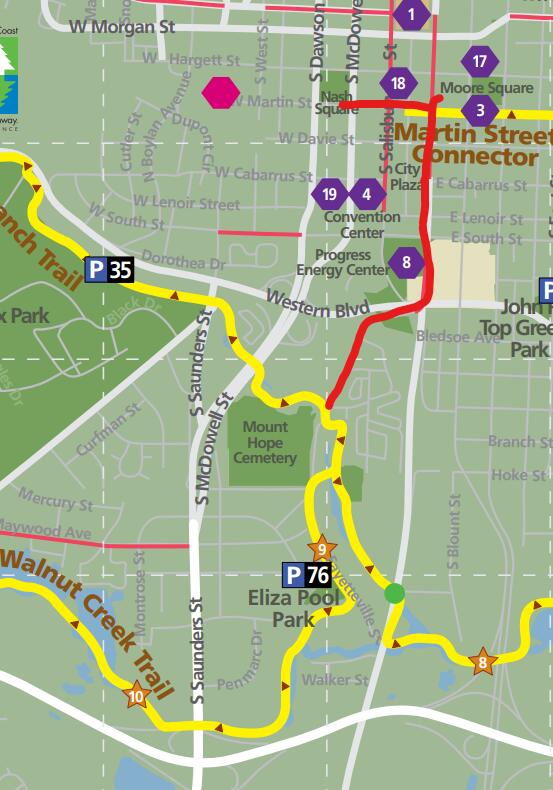
I think that this development needs a lightweight people mover that that moves back and forth between it and downtown proper: possibly something that runs north along Wilmington St., loops around the performing arts center, and then heads back down Salisbury to Wilmington. If that’s too expensive, as it undoubtedly will be, then expand the RLine to run this additional route.
Either way, this will allow access to Raleigh’s growing downtown population without the need for them to get into cars. We can ride the RLine to the convention center and then switch buses to the DTS route.
Require as a condition of funding that the developers operate their own transit system to and from DTR. Free ride with a gameday ticket. South on Saunders, North on Wilmington, pickup in the Moore square station.
Also, DTS is on a greenway - Have Kane/Malik sponsor the protected bike lane program to close the gap from DTR to DTS with heavy bikeshare facilities.
Not entirely correct. TIFs are loans, and so the money that funds improvements on the front end has to come from somewhere. That somewhere is public reserve or debt capacity.
That’s a good idea, but I also think that there’s also an opportunity for some synergy between DTS and the Convention Center. Imagine how valuable a resource like a 20,000 seat open air stadium could be for attracting conventions that could utilize such a resource? Already the convention center is walkable to the Duke Energy Center; connecting it to an outdoor stadium resource only expands the advantages to choose Raleigh for a convention. Isn’t DTS also supposed to have hotel beds? If so, that’s another reason to connect the two with a lightweight transit solution.
I agree that there’s a need for transit. But why does it need to be a new people mover?
We’ll (hopefully) have a shiny new BRT line that connects the Convention Center and Wilmington St. BRTs hold more people per vehicle, has much fewer stops than buses, and is something the city’s getting ready to commit to. So I’m not seeing why we need to go out of our way to build and maintain something new and foreign when we could make use of what we already have.
EDIT: reworded to make it clearer that I’m asking about practical benefits, not cost savings.
Gotcha. It’s been a while since I was in that line of work, but I think they may be talking about a synthetic TIF. So it’s not really a formal TIF. it’s self-funded. With that said, I could be 100% wrong
If you read my post, you’d see that I said that a people mover would likely be too expensive. After that, I added that a bus solution would work too. Specifically I mentioned an additional RLine route.
Yeah, I saw that post and understood that, too. What I meant to ask was what’s especially good about a people mover in this situation? Even if we ignore money for just a second and just talk about what we see and what we get, the benefits of an APM versus a bus/BRT seem pretty similar.
(I also edited that earlier post of mine too make that point clearer)