Is there any news on the status of the $1B S-Line grant for the Raleigh-Wake Forest section of the line that was awarded at the end of 2023? Recently it has emerged that the Trump administration appears to be trying to run out the clock on completing the paperwork and agreements to finalize the previously-awarded grants that it doesn’t like (read: projects that don’t prioritize cars), and several communities have received notice of outright cancellation of their grants. So far I have mostly only heard of bike/ped grants being affected, but I can’t imagine a grant this large for trains isn’t liable to be affected too. Last we heard, NCDOT was still expecting the funding to remain and it was reportedly brought up during Secretary Duffy’s visit to tour Helene recovery. I hope that’s the case, but I can’t help but see what is happening for other projects that don’t align with USDOT’s regressive new cars-first ideology and wonder if our biggest rail expansion project in years could be at risk of meeting the same fate. Does anyone have any further or more recent information?
I would read the lack of any update as a relatively positive thing, since DOT has explicitly announced recision of funds for other projects by now.
Trump’s DOT does want to support passenger rail, to some degree. Assuming they do manage to claw back money especially from CAHSR, NC is one of the most likely recipients, as a relatively uncontroversial project with bipartisan support in a red/purple state where the implementing agency is generally regarded as competent and frugal.
Bypassing Greensboro is only feasible if you build out a fully upgraded, electrified NCRR first. You are correct to point out that it would have to be framed as a part of a project that extends beyond the borders of NC such as implementing 4 hour DC-Atlanta service. And of course an alternative hitting both Greensboro and Raleigh, as well as one bypassing Raleigh and going through Greensboro and/or Durham would quite reasonably need to be evaluated as well.
Unless NCDOT decides to make a freeway out of NC 49 between Asheboro and Charlotte – unlikely, I think – the comparison of train time Raleigh-Charlotte vs drive time on I-85 will only get more favorable for rail as the population of NC continues to increase. In other words, 2 hours 30 minutes for rail will look better and better over time. As for substantially faster running times Raleigh-Charlotte, we already can’t afford SEHSR between Raleigh and Petersburg. Plus, we have the Wilmington and Asheville people asking for trains. It will be interesting to see how politicians sort out the sequence.
Driving between the two cities would have to become absolutely miserable to get the sort of attention needed for substantially improved rail service. It’s sad to say, but I fear it’s true.
Right now, during rush hour, I just checked the 40/85 route between Raleigh and Charlotte, and most of it is showing green on Google maps. That is, of course, after leaving the Triangle. 40/85 from Durham to Greensboro is wide and usually free flowing, and 85 from Greensboro to Charlotte also looks like smooth sailing. And, sadly, the state will never let the freeways get to the point where they might trigger serious conversation about upgrading the train experience beyond normal service. Yes, I’ve all but given up hope for anything substantial to happen in my lifetime.
I wouldn’t say it’s impossible to increase I-85 capacity between Mebane and Charlotte, but the low-hanging fruit has already been picked. The eight-lane segments have used the former median. Bridge widths along those segments would make expansion very expensive. The six-lane segments are more easily expanded but usually that’s not where the problems are. In any event, the cost-benefit ratio of increasing capacity would be questionable.
For those who live in the Triangle and do business in Charlotte or vice versa, spending five hours (at best) in a car for a same-day trip gets tiresome after you’ve done it 100 times. That’s where the train comes in. I don’t necessarily want to spend seven hours in a train, either. But if the choice becomes five hours in a car or five hours in a train, substantially more people will choose the train than they do now – and the ridership is pretty good already.
As for what happens in my lifetime, I’d be satisfied with a new Charlotte station, a Wilmington train, and getting to 2 hours 40 minutes Raleigh-Charlotte which is within reach. I don’t expect to see anything faster than 90 mph in North Carolina. Maybe my sons will.
Being from Raleigh and getting my undergrad degree at UNC Charlotte, I am quite familiar with the US64/NC49 route, and it is a great “secret” to getting around the interstates. With the boom of Chatham County and the Toyota mega-site, I can only assume that this route will continue to grow as strong alternate between I-40 and I-85.
I remembered hearing about this but haven’t kept up with it. Wow is it huge! Is the entire thing going to be Toyota battery manufacturing?
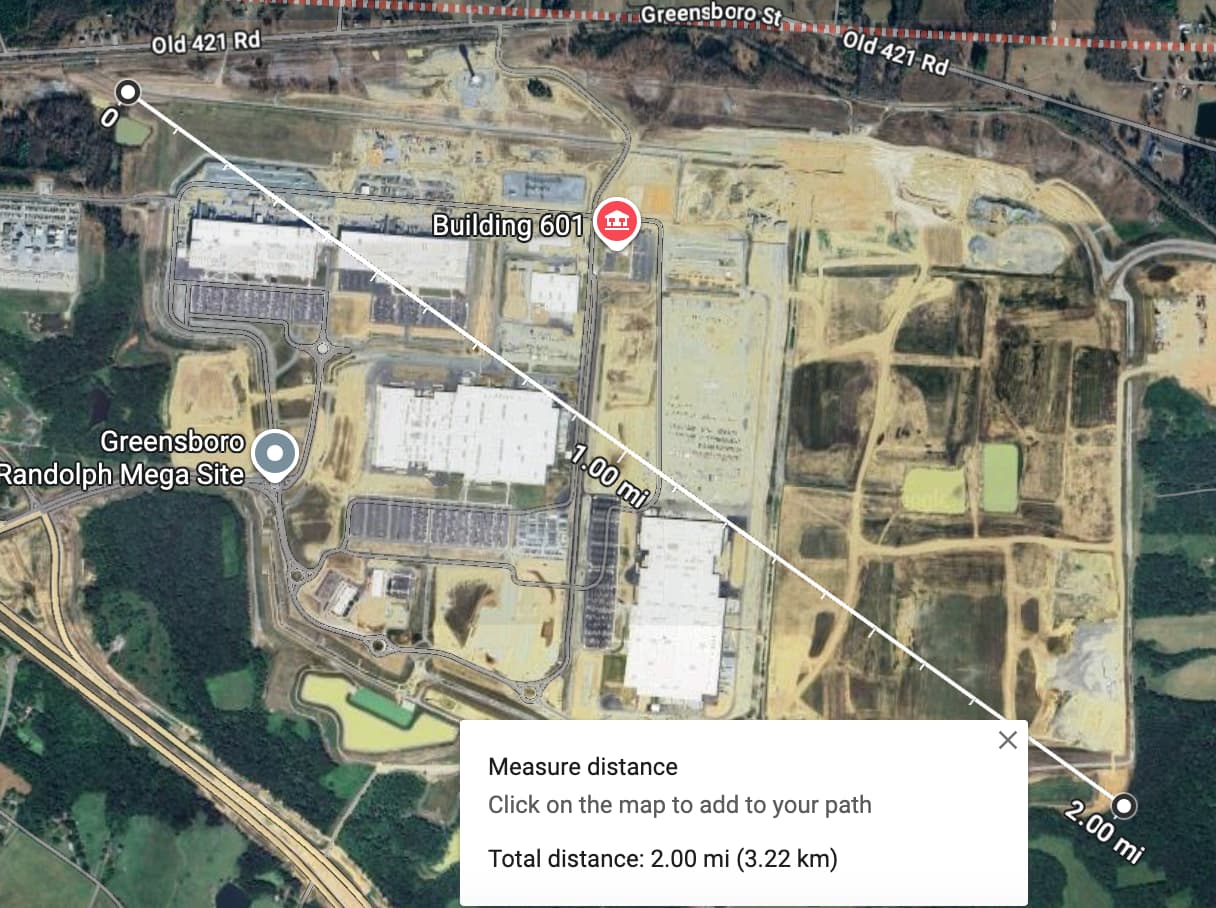
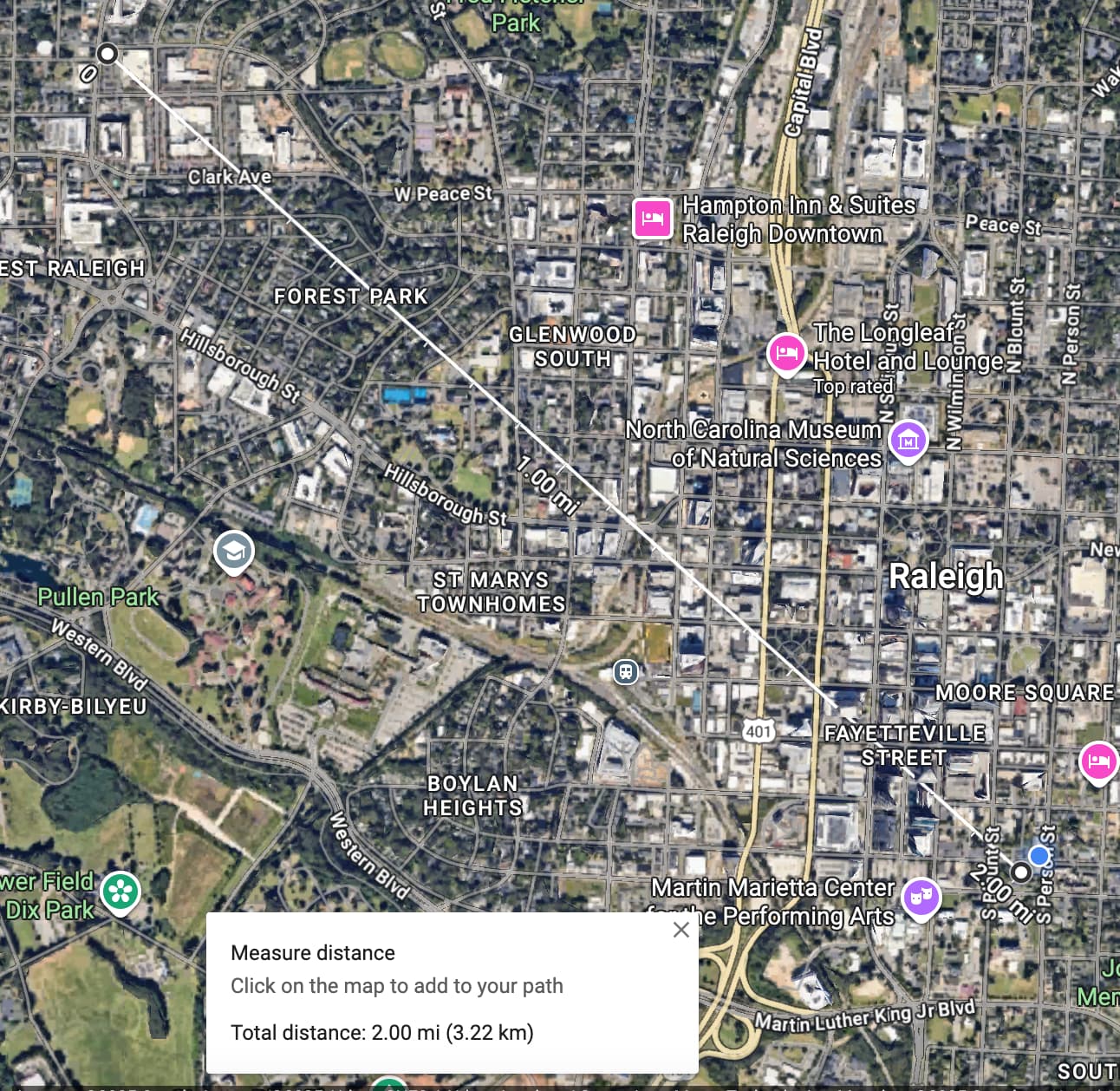
Here it is (the yellow square) within the borders of Randolph county (dashed line):

That is truly a mega site! Thanks for all the maps.
I do have to say, NC has some really great town names.
Maybe I’m thinking too far outside the box but what is the feasibility of HSR to Wilmington? (at least from Goldsboro southward). Seems like it would be a good testbed since it’s extremely straight and goes through the middle of nowhere. Most of the track and various bridges have to be rebuilt anyway, but the ROW looks like it’s generally just overgrown otherwise.
Similarly, Charlotte-Wilmington seems like it would be a decent candidate for HSR. The CSX line goes almost dead straight through ENC, and that drive is agonizingly boring.
Incidentally, Charlotte to Wilmington contains literally the longest stretch of straight track in the USA. Goldsboro to Wilmington has no such records but you are indeed right- not a lot of curves to deal with. So, at first glance, a great opportunity for HSR.
A problem here is that although the railroads are very straight, and the region is generally sparsely populated, what density there is tends to cluster around the historic town centers that are almost always centered on the railroad.
I agree with Orulz. From Selma to the outskirts of Goldsboro, the NCRR is 20 miles with only one shallow curve. South of Goldsboro, the ex-ACL is 78 miles with only two large curves and three shallow curves all the way to Smith Creek in Wilmington. But along the way you’ve got to deal with Burgaw, Wallace, Rose Hill, Magnolia, Warsaw, Faison, Calypso, Mount Olive, Dudley, Brogden, Princeton, Pine Level, etc. Building HSR through wide open area on the Coastal Plain is indeed relatively easy, but dealing with all the road crossings in those towns is not. As soon as you start bypassing those towns or building large numbers of bridges, the costs rise rapidly.
A CAMPO meeting scheduled for tomorrow will talk more about the Triangle Rail Study’s recommendations on how to incrementally work towards a regional rail system. A lot of it clarifies what I reported on earlier, but there’s some additional context and data that’s still interesting.
Click each point to expand:
So where will trains run first?
The report found that the Mebane-to-Clayton corridor is probably the most likely to win federal and state funding. This is good to know, since this work did not intend to recreate or validate ideas from the old commuter rail attempt; the idea that the Mebane-Clayton route is “the best” just brought itself back to life. HDR, the firm that NCDOT paid to do this study, explains it like this:
Remember that a “local match” is required before feds give you money for these sorts of projects.
Does this mean the Mebane-Clayton corridor is exactly where we’ll get regional rail in the Triangle? We don’t know yet; like we keep saying, this is just the first of many long steps where we collect the information that planners, lawyers, and engineers need to make regional rail in the Triangle happen.
First, the report clarifies what they meant from the awkward service concepts that they had:
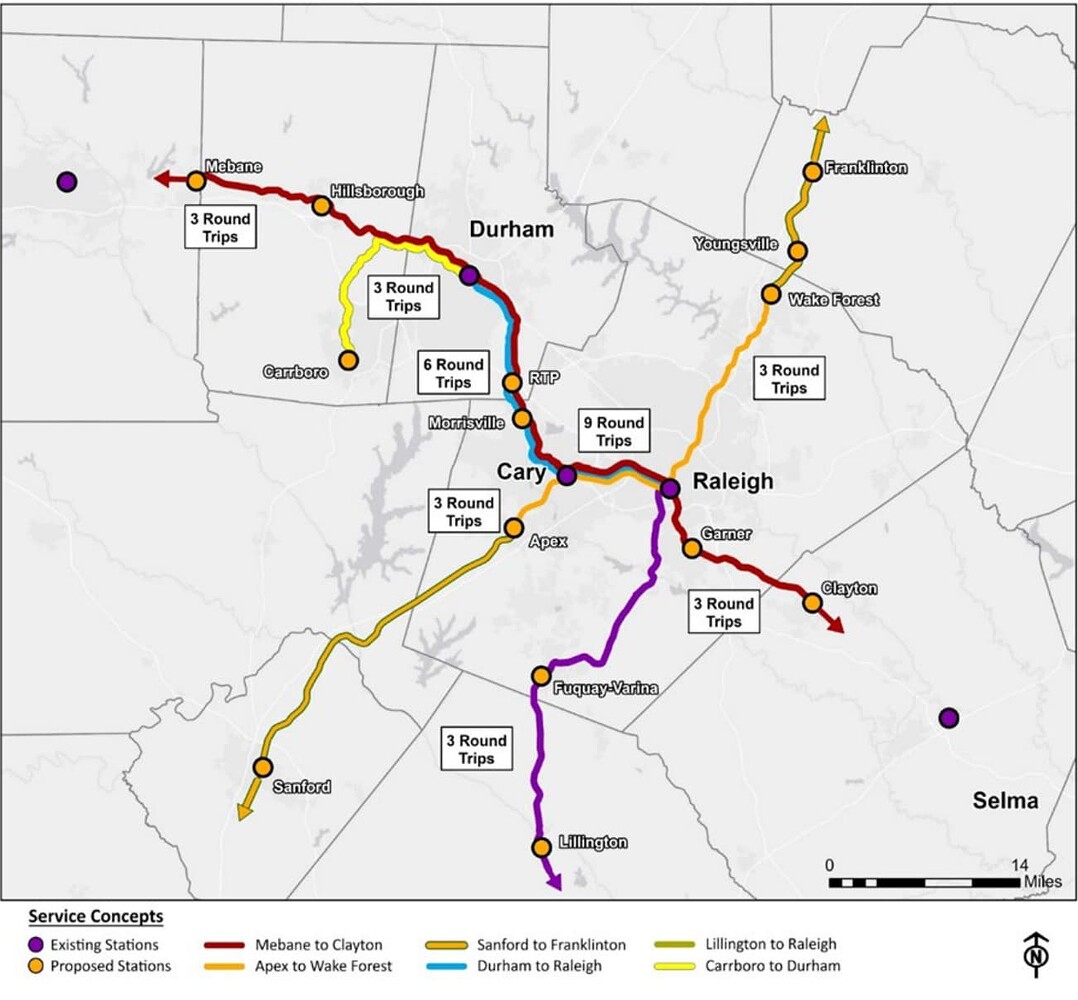
…which means the awkward corridors and its service counts are not necessarily the actual routes that they think trains should run. Rather, it’s how they broke up our potential rail network into easy-to-examine chunks just so we can understand it better.
So what are the corridors that trains should actually run through?
HDR calls for NCDOT, CAMPO, and/or TWTPO to take charge in this work - implying that, as @orulz and I’ve dreamed of, NCDOT just might have a bigger role in planning train services, too, in the future!
How will we pay for these improvements?
This means that, rather than trying to say “let’s make rail better in the Triangle!” or “let’s improve the whole of XYZ corridor!” by tossing all the money we need at once, it’s better to break things down into more granular, specific needs - and to go to different funding sources as appropriate.
Federal, state, local, railroad owner-based,… this approach acknowledges that different improvements are more interesting to different stakeholders - and, therefore, they’d be willing to pay different amounts for different pieces of the overall puzzle.
Also, different funding mechanisms implies different kinds of homework that local officials need to do. NEPA and pre-NEPA planning from individual cities for future locations of stations, a “network rail operations study” where NCDOT and freight rail companies figure out how passenger and freight trains can play nice with each other from scheduling and hardware perspectives, picking a site for a regional train maintenance facility, registering projects into the state’s competitive funding program,… not all of them are appropriate for every part of Triangle rail upgrades.
That leads to the next question!
What do we need that we don't already have?
You’ll remember from the commuter rail study that a big reason it was shelved is because the need for new infrastructure made things way too expensive (especially from Cary westwards). The report from HDR also pointed out the specific things we need, as well as an initial guesstimate of costs.
The June 2025 bit is obviously important since no one knows what the Trump administration is going to do (for transit funding and otherwise). Even if it’s at the expense of California’s high speed rail, our state is probably still competitive for new money. Of course, the State of North Carolina is an entirely different matter.
I’ll talk more about what’s on that project matrix in a second, but here’s some notes on how the things on there were ranked:
The link to the CAMPO meeting lets you download the full matrix, but here are a few that particularly caught my eye:
-
New stations in Mebane, Hillsborough, RTP, Garner, Clayton, Apex, Wake Forest, and/or Morrisville ($16M ~ $25M per station)
-
New stations + new signals, straightened tracks etc. in Sanford, Youngsville, Franklinton, Fuquay-Varina, Lillington, and/or Carrboro (up to $200M per station)
-
New platforms in Durham ($260M including second track), Cary ($80M including second track), and Raleigh ($1.3 billion including track changes and modifications to the existing train yard)
-
Heavy rail maintenance facility ($220M, assumed to be near the intersection of Old Hillsborough Rd. and Spruce Pine Trail in rural Orange County for the time being)
-
New sidings, layover tracks, converting sidings into second or third mainline tracks etc. ($60M to $340M depending on the location)
The report also calls for CAMPO and TWTPO to update both the project matrix and decision process “every two years AFTER the most recent NCDOT SPOT scores have been released in the latest round of prioritization”.
Could we game the system by starting out with inconvenient rail services, then expanding them to be higher-frequency or otherwise better?
Short answer: obviously no. But it may be worth it to shoot this idea down in a more rigorous way.
This study also begs everyone in the Triangle to consider something important:
Seems like the team behind this is doing a great job, very thoughtful/careful.
However, wow… over a billion for new platforms in Raleigh??
Thanks for this summary. This incremental approach can be very effective, while keeping the big picture in mind. We need leaders and the general public to understand both, and support funding for these projects. The RTP station is a good example. Also all of the grade separations.
It’s not just platforms, the $1.3B is the cost of the entire project to extend Piedmont service to Wake Forest, which NC received federal grants for in 2023. That includes track upgrades and modifications to Capital Yard, several new bridges, and the new platform at Union Station.
There’s much to be said for incrementalism, which is the approach that ultimately succeeded in getting 5 trains a day from Raleigh to Charlotte. If NCDOT had tried to achieve that from day one, they would have been laughed out of the General Assembly. Crawl before you walk, walk before you run.
It is interesting that the total price tag for the all the lines is the same order of magnitude as the price tag for SEHSR.
…almost as if these projects are exactly the kinds of work that would need to go into making SEHSR happen 
The corridors in this study that aren’t along SEHSR (ignoring the southern parts of the CSX S-line) are Mebane-Clayton (~60mi), Lillington-Raleigh (~30mi), and Cary-Sanford (~30mi). That roughly adds up to the same distance along the SEHSR corridor that’s not covered by this study (~110mi between Wake Forest and Petersburg, VA). Since we know that SEHSR would need a similar caliber of track and station work as the Triangle-wide track work that we’re looking at now, it makes perfect sense that their cost estimates are close.
Exactly! …though the incremental steps that you take need to be able to stand on their own, too. As the study also pointed out, there’s a difference between a minimally viable service that could be expanded in the future versus a sub-par service that’s betting on a future success but isn’t delivering anything useful in the present.
If Charlotte’s Gateway Station ever opens, ridership would explode. Currently, Raleigh to Charlotte is only ~30 min more than by car. A lot of people would ride down to see a Panther’s or Hornet’s game, stay overnight, then ride back the next morning.
Yeah, the lack of a downtown (uptown) Charlotte station is a real drag. I think it would be a game-changer. I personally would take it if I could arrive in Uptown, then walk to my hotel.
If I recall, it was originally announced that the initial phase of the Gateway station would open in 2023 and the full project would be completed in 2025. Now I think 2027 is the earliest possible date, and I have heard 2028-2030 or later as being more likely.
The crazy thing is that the track and platform are in place. I spoke with someone from NC DOT this August, and she noted that those portions of the project were delivered on time and on budget back in 2022. The state invested over $80 million to get that track and platform in place, and the city hasn’t been able to get the station done. Since Charlotte has not gotten its act together on the station, NC DOT was at one point planning a temporary station, but it is unclear if that is still being considered.
Edit: Charlotte has a $0.01 sales tax referendum on the ballot this November. I would think/hope that after the results of that vote, the city will have a clearer idea of its transit funding (for good or bad) and can finally move forward with plans