Hey everyone, I want to give y’all a shoutout for the kind responses ! Many of us are passionate about our ideas and opinions, and it’s nice to see everyone share their thoughts in a positive way.
This truly makes for an enjoyable experience. I’ve really enjoyed reading this
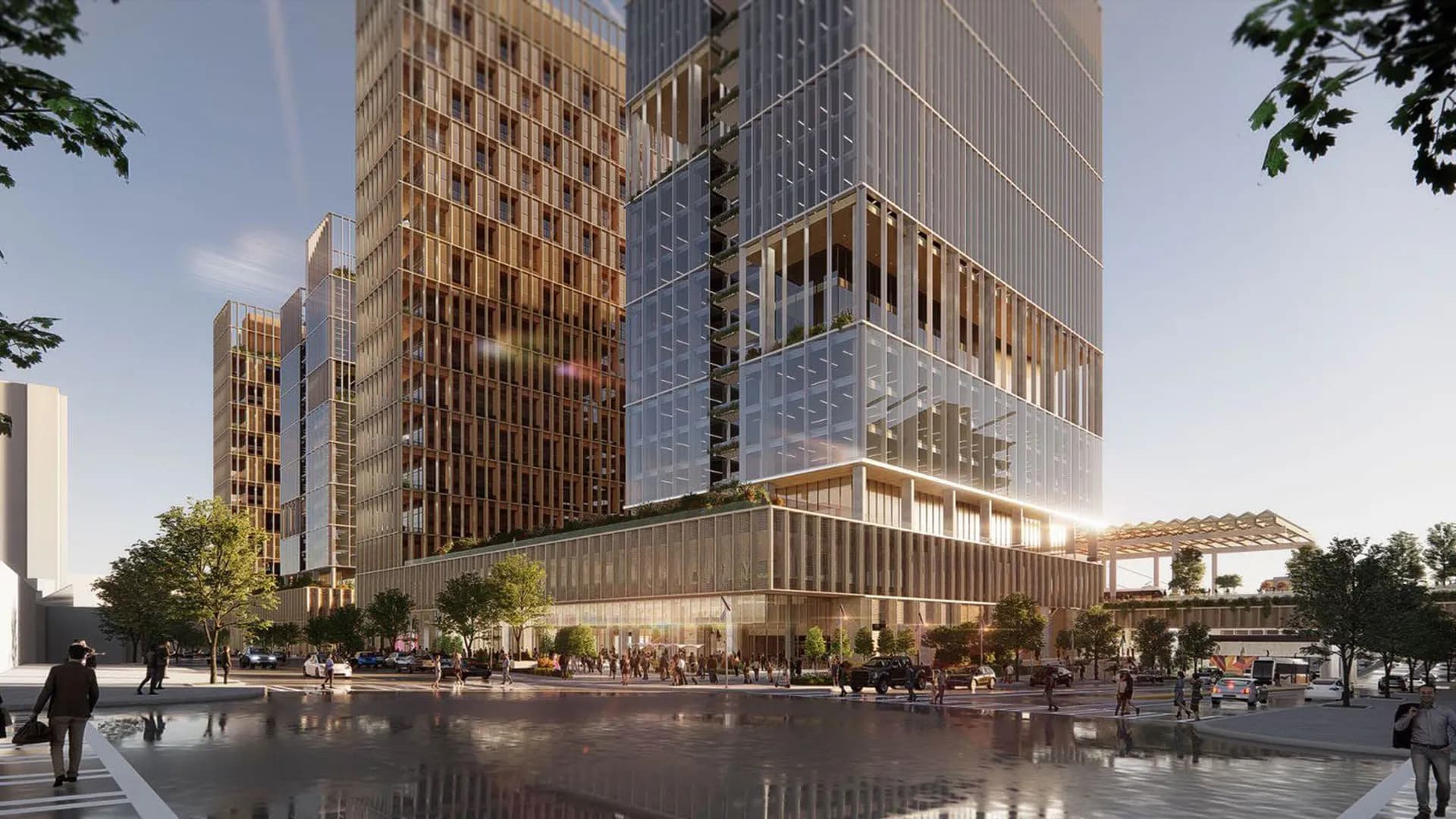
The inability of the City of Charlotte to launch the Gateway station project is frustrating and embarrassing. There is talk of an interim station at the Gateway site, much like Durham had an interim station.
People already ride the Piedmonts to Charlotte for Carolina Panthers games; I’ve done it myself and plan to do it again this year. I agree, though, that there would be a big uptick in ridership if the station were near the stadium. Currently it’s a 2.2 mile walk, and aside from the distance and potentially the weather many people aren’t comfortable with walking because of the homeless shelter that is between the station and the city center. It is possible to ride the bus or take Uber/Lyft, of course. Ironically there is a light rail station just 1500 feet from the current Amtrak station, but it’s on the other side of the NS freight yard. Far too dangerous and besides, it’s a trespass and the NS police force is certain to catch you.
But they don’t have a ticket vending machine at the current station, making it so that you have to buy your fare in cash or already have it (or maybe use a phone app). I usually end up walking or biking to the Light Rail and then getting a ticket before I start riding CATS.
And they literally have all the platform improvements built. It’s almost ready to accept trains as-is. Just put a goddamn tailgate tent in the parking lot next door and run a ticket vending machine out of a construction trailer. It’s beyond embarrassing.
I’ve been following along and apparently NCDOT is getting pissed at their dragging as well according to this Axios article (apologies for the axios link, you’ll just have to suffer through the kindergarten-level writing).
I don’t understand why they write like that. Maybe they could merge with Raleigh Mag(azine) and just make my eyes fall out.
But yeah, I thought like maybe 6-8 years ago that the new station was about to be built. I can’t believe they haven’t even figured out what they’re doing yet, much less actually break ground. Say what you will about our pointless extra bus station, at least our train station is downtown and looks normal.
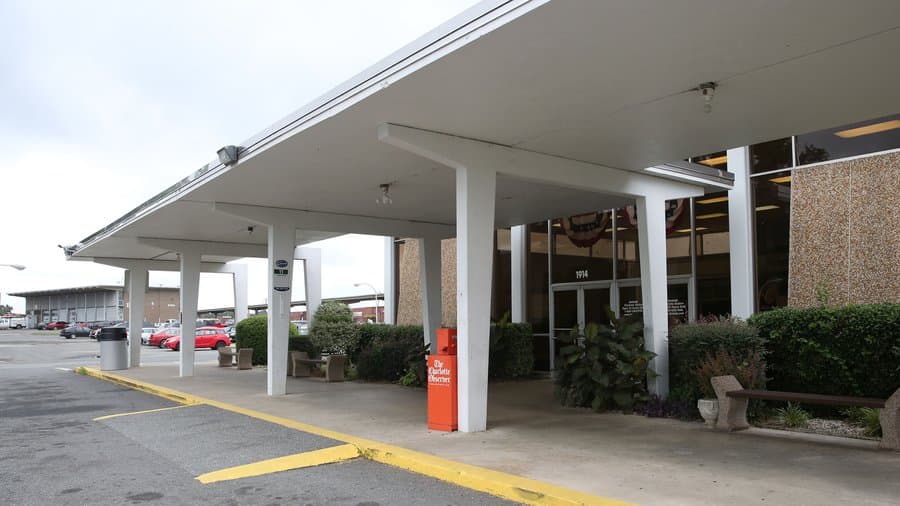
Whoever is responsible for their current station deserves prison. It’s from the 60s so I’m assuming that it was explicitly designed to harm minorities.
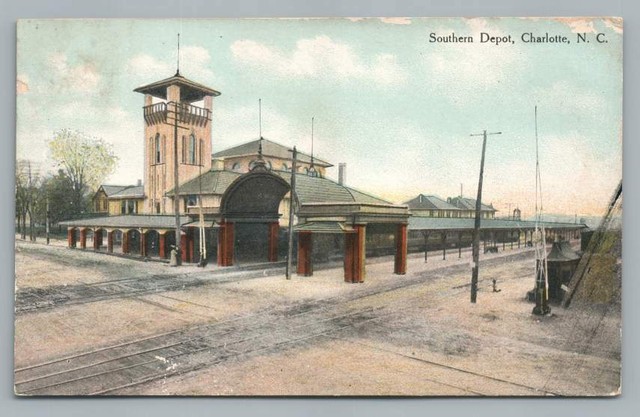
Prior to 1964, Southern Railway had a station at what’s now the Charlotte Gateway site. It was designed by the well-known architect Frank Milburn in 1909 and resembled the extant Salisbury station that he also designed.
In the early 1960s the very busy Southern main line was at ground level and had several grade crossings in the city center including Trade St. This caused traffic congestion and safety problems. Southern worked with the City on a project to elevate the tracks above street level. The project would wipe out the 1909 station, so Southern built a new station in 1964… the one still in use today.
Bear in mind that prior to 1971 when Amtrak was created, passenger railroading in the U.S. was entirely a private sector affair. Like most RRs in the 1960s, Southern saw passenger trains as just a menace to its financial health. Ridership was falling, trains were being discontinued left and right, and Southern had no incentive to spend its own money (no government subsidy back then!) on a more substantial station. The 1964 station was sited in a partly developed commercial/industrial area. Southern already owned the tract. No historic building was razed to make way for it.
Aside from its inconvenient location, the 1964 station was a decent Mid-Century Modern design – but it got minimal upkeep over the years. No surprise, then, at how run down it is today. Meanwhile, ridership unexpectedly went up when the Piedmonts began running in the 1990s. Didn’t take long for the passenger volume to overwhelm the small station.
I think we were just being dry humored, but that’s all interesting information. Thank you for sharing it. It’s crazy though that this started to be overwhelmed in the 90s when many people on here may not have even been born, and it’s “possibly” on track to be replaced in 2030. 40 years is slow even for government work!
This is the Strong Towns approach I am 100% here for.
Get a corporate sponsor (pick a bank or insurance company, lol) and make it fun. Brand it for Panthers and MLS games. Set up a food truck area. It would be “embarrassing“ I guess, but not as embarrassing as the current station location.
Charlotte isn’t the only city that lost a downtown station in favor of a less convenient one. Richmond, Jacksonville, Atlanta, Savannah, etc. Some of these happened prior to Amtrak, some later. It nearly happened in Greensboro, too, but the city and NCDOT were able to rescue the 1927 station and put it back into use. Trains had moved to a very inconvenient station alongside the NS freight yard (sound familiar?) in 1979.
As for temporary stations, don’t forget that when the Carolinian restarted in 1990, the Durham station was literally a bus shelter on the site of the former station next to the courthouse. (The 1964 Charlotte station is luxurious in comparison.) Then NCDOT opened a temporary station across the track from the current station.
And they were not supposed to be where they are today.
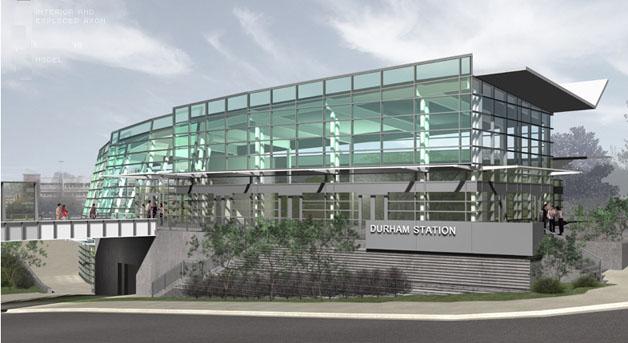
Durham’s Amtrak and bus stations were supposed to be in the same building. Open Durham, a research project from a local historic preservation advocacy group, shows an early rendering of what the station building was supposed to look like. The building itself looks like how it does today - but notice that there’s an unfamiliar bridge on the left that extends over Chapel Hill St. to reach station platforms.
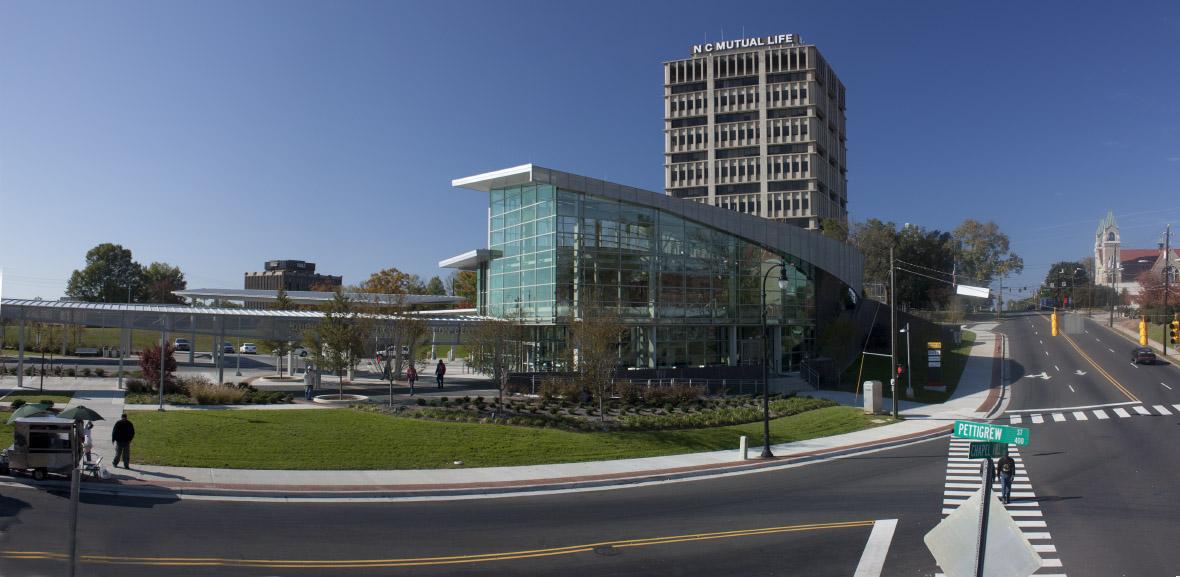
This implies that the second floor of the station building would’ve been the Amtrak area, while the ground floor was for buses (as things are today). However, if you’ve actually been to Durham, you’ll notice that this is what you’ll see:
The bridge would’ve been on the right side of this picture, if it was actually built.
So why did that bridge never get built - and why did Amtrak pull out of this project and build a redundant station on the other side of the tracks, instead? (Note that they doubled down on with a renovation that finished last year, so this is unlikely to change anytime soon )
I’m actually curious if anyone knows, since Open Durham had this comment…
Amtrak wouldn’t have had anything to do with it. They just occupy space made available by NCDOT or the city.
My guess is three reasons. One, someone at NCDOT at the time was interested in historic preservation. Two, given how long it took the Raleigh station to come together (and how long it’s taking the Charlotte station to come together), NCDOT didn’t want to get stuck in another multi-party project. Three, somebody was arguing over money.
In terms of time penalty, the 20-30 minutes of travel to get from the North Tryon station (does it even have a name? Charlotte Southern Station?) to, well, anywhere is probably the easiest to fix.
Also worth noting that the attitude of governments at the time was not just “we’re not going to help,” it was “these railroad companies are made out of money(1), so we are going to use every regulatory tool we have to extract as much value as we can out of them.”
Indeed, many of the great fortunes of the prior two generations were made in railroads and more importantly the ancillary businesses they enabled – never mind that was already yesterday’s news and that the “underdog” auto industry had become the new titans
Oh, so that’s what the second floor of that station is for.
Gosh the internet is awful when it comes to researching history of things that happened in the internet era - but 2 decades ago. Anyway, I guess it must mean that I’m old, because I have the answer.
The clue lies in the year the station was built: 2008. Another hint, this had almost nothing to do with Amtrak.
The answer: this bus station was planned concurrently with the ~ 1997-2007 “TTA Regional Rail” project. The triangular parcel across Chapel Hill Street from the bus station was supposed to be the site of the Regional Rail station, and the bridge would connect between the two. The bus station was built with a knock-out section for the bridge, and it could still theoretically be added today - but since the regional rail was cancelled, there’s nothing really worth connecting to there, and the bridge was never built.
I believe that Amtrak was going into the Walker Warehouse (where it is today) no matter what happened with the Regional Rail project. Even during Regional Rail planning, the connection between the bus station/regional rail station (on the south side of the tracks) and Amtrak station (north side) was always planned to involve a walk along Chapel Hill street.
To be fair, I only found that during a li’l bit of down time at my work. Whoops
In my defense, though: I did find that the NEPA FEIS for the TTA Regional Rail attempt vaguely mentioned plans for a new intermodal transit in Durham, and how the city convinced what we now call GoTriangle to move their proposed platforms to the east. But unlike today’s NEPA documents, these reports didn’t include specific site diagrams - so I couldn’t make any more assumptions about the actual design of the Durham transit hub.
This is the part that I didn’t want to assume - and the comment from Bill Bell (Durham’s mayor at the time) made me think there was more to it than that.
Seriously? That feels like such an obvious (dare I say dumb?) oversight, lol.
I kept running into this 1997 report from GoTriangle (then TTA) called “Station Area Development Guidelines for the Regional Transit Stations” - though I couldn’t find a copy of that online. It would be funny if that report actually supported that decision…

 )
)