@keita This is correct. My ex-firm designed the original station (and is currently expanding it). The bridge was always planned to be added on later to connect to rail across the street. There was also supposed to be a light-rail station around the corner (RIP).

13 Likes
Took this photo the other day from the train station, showing how the platform is pretty much perfectly lined up with the bus terminal behind.

7 Likes
Train operations are expensive. Who would fund it? You’d probably get more bang for the buck by expanding the GoRaleigh shuttle bus service.
2 Likes
Switching topics: we’ve usually talked here about how electrifying the tracks in the Triangle (and North Carolina at large) are non-starters because of the cost involved. However, an industry journal reported that a regulatory decision changed that math for Caltrain in Silicon Valley/San Francisco:
Y’know how you wear out your car/bike’s tires and pads every time you brake? Regenerative braking is a family of techniques that let you “brake” differently so that a fraction of the lost kinetic energy can be recovered. This means that, every time an electric Caltrain vehicle slows down, a percentage of the energy used to speed up the train in the first place can be converted back into electricity, then returned to the electrical grid.
This means:
Last year, California also decided to exempt rail electrification projects from having to undergo their notorious environmental reviews as long as they’re done on existing tracks. Combining these two changes, these changes make it cheaper and faster to build electric trains.
Remember, too, that the benefit of electric trains go beyond environmental things; they also include:
-
Cheaper maintenance (electric trains have fewer moving parts)
-
Faster travel times (they can accelerate and slow down more quickly than diesel trains)
-
More flexible schedules (this is downstream of the first two points)
-
Longer shelf-life of vehicles (this is also a consequence of the first point)
North Carolina would need to pass its own similar laws (and possibly the federal government, too, for reinterpreting NEPA) if we were to also attempt something like this. Still, this could be a really effective way to change the math for whether rail electrification in the Triangle is doable!
13 Likes
That would be absolutely amazing. And I have to think that a state-level environmental review reform could get some bipartisan support..
2 Likes
Lucid Stew on YouTube just did an evaluation of HSR from Raleigh to Charlotte: What Could True High Speed Rail In North Carolina Look Like?
He makes the case that it would be good to build a new alignment along I-85 instead of upgrading the Piedmont Corridor but repeatedly runs into the convenience of the Piedmont Corridor for serving towns along the way, though he takes for granted that we wouldn’t electrify the Piedmont Corridor.
I would love to see electrification eventually, but I wouldn’t hold up other investments to do that. I think sometimes we can get too focused on international examples, without letting incremental investments from where we are be considered.
Speaking of Environmental Review, I am constantly curious about how recent reforms to NEPA will affect it. The Fiscal Responsibility Act of 2023 (FRA) had some pretty significant reforms to NEPA and Seven County Infrastructure Coalition v. Eagle County was also significant.
7 Likes
This must be strictly a regulatory hurdle here in the US. I know in Switzerland, they have been boasting for decades, how the trains going down the mountains put energy back into the grid, which offsets a large portion of the energy required to pull the trains up the maintains.
3 Likes
SF-SJ is a 40-mile corridor that is mostly flat and mostly straight south of San Bruno. Most of its grade crossings were closed or eliminated prior to electrification. There is no through-freight and only a small number of freight customers. Caltrain runs about 50 trains a day in each direction. This has almost nothing in common with Charlotte-Raleigh.
2 Likes
Interesting video exploring possibilities for North Carolina high speed rail. Seems to be pretty well researched as well. https://www.youtube.com/watch?v=efUoY2WLMCk
Raleigh to Charlotte in 93 minutes would be incredible!
11 Likes
VPRA has announced that schedule disruptions for construction on the new Long Bridge (over the Potomac River) will begin on Jan 12, 2026, going through 2030.
Amtrak has not yet loaded the new Carolinian schedule into their system. Also remains to be seen whether NCDOT will adjust the Piedmont schedule around the later south/west-bound Carolinian.
4 Likes
New schedule is in the system: southbound 12:10pm WAS - 6:24pm RGH
The two southbound trains are now 1.5h apart. The northbound trains are 1.25h apart. At least the SB Carolinian won’t get stuck behind the oft-delayed Floridian, unlike its NB counterpart.
6 Likes
In case it hasn’t been shared already, or just as a reminder, NCDOT is seeking public input on its updated State Rail Plan. There is a survey here open through December 10: https://publicinput.com/NC-StateRailPlan
3 Likes
Passanger count sets another record for 2025, up about 79,000 over previous year, and a 59% increase since 2019.
https://www.newsobserver.com/news/local/article314247500.html?tbref=hp
17 Likes
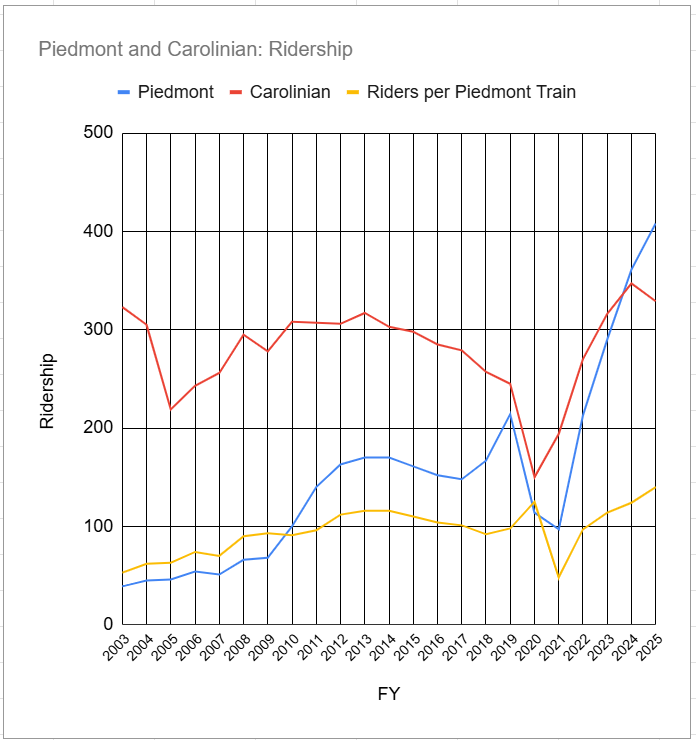
I’ve been tracking these statistics myself for some time, and it really is looking good for Amtrak in NC. My statistics are based on Amtrak’s end-of-FY reports which are typically published at the end of September. Importantly, not only is ridership at an all-time high, ridership per train is also higher than ever. It’s important to note that per-train ridership has continued to steadily increase (except for COVID) even as the number of Piedmont round-trips per day has gone from one to four. The general pattern has been that as frequency increases by a factor of two, ridership increases by a factor of three. This trend shows no sign of letting up.
Actually it’s rather frustrating that, in spite of numbers like these, we’re still stuck at just four Piedmonts per day.
11 Likes
What do you think the top number of Piedmonts a day is possible? And what do think the optimal number is? I would think with the freight schedule, there is a limit on how the number of passenger trains a day. I agree with you, I hope the NCRail is looking at adding at least one if not two more trains a day.
I predict that per-train ridership would continue to increase up to 2-hour frequency, which would be 8 or 9 daily round trips. Further increases from a train every 2 hours, to hourly service, would see overall ridership continue to increase, but per-train ridership would level off. I think the ROI for increased intercity service starts to diminish if you go more frequent than hourly, although there’s plenty of room for regional service to carry more passengers at higher frequency in the corridor as well.
9 Likes
If I recall right, hourly is what you’ve got going on between Milan and Rome these days, but with 2 train companies, that’s 2 per hour - either direct through or stops in Florence and Bologna. What I liked about that is the predictability and convenience. You want to to go Florence, when? The trains run nearly on your schedule, rather than building your day/s around the train.
For NCRail, I’d love to see trains running regularly enough that people ask why drive when the train is leaving in xx minutes.
4 Likes
I think the Piedmont could be a viable commuting solution between downtown Durham and Raleigh if it ran frequently enough. The lack of a night train running west is the only thing that keeps me from riding way more often. Durham to Charlotte or Greensboro is also a ride I would do more often if I had less anxiety about catching the return ride. I drove to GSO almost every weekend for a few years and it would’ve been nice to take the train instead. I could’ve, except I was often leaving on Friday evening after the last westbound had already left.
1 Like
To quote Wikipedia about the Tokyo-Osaka shinkansen, “At peak times, the line carries up to 16 trains per hour in each direction with 16 cars each (1,323-seat capacity and occasionally additional standing passengers) with a minimum headway of three minutes between trains.” It’s no exaggeration; I’ve ridden them. Probably the most extreme example of what fast, frequent rail service can do.
But we’re a long way out from that here. I agree with Orulz that trains every other hour would be about right for NC’s population. Besides, as a practical matter you’d have to double-track the entirety of Greensboro-Cary and triple-track at least part of Greensboro-Charlotte if you want to do more than that, not to mention outlays for station expansion, rolling stock, etc. We already have the SEHSR plan sitting idle because nobody can find the ten figures required to build it.
4 Likes
I think the case for 2-hour frequency is absolutely ironclad. The added convenience of extra frequency will mean that ridership per train will increase. There’s no good excuse for why it’s taking them so long to get service up to this level. Certainly not lack of demand.
I think that hourly train service - 18 round trips per day, a departure every hour from 5am through 10pm, is the real target that can be achieved based on current population and demand. Making the trains a lot faster is what it would take to boost demand to support frequency beyond that.
10 Likes